Learn about the Cabinet Mission Plan 1946, objectives, proposals, significance and failure. Discover how it shaped India’s path to independence and partition.
Cabinet Mission Plan 1946
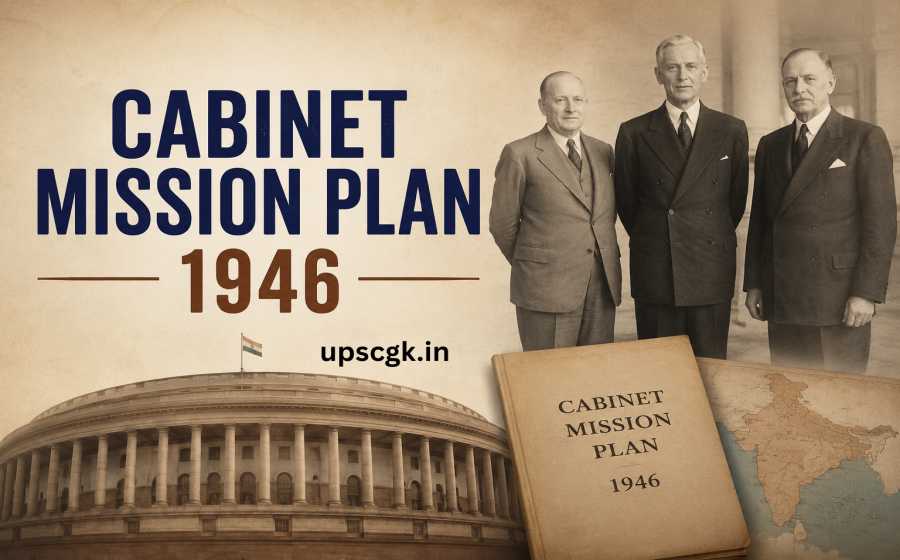
The Cabinet Mission Plan of 1946 was one of the most important political initiatives undertaken by the British government to resolve India’s constitutional deadlock and facilitate the transfer of power. It was the final major attempt to preserve the unity of India while addressing the demands of both the Indian National Congress and the Muslim League. Although the plan ultimately failed, it played a crucial role in shaping the events that led to India’s independence and the partition of the subcontinent in 1947.
Table of Contents
Background of the Cabinet Mission Plan
By the end of the Second World War, Britain was facing severe economic and political challenges. The British government realized that it could no longer maintain its colonial rule over India. At the same time, political tensions between the Indian National Congress and the Muslim League had intensified.
The Congress demanded a united and independent India, while the Muslim League, under the leadership of Muhammad Ali Jinnah, insisted on the creation of Pakistan as a separate homeland for Muslims. Previous efforts such as the Cripps Mission had failed to resolve these differences.
To find a constitutional solution acceptable to all parties, the British government sent a high-level delegation known as the Cabinet Mission to India in March 1946.
Members of the Cabinet Mission
The Cabinet Mission consisted of three members of the British Cabinet:
- Lord Pethick-Lawrence
- Sir Stafford Cripps
- A. V. Alexander
Their primary objective was to negotiate with Indian leaders and formulate a plan for the transfer of power.
Objectives of the Cabinet Mission
The main objectives of the Cabinet Mission were:
- To create a constitutional framework for an independent India.
- To maintain the unity of India.
- To avoid the partition of the country.
- To establish a representative government.
- To facilitate the peaceful transfer of power from British rule to Indian leaders.
Main Provisions of the Cabinet Mission Plan
The Cabinet Mission announced its proposals on 16 May 1946. The key provisions were as follows:
1. Formation of an Indian Union
The plan proposed the creation of an Indian Union that would include both British Indian provinces and princely states.
The Union would control only three subjects:
- Defence
- Foreign Affairs
- Communications
All other powers would remain with the provinces.
2. Provincial Grouping
The provinces were to be divided into three groups:
Group A
- Madras
- Bombay
- United Provinces
- Bihar
- Central Provinces
- Orissa
Group B
- Punjab
- North-West Frontier Province
- Sindh
- Baluchistan
Group C
- Bengal
- Assam
Each group would have the authority to frame its own constitution and manage certain common subjects.
3. Constituent Assembly
A Constituent Assembly was to be established to draft the Constitution of India.
The assembly would consist of representatives elected by provincial legislatures and nominees from princely states.
4. Interim Government
An interim government was proposed at the center until the Constitution was framed and power was transferred.
The government would include representatives from major political parties.
5. Princely States
The princely states would participate in the Union but would retain control over their internal affairs.
Response of Political Parties
Congress Reaction
The Indian National Congress accepted the idea of a Constituent Assembly but opposed compulsory provincial grouping. Congress believed that provinces should have the freedom to decide whether they wished to join a group. Leaders such as Jawaharlal Nehru and Mahatma Gandhi favored a strong central government rather than a weak federation.
Muslim League Reaction
Initially, the Muslim League accepted the plan because the grouping system provided Muslim-majority provinces with considerable autonomy.
However, after Congress interpreted the grouping provisions differently, the League withdrew its support. Jinnah feared that Congress would dominate the proposed Union and undermine Muslim interests.
Failure of the Cabinet Mission Plan
The Cabinet Mission Plan eventually failed due to several reasons:
1. Differences Over Grouping
Congress and the Muslim League had conflicting interpretations regarding the grouping of provinces.
2. Demand for Pakistan
The Muslim League remained committed to the creation of Pakistan, while Congress opposed the division of India.
3. Weak Central Government
Many Congress leaders believed that the proposed Union government would be too weak to govern effectively.
4. Political Distrust
Years of political rivalry had created deep mistrust between Congress and the Muslim League, making compromise difficult.
5. Direct Action Day
On 16 August 1946, the Muslim League launched Direct Action Day to press its demand for Pakistan. The resulting communal violence further damaged prospects for cooperation.
Significance of the Cabinet Mission Plan
Despite its failure, the Cabinet Mission Plan holds great historical significance.
- It was the last major British attempt to preserve a united India.
- It laid the foundation for the formation of the Constituent Assembly.
- It accelerated the process of transferring power to Indian leaders.
- It exposed the deep political divisions between Congress and the Muslim League.
- It indirectly paved the way for the partition of India in 1947.
Many historians consider the Cabinet Mission Plan the closest India came to achieving independence without partition.
Summary
The Cabinet Mission Plan of 1946 represented a crucial turning point in India’s freedom struggle. It sought to balance the aspirations of various political groups while preserving national unity. However, conflicting interests, political mistrust, and the growing demand for Pakistan prevented its successful implementation. Although the plan failed, it significantly influenced the constitutional and political developments that eventually led to Indian independence and the partition of the subcontinent in 1947. Today, the Cabinet Mission Plan remains an important chapter in modern Indian history, highlighting both the possibilities and limitations of political compromise during a period of immense national transformation.
Also Check: History