Learn about the Champaran Kheda and Ahmedabad Movements, Gandhi’s first major satyagrahas in India that shaped the freedom struggle and mass political awakening
Champaran Kheda and Ahmedabad Movements
The Champaran, Kheda, and Ahmedabad Movements were among the earliest and most significant struggles led by Mahatma Gandhi after his return to India from South Africa in 1915. These movements, launched between 1917 and 1918, introduced the principles of Satyagraha (truth and non-violence) into Indian politics and demonstrated the power of peaceful resistance against injustice. They also established Gandhi as a national leader and laid the foundation for the mass movements that later became a crucial part of India’s freedom struggle. These three movements addressed the grievances of peasants and workers and highlighted Gandhi’s ability to unite people through non-violent methods.
Table of Contents
Champaran Movement (1917)
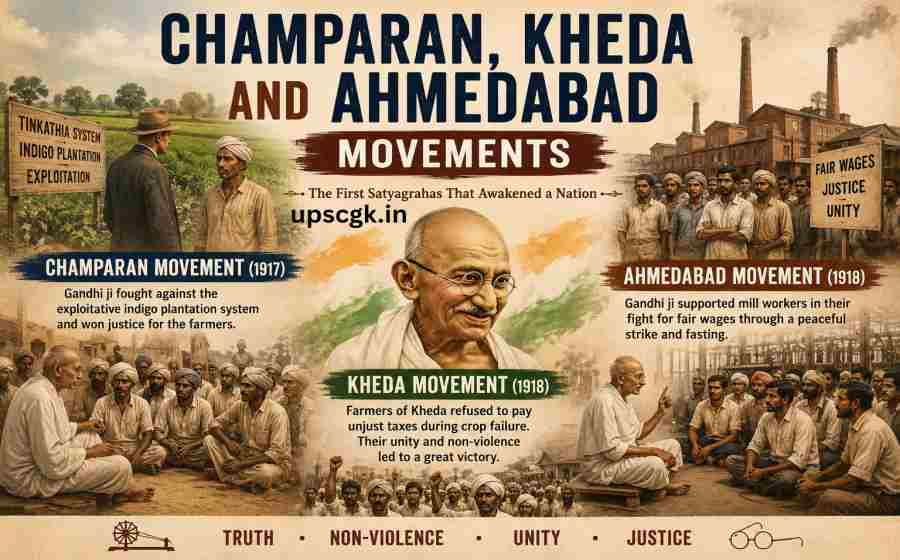
The Champaran Movement was Gandhi’s first major political action in India. It took place in the Champaran district of Bihar, where indigo farmers were suffering under the exploitative policies of British planters.
Causes of the Movement
The farmers were forced to cultivate indigo on a portion of their land under the Tinkathia System, which required them to grow indigo on three-twentieths of their holdings. The British planters purchased the crop at extremely low prices, causing severe financial hardship to the peasants.
Local leaders and peasants repeatedly protested against this system. One determined farmer, Raj Kumar Shukla, persuaded Gandhi to visit Champaran and investigate the issue.
Gandhi’s Role
Gandhi reached Champaran in 1917 and conducted a detailed inquiry into the conditions of the peasants. Despite being ordered by the British authorities to leave the district, he refused and accepted the possibility of punishment. His peaceful defiance attracted widespread public support.
After gathering evidence from thousands of farmers, Gandhi negotiated with the government and the planters.
Results of the Movement
- The Tinkathia System was abolished.
- Farmers received partial compensation for their losses.
- The government accepted several recommendations aimed at improving the condition of peasants.
- Gandhi emerged as a prominent national leader.
The Champaran Movement demonstrated the effectiveness of Satyagraha and showed that organized, peaceful resistance could achieve meaningful reforms.
Ahmedabad Mill Workers’ Strike (1918)
The Ahmedabad Movement was related to industrial workers rather than peasants. It took place in Ahmedabad, Gujarat, which was an important textile manufacturing center.
Causes of the Movement
During a plague epidemic, mill owners had granted workers a special allowance known as the “plague bonus.” When the epidemic ended, the owners decided to withdraw the bonus, while workers demanded higher wages to cope with rising living costs. A dispute arose between the mill owners and workers regarding wage increases.
Gandhi’s Intervention
Gandhi acted as a mediator between the two sides. When negotiations failed, he advised workers to remain united and continue their peaceful strike.
To strengthen the workers’ determination and maintain discipline, Gandhi undertook a fast. His moral authority increased pressure on the mill owners to reach a fair settlement.
Results of the Movement
- The dispute was resolved through arbitration.
- Workers received a wage increase of 35%.
- The movement highlighted the importance of non-violent protest in labor disputes.
- Gandhi strengthened his reputation as a leader who could address the concerns of different sections of society.
The Ahmedabad Strike was significant because it marked Gandhi’s first use of fasting as a political and moral weapon in India.
Kheda Movement (1918)
The Kheda Movement took place in the Kheda district of Gujarat. It was primarily a peasant struggle against unjust taxation during a period of agricultural distress.
Causes of the Movement
In 1918, Kheda experienced severe crop failure due to poor harvests. According to government rules, farmers were entitled to tax relief if crop production fell below a certain level.
Despite the poor harvest, the British government insisted on collecting full land revenue from the peasants. The farmers, already facing financial difficulties, found it impossible to pay the taxes.
Gandhi’s Leadership
Gandhi, along with leaders such as Sardar Vallabhbhai Patel and Indulal Yagnik, organized the peasants and urged them not to pay revenue until their demands were met.
The movement remained peaceful and disciplined. Farmers collectively refused to pay taxes, demonstrating unity and courage despite government pressure.
Results of the Movement
- The government suspended tax collection in many cases.
- Confiscated properties were returned to several farmers.
- Peasants gained confidence in collective action.
- Gandhi’s strategy of non-violent resistance achieved success without violence.
The Kheda Satyagraha strengthened the bond between Gandhi and the rural population and further expanded the reach of the national movement.
Significance of the Three Movements
The Champaran, Kheda, and Ahmedabad Movements played a crucial role in the development of India’s freedom struggle.
Major Significance
- They marked Gandhi’s successful entry into Indian politics.
- They popularized the principles of Satyagraha and non-violence.
- They demonstrated the strength of mass participation.
- They united peasants, workers, and common people against injustice.
- They increased public confidence in peaceful resistance.
- They prepared the ground for larger movements such as the Non-Cooperation Movement and the Civil Disobedience Movement.
Summary
The Champaran, Kheda, and Ahmedabad Movements were turning points in modern Indian history. Through these struggles, Mahatma Gandhi transformed local grievances into powerful examples of collective action and non-violent resistance. The success of these movements not only improved the conditions of farmers and workers but also established Gandhi as the undisputed leader of the Indian national movement. Their legacy continues to symbolize the power of truth, unity, and peaceful protest in achieving social and political change.
Also Check: History