
Learn about the Subsidiary Alliance, Lord Wellesley’s policy that expanded British control in India through political influence, protection and treaties.
Subsidiary Alliance
The Subsidiary Alliance was one of the most important political strategies used by the British East India Company to expand its control over India. Introduced by Lord Richard Wellesley in 1798, this policy helped the British establish their dominance over many Indian princely states without directly conquering them through warfare. It became a powerful diplomatic tool that gradually increased British influence and weakened the independence of Indian rulers.
The Subsidiary Alliance played a major role in the expansion of British rule during the late eighteenth and early nineteenth centuries. Through this system, many Indian kingdoms came under British control, paving the way for the establishment of the British Empire in India.
Table of Contents
Background of the Subsidiary Alliance
When Lord Wellesley became the Governor-General of India in 1798, the British faced competition from other European powers, especially France. Several Indian rulers maintained friendly relations with the French and employed French military officers in their armies. Wellesley believed that these connections threatened British interests in India.
To eliminate French influence and strengthen British authority, Wellesley introduced the Subsidiary Alliance system. Instead of annexing states directly, the British persuaded Indian rulers to accept British protection under certain conditions. This allowed the British to expand their political power while avoiding costly wars.
Main Features of the Subsidiary Alliance
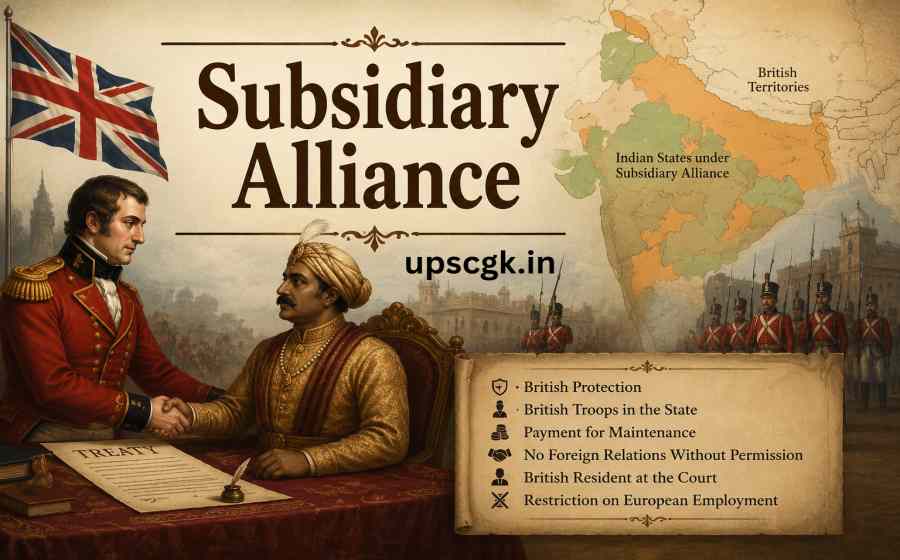
The Subsidiary Alliance had several important conditions that Indian rulers had to accept:
1. British Troops in the State
The ruler was required to maintain a British military force within his territory. These troops were meant to protect the state from external attacks and internal disturbances.
2. Payment for Maintenance
The ruler had to pay for the maintenance of the British troops. Payment could be made either in cash or by surrendering a portion of territory to the British.
3. No Foreign Relations Without Permission
The ruler could not enter into treaties or diplomatic relations with any other state or foreign power without British approval.
4. Restriction on European Employment
The ruler was not allowed to employ Europeans, especially French officers, without the consent of the British.
5. British Resident at the Court
A British Resident was appointed in the ruler’s court. Although officially an advisor, the Resident often influenced important political decisions.
6. British Protection
In return, the British promised to protect the ruler from external enemies and internal rebellions.
Objectives of Lord Wellesley
The Subsidiary Alliance was introduced with several objectives:
- To expand British political influence in India.
- To eliminate French influence from Indian states.
- To strengthen the military position of the British East India Company.
- To reduce the chances of Indian rulers forming alliances against the British.
- To increase British control without direct annexation of territories.
These objectives helped the British establish themselves as the dominant power in India.
States That Accepted the Subsidiary Alliance
Several Indian states accepted the Subsidiary Alliance at different times. Some important examples include:
- Hyderabad (1798) – The first major state to accept the alliance.
- Mysore (1799) – After the defeat of Tipu Sultan.
- Awadh (1801).
- Peshwa State (1802) through the Treaty of Bassein.
- Several Maratha rulers later came under British influence through similar arrangements.
As more states joined the alliance, British authority expanded rapidly across the Indian subcontinent.
Advantages of the Subsidiary Alliance
From the British perspective, the policy offered many advantages:
For the British
- Expansion of influence without expensive military campaigns.
- Control over the foreign policies of Indian states.
- Increased revenue through payments and territorial acquisitions.
- Reduction of French influence in India.
- Strengthening of British military presence throughout the country.
For Indian Rulers
- Protection from rival states and invasions.
- Support against internal rebellions.
- Security provided by a powerful military force.
Disadvantages of the Subsidiary Alliance
Despite its apparent benefits, the alliance had serious drawbacks for Indian rulers.
Loss of Independence
The rulers lost control over their foreign affairs and became dependent on the British.
Financial Burden
Maintaining British troops was expensive. Many states faced financial difficulties because of the heavy payments required.
Political Interference
British Residents frequently interfered in the internal affairs of states, reducing the authority of local rulers.
Weakening of Native Armies
Since British troops provided security, many rulers reduced their own military forces, making them dependent on the British.
Expansion of British Control
The alliance gradually transformed independent states into subordinate allies under British influence.
Impact of the Subsidiary Alliance
The Subsidiary Alliance had a far-reaching impact on Indian history. It enabled the British East India Company to become the most powerful political force in India. By controlling the foreign relations and military affairs of Indian states, the British effectively dominated large parts of the country without direct annexation.
The policy also weakened Indian rulers and prevented them from forming united resistance against British expansion. As a result, British supremacy increased significantly during the early nineteenth century.
Many historians consider the Subsidiary Alliance one of the most successful diplomatic strategies employed by the British. It laid the foundation for further expansion and contributed greatly to the establishment of British colonial rule in India.
Summary
The Subsidiary Alliance was a crucial policy introduced by Lord Wellesley to strengthen British power in India. While it offered protection to Indian rulers, it significantly reduced their independence and increased British influence over their kingdoms. Through this system, the British East India Company expanded its authority across India without relying solely on military conquest. The policy became a turning point in the history of British expansion and played a major role in shaping India’s colonial past.
Also Check: History