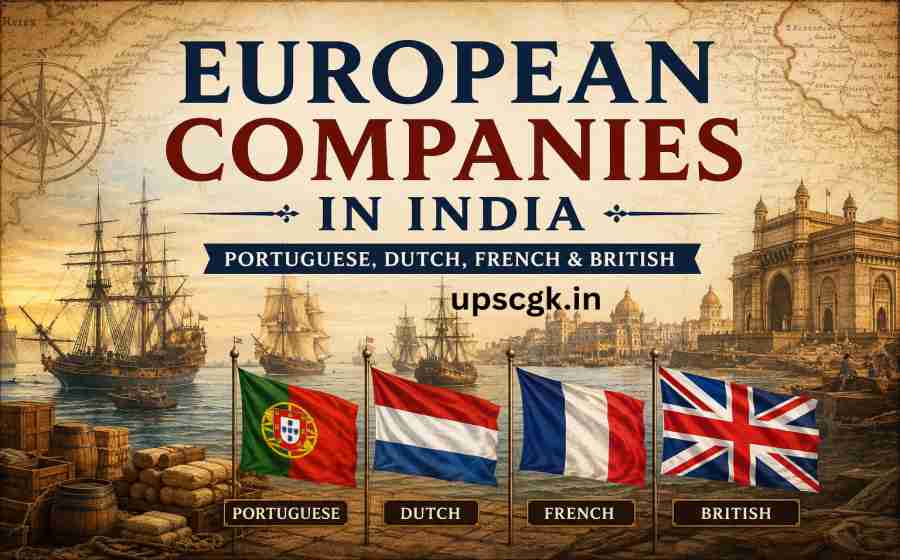
Discover European Companies in India, including the Portuguese, Dutch, French and British, their trade activities, settlements and historical impact.
European Companies in India
The arrival of European trading companies in India marked a significant turning point in Indian history. Motivated by the desire to control the lucrative spice trade and establish commercial dominance in Asia, several European powers reached India’s shores between the 15th and 18th centuries. Among them, the Portuguese, Dutch, French, and British played the most important roles. While they initially came as traders, some gradually expanded their influence into political and military affairs, ultimately shaping the future of the Indian subcontinent.
Table of Contents
Background: Why Europeans Came to India
India was famous worldwide for its spices, textiles, silk, indigo, precious stones, and other valuable goods. European nations sought direct sea routes to India to bypass Arab and Venetian middlemen who controlled traditional trade routes.
The discovery of sea routes to Asia during the Age of Exploration encouraged European countries to establish trading centers and gain access to India’s rich markets.
Portuguese in India
The Portuguese were the first Europeans to arrive in India.
Arrival of the Portuguese
In 1498, the Portuguese explorer Vasco da Gama reached Calicut (present-day Kozhikode) on the Malabar Coast. His voyage opened a direct sea route between Europe and India via the Cape of Good Hope.
Expansion and Settlements
The Portuguese established trading centers and gradually expanded their influence. In 1510, Afonso de Albuquerque captured Goa, which became the headquarters of Portuguese power in India.
Major Portuguese settlements included:
- Goa
- Daman
- Diu
- Cochin
Decline
The Portuguese faced competition from other European powers, particularly the Dutch and British. Corruption, limited resources, and military defeats weakened their position. By the 18th century, their influence had significantly declined, although Goa remained under Portuguese control until 1961.
Dutch East India Company
The Dutch entered the Indian trade to challenge Portuguese dominance.
Establishment
The Dutch East India Company (VOC) was established in 1602. It became one of the world’s most powerful trading corporations.
Trading Activities
The Dutch focused mainly on trade rather than territorial expansion. Their primary interests included:
- Spices
- Textiles
- Indigo
- Saltpetre
Important Dutch trading centers were established at:
- Pulicat
- Nagapattinam
- Surat
- Cochin
Decline
The Dutch gradually lost influence due to intense competition from the British. Their defeat in the Battle of Bedara in 1759 effectively ended Dutch political ambitions in India.
French East India Company
The French were another major European power that attempted to establish a strong presence in India.
Formation
The French East India Company was founded in 1664 under the patronage of Louis XIV.
French Settlements
The French established trading centers at:
- Pondicherry
- Chandernagore
- Mahe
- Karaikal
- Yanam
Among these, Pondicherry became the most important French settlement in India.
French Expansion
Under the leadership of Joseph François Dupleix, the French sought to expand political influence by intervening in local Indian affairs.
Carnatic Wars
The rivalry between the French and British led to three Carnatic Wars fought in South India during the 18th century. These wars became crucial in determining which European power would dominate India.
Decline
The French suffered major defeats at the hands of the British. The decisive British victory in the Carnatic Wars ended French ambitions of building an empire in India.
British East India Company
The British eventually emerged as the most successful European power in India.
Establishment
The British East India Company was established in 1600 through a royal charter granted by Queen Elizabeth I.
Early Trading Centers
The British established factories and trading posts at:
- Surat
- Madras (Chennai)
- Bombay (Mumbai)
- Calcutta (Kolkata)
These centers gradually became major administrative and commercial hubs.
Rise to Political Power
Unlike the Dutch, the British expanded beyond trade. They built a strong military presence and took advantage of political divisions among Indian rulers.
Key events that strengthened British control included:
Battle of Plassey (1757)
The British, led by Robert Clive, defeated Siraj-ud-Daulah. This victory gave the Company control over Bengal’s vast resources.
Battle of Buxar (1764)
The British defeated a combined force of Indian rulers, further consolidating their authority in northern India.
Expansion Across India
During the 18th and 19th centuries, the British East India Company expanded through wars, alliances, and annexations. It gradually brought most of India under its control.
End of Company Rule
The Indian Rebellion of 1857 exposed weaknesses in Company administration. In 1858, the British government took direct control of India, marking the beginning of the British Raj.
Comparison of European Companies in India
| European Power | Year of Arrival | Main Center | Primary Objective | Outcome |
|---|---|---|---|---|
| Portuguese | 1498 | Goa | Spice Trade | Influence declined |
| Dutch | 1602 | Pulicat | Commercial Trade | Lost to British |
| French | 1664 | Pondicherry | Trade and Political Expansion | Defeated in Carnatic Wars |
| British | 1600 | Calcutta, Bombay, Madras | Trade and Empire Building | Established British Rule |
Impact of European Companies on India
The European companies brought significant changes to India:
- Expansion of international trade.
- Introduction of new naval and military technologies.
- Development of ports and commercial centers.
- Cultural and architectural influences.
- Political intervention in Indian affairs.
- Establishment of colonial rule, particularly by the British.
While trade initially benefited certain regions, foreign control eventually led to economic exploitation and political domination.
Summary
The Portuguese, Dutch, French, and British arrived in India primarily for trade, but their ambitions and achievements differed significantly. The Portuguese pioneered European maritime trade with India, the Dutch focused on commerce, the French attempted political expansion, and the British successfully transformed a trading company into a colonial empire. Their presence profoundly influenced India’s economic, political, and social history, making the study of European companies an important part of understanding India’s past and its path toward modern nationhood.
Also Check: History