Explore the Vijayanagara Empire – administration, economy, trade, society, art and culture. Learn its rich history and lasting legacy in South India.
Vijayanagara Empire
The Vijayanagara Empire was one of the most powerful and prosperous empires in South Indian history. It played a major role in preserving and promoting Hindu culture and traditions during a period when various parts of India faced repeated invasions and political instability. Established in 1336 CE by Harihara I and Bukka Raya I, the empire lasted for more than three centuries and became famous for its efficient administration, flourishing economy, and rich cultural achievements.
The capital city, Vijayanagara (present-day Hampi in Karnataka), was one of the largest and wealthiest cities in the world during its time. The empire reached its greatest height under Krishnadevaraya, who ruled from 1509 to 1529 CE. His reign is often considered the golden age of the Vijayanagara Empire because of political stability, economic prosperity, and cultural development.
Table of Contents
Administration of the Vijayanagara Empire
The Vijayanagara rulers developed a strong administrative system that helped maintain stability and control over a vast territory.
Central Administration
The king occupied the highest position in the administration and enjoyed supreme authority. The ruler was responsible for military affairs, justice, revenue collection, and policymaking. The king was assisted by ministers and advisors who helped manage the administration.
The council of ministers played an important role in decision-making. Important officials included:
- Prime Minister or Chief Minister
- Treasurer
- Military commander
- Chief judicial officer
- Foreign affairs officials
Although the king held significant power, ministers and local officials helped ensure efficient governance.
Provincial Administration
The empire was divided into several provinces called Rajyas or Mandalams. These provinces were administered by governors who were usually members of the royal family or trusted nobles.
The provinces were further divided into:
- Districts
- Smaller regions
- Villages
Village administration formed the foundation of governance. Village assemblies managed local affairs such as tax collection, irrigation systems, and settlement of disputes.
Nayankara System
One of the unique features of Vijayanagara administration was the Nayankara system. Under this system, military chiefs called Nayakas received land grants in exchange for military service.
Their responsibilities included:
- Maintaining law and order
- Collecting taxes
- Providing soldiers during wars
- Managing local administration
The Nayankara system strengthened military organization and improved regional administration. However, over time, some Nayakas became powerful and independent, contributing to the weakening of the empire.
Judicial Administration
Justice was administered according to traditional laws and customs. The king acted as the highest judicial authority. Local village councils also resolved minor disputes. Punishments were often severe to maintain law and order.
Economy of the Vijayanagara Empire
The economy of the Vijayanagara Empire was strong and diverse. Agriculture, trade, crafts, and taxation formed the backbone of economic prosperity.
Agriculture
Agriculture was the primary occupation of the people. The rulers gave special attention to irrigation and water management.
Major irrigation methods included:
- Tanks and reservoirs
- Wells
- Canals
- Dams
The construction of irrigation facilities increased agricultural productivity. Important crops grown included:
- Rice
- Sugarcane
- Cotton
- Pulses
- Spices
The government earned significant revenue through land taxes collected from farmers.
Trade and Commerce
Trade played a major role in the empire’s economic development. Vijayanagara maintained active trade relations with many countries including:
- Persia
- Arabia
- China
- Portugal
- Southeast Asian regions
The empire exported:
- Spices
- Cotton textiles
- Rice
- Iron
- Precious stones
Imports included:
- Horses
- Luxury goods
- Silk
- Metals
Ports on the western and eastern coasts facilitated international trade activities. Foreign travelers such as Nicolo Conti, Domingo Paes, and Abdur Razzaq described Vijayanagara as an extremely rich and prosperous kingdom.
Industries and Crafts
Various industries developed under royal patronage. Important industries included:
- Textile production
- Metalwork
- Jewelry making
- Stone carving
- Handicrafts
Skilled artisans produced high-quality goods which were traded both within and outside India.
Coinage System
The empire introduced a well-organized currency system. Gold coins known as Pagodas became widely used. Silver and copper coins were also circulated for everyday transactions. A stable monetary system encouraged commercial activities and strengthened economic growth.
Culture of the Vijayanagara Empire
The Vijayanagara Empire became a major center of art, literature, architecture, religion, and education.
Religious Environment
The rulers of Vijayanagara mainly followed Hinduism and supported Hindu institutions and temples. However, they generally adopted a policy of religious tolerance and allowed followers of different religions to practice freely.
Many temples were constructed during this period, which became important centers of religious and social life.
Literature
Literature flourished under royal patronage. Sanskrit, Telugu, Tamil, and Kannada languages witnessed significant development.
Krishnadevaraya himself was a famous scholar and poet. His work Amuktamalyada is considered an important literary contribution.
The royal court was known for the famous Ashtadiggajas, a group of eight distinguished Telugu poets who enriched literature.
Architecture
Architecture reached remarkable heights during the Vijayanagara period. The empire developed a distinct architectural style that combined traditional South Indian elements with innovative designs.
Features of Vijayanagara architecture included:
- Massive temple towers
- Decorative pillars
- Stone carvings
- Large halls
- Temple complexes
The monuments at Hampi represent the finest examples of this architectural excellence.
Famous structures include:
- Virupaksha Temple
- Vittala Temple
- Lotus Mahal
- Hazara Rama Temple
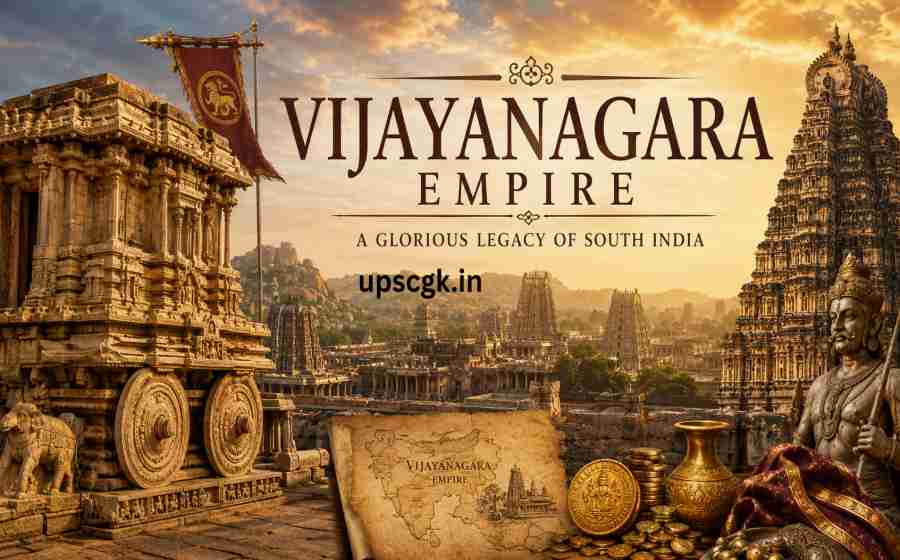
The stone chariot of the Vittala Temple remains one of the most recognized symbols of Vijayanagara art.
Music and Dance
Music and dance received royal support and became important parts of cultural life. Traditional forms of classical music and dance developed significantly during this period. Religious festivals, celebrations, and court performances encouraged artistic growth.
Summary
The Vijayanagara Empire occupies an important place in Indian history because of its strong administration, prosperous economy, and remarkable cultural achievements. The empire successfully protected South India from external threats while promoting trade, agriculture, literature, and architecture. Although the empire declined after the Battle of Talikota in 1565, its contributions continue to influence Indian culture and heritage. The monuments of Hampi and the rich traditions of South India still reflect the glory and greatness of the Vijayanagara Empire.
Also Check: History