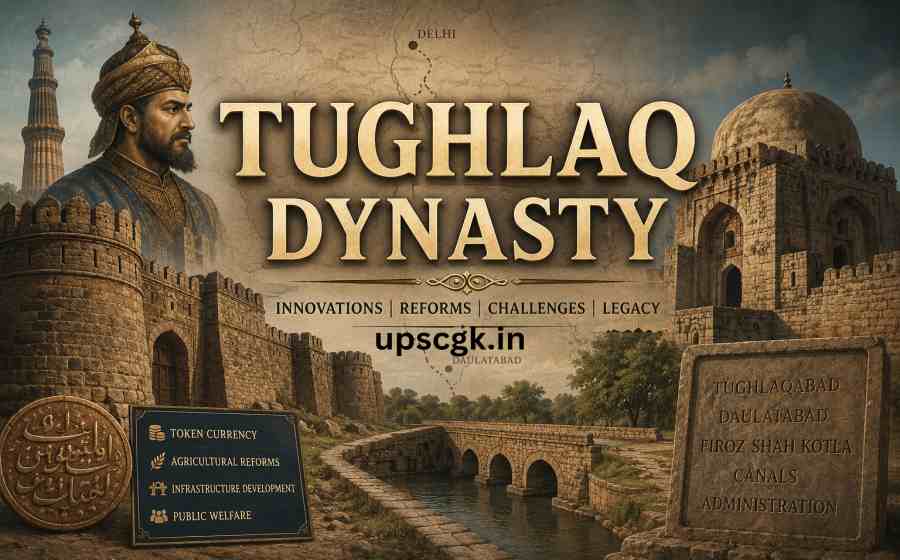
Explore the Tughlaq Dynasty and learn about its major innovations, ambitious reforms and failures under rulers like Muhammad bin Tughlaq and Firoz Shah Tughlaq.
Tughlaq Dynasty
The Tughlaq Dynasty was one of the important ruling dynasties of the Delhi Sultanate that governed large parts of India from 1320 to 1414 CE. It succeeded the Khalji Dynasty and played a major role in shaping medieval Indian administration, economy, architecture, and governance. The dynasty was founded by Ghiyasuddin Tughlaq and reached its peak under Muhammad bin Tughlaq and Firoz Shah Tughlaq. The Tughlaqs are remembered for introducing bold reforms and innovative ideas, but they are also famous for administrative failures and impractical decisions that weakened the empire.
The history of the Tughlaq Dynasty presents a combination of vision and miscalculation. Some rulers tried to modernize administration and improve governance, but poor implementation created severe problems for the people and the empire.
Table of Contents
Foundation of the Tughlaq Dynasty
The Tughlaq Dynasty was established in 1320 CE by Ghiyasuddin Tughlaq after the decline of the Khalji rulers. Ghiyasuddin was an efficient military leader and administrator. He strengthened law and order, improved security, and expanded the territory of the Delhi Sultanate.
He built the city of Tughlaqabad near Delhi, which reflected his military thinking and defensive strategy. Massive walls and strong fortifications showed his concern for protection against invasions.
After his death, his son Muhammad bin Tughlaq became ruler and introduced some of the most ambitious reforms in Indian medieval history.
Major Innovations of the Tughlaq Dynasty
1. Transfer of Capital from Delhi to Daulatabad
Muhammad bin Tughlaq decided to shift the capital from Delhi to Daulatabad in the Deccan region. His objective was strategic and political. Since Daulatabad was closer to the center of the empire, he believed it would help in controlling both northern and southern regions effectively.
The decision was based on logical thinking because the empire had expanded considerably. A central location could improve administration and communication.
However, forcing people, officials, and scholars to migrate over long distances created hardship. People faced exhaustion, disease, and economic losses.
2. Introduction of Token Currency
One of Muhammad bin Tughlaq’s most innovative ideas was introducing token currency made of copper and brass instead of silver coins.
The ruler intended to reduce dependence on precious metals and increase money circulation in the economy. Similar systems had existed in some parts of the world.
The idea itself was advanced for its time, but there was a major problem. The government lacked proper control over coin production. As a result, people began producing fake coins at home. Counterfeit currency spread rapidly, creating economic chaos.
Eventually, the ruler had to withdraw the policy and exchange fake coins for real money, causing heavy losses to the treasury.
3. Agricultural Reforms
Muhammad bin Tughlaq also introduced agricultural reforms aimed at increasing production and improving revenue collection.
He created a department for agriculture and provided loans to farmers so they could cultivate new lands. This reflected an early attempt to support agricultural development.
Unfortunately, excessive taxation in some regions and poor management reduced the success of these reforms.
4. Development of Infrastructure
Firoz Shah Tughlaq, who succeeded Muhammad bin Tughlaq, focused on public welfare and development projects.
He constructed:
- Roads
- Canals
- Gardens
- Mosques
- Schools
- Hospitals
His irrigation projects increased agricultural productivity and improved living conditions. Canal construction helped farmers receive water for cultivation.
5. Architectural Contributions
The Tughlaq rulers left a significant mark on architecture. Their buildings emphasized simplicity, strength, and durability.
Important architectural structures include:
- Tughlaqabad Fort
- Firoz Shah Kotla
- Tombs and mosques built during the period
The architecture of the Tughlaq period differed from earlier decorative styles because it focused more on military strength and practical design.
Major Failures of the Tughlaq Dynasty
Although the dynasty introduced several innovations, many decisions failed due to weak implementation.
Failure of Capital Transfer
The transfer of the capital caused enormous suffering among citizens. People had to travel long distances under difficult conditions. Eventually, the capital was shifted back to Delhi, making the effort ineffective.
Failure of Token Currency
The token currency experiment became one of the most famous failures in medieval Indian history. Counterfeit coins destroyed trust in the economy and reduced state revenue.
Excessive Taxation
Muhammad bin Tughlaq imposed high taxes in the Doab region between the Ganga and Yamuna rivers.
Unfortunately, the period experienced famine and poor harvests. Farmers suffered greatly and many abandoned agriculture, creating economic distress.
Administrative Instability
Several ambitious policies lacked proper planning and execution. Constant changes and failed experiments reduced public confidence in the government.
Weakening of Central Authority
After Firoz Shah Tughlaq, succession disputes and weak rulers reduced the strength of the empire. Regional powers started becoming independent.
The situation became worse after the invasion of Timur in 1398 CE. His invasion caused destruction in Delhi and severely weakened the Delhi Sultanate.
Summary
The Tughlaq Dynasty remains one of the most fascinating periods in medieval Indian history because of its combination of innovation and failure. The rulers displayed extraordinary vision and attempted administrative reforms that were far ahead of their time. Policies such as token currency, capital transfer, and agricultural reforms showed creative thinking and ambition.
However, practical difficulties, weak administration, and poor implementation turned many ideas into failures. The dynasty ultimately declined because of internal weakness and external attacks. Even with its shortcomings, the Tughlaq period contributed significantly to India’s administrative systems, architecture, and historical development.
Also Check: History