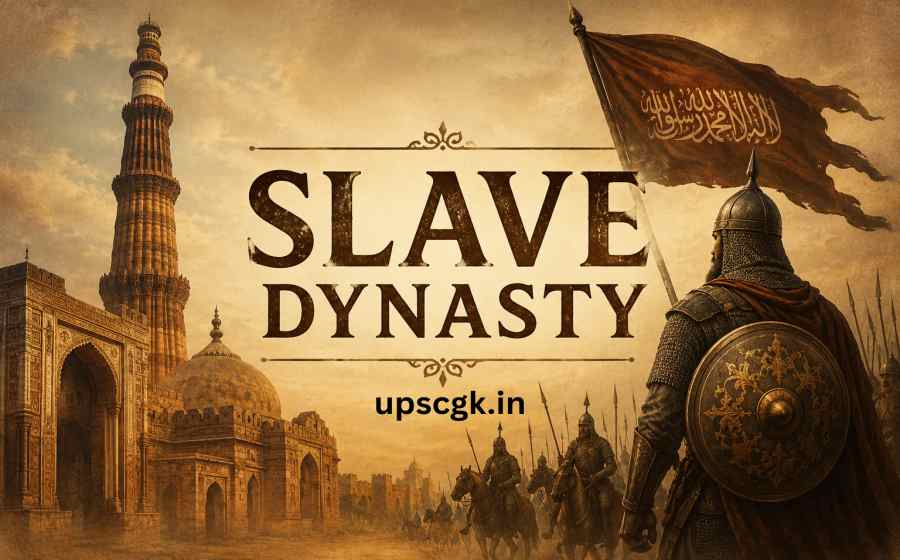
Explore the Slave Dynasty of India, its rulers, achievements, administration and contributions that shaped the Delhi Sultanate and medieval history.
Slave Dynasty
The Slave Dynasty, also known as the Mamluk Dynasty, was the first ruling dynasty of the Delhi Sultanate in India. It ruled from 1206 to 1290 CE and laid the foundation for Muslim rule in northern India. The rulers of this dynasty were originally slaves who rose to powerful positions because of their talent, military skills, and administrative abilities. Since many rulers had once served as slaves under their masters, historians called it the Slave Dynasty.
The establishment of the Slave Dynasty marked an important phase in medieval Indian history because it introduced new systems of administration, military organization, architecture, and governance. The dynasty played a major role in shaping the political structure of the Delhi Sultanate and created a strong base for future dynasties.
Table of Contents
Origin of the Slave Dynasty
The Slave Dynasty began after the death of Muhammad Ghori in 1206 CE. Muhammad Ghori had no children and had relied heavily on his trusted generals and slaves. Among them, Qutb-ud-din Aibak emerged as the most powerful leader in India. After Ghori’s death, Aibak declared himself ruler and established independent authority in Delhi.
The rulers of this dynasty are also called Mamluks. The term “Mamluk” means a person purchased as a slave and trained for military service. These slaves often became highly skilled administrators and commanders.
Major Rulers of the Slave Dynasty and Their Contributions
1. Qutb-ud-din Aibak (1206–1210 CE)
Qutb-ud-din Aibak was the founder of the Slave Dynasty. He was originally a Turkish slave purchased by Muhammad Ghori. Due to his bravery and loyalty, he rose to an important military position.
Contributions:
- Established the Slave Dynasty and became the first Sultan of Delhi.
- Started the construction of the Qutub Minar in Delhi.
- Began the construction of the Quwwat-ul-Islam Mosque.
- Expanded Muslim territories in northern India.
- Known for generosity and was called “Lakh Baksh”, meaning “giver of lakhs.”
Although his rule was short, he successfully established a foundation for future rulers.
2. Aram Shah (1210–1211 CE)
After Aibak’s death, his son Aram Shah became ruler. However, he was considered weak and lacked leadership qualities.
Contributions:
- His reign was short and unstable.
- Faced opposition from nobles and administrators.
- Eventually removed from power.
3. Iltutmish (1211–1236 CE)
Iltutmish was one of the greatest rulers of the Slave Dynasty. He was Aibak’s son-in-law and had earlier served as a slave. He strengthened the Delhi Sultanate and secured its future.
Contributions:
- Shifted the capital permanently to Delhi.
- Organized the Iqta system, where land revenue rights were given to officials in exchange for service.
- Introduced silver Tanka and copper Jital coins.
- Received recognition from the Caliph of Baghdad, which increased his legitimacy.
- Defended India from the Mongol threat.
- Completed the construction of the Qutub Minar.
Iltutmish transformed the Sultanate into a stable and organized state.
4. Razia Sultan (1236–1240 CE)
Razia Sultan was the daughter of Iltutmish and became the first and only woman ruler of the Delhi Sultanate.
Contributions:
- Encouraged education and justice.
- Attempted to reduce the power of Turkish nobles.
- Promoted capable individuals regardless of their social background.
- Worked toward efficient administration.
However, many nobles opposed her because they did not accept female leadership. She eventually lost power and died in conflict.
5. Ghiyas-ud-din Balban (1266–1287 CE)
Balban was among the most powerful rulers of the Slave Dynasty. Like earlier rulers, he had once been a slave and later became Sultan.
Contributions:
- Strengthened the authority of the Sultan.
- Introduced the policy of “Blood and Iron”, emphasizing strict discipline and strong governance.
- Reorganized the army and administration.
- Crushed rebellions and maintained law and order.
- Strengthened borders against Mongol invasions.
Balban believed in absolute monarchy and increased the dignity of the Sultan’s position.
Administrative Contributions of the Slave Dynasty
The Slave Dynasty introduced several administrative systems that influenced later rulers:
Centralized Administration
The rulers established a strong central government where the Sultan had supreme authority.
Iqta System
Under this system, land areas were assigned to officials who collected revenue and maintained administration.
Military Organization
The dynasty developed an organized military structure with trained soldiers and commanders.
Judicial System
Islamic law played an important role in governance, and judges handled legal matters.
Architectural Contributions
The Slave Dynasty introduced early Indo-Islamic architecture in India. Their structures combined Indian and Islamic styles.
Important monuments include:
- Qutub Minar
- Quwwat-ul-Islam Mosque
- Tomb of Iltutmish
- Alai Darwaza foundations and related structures
These monuments demonstrate artistic and engineering advancements of the period.
Importance of the Slave Dynasty
The Slave Dynasty holds a special place in Indian history because:
- It established the Delhi Sultanate.
- It laid the administrative foundation for later dynasties.
- It introduced new military systems.
- It promoted architecture and urban development.
- It helped shape medieval political systems in India.
The dynasty acted as a bridge between early Islamic conquests and the later expansion of the Delhi Sultanate.
Summary
The Slave Dynasty was the first ruling dynasty of the Delhi Sultanate and played a crucial role in medieval Indian history. Despite beginning with rulers who had once been slaves, the dynasty produced capable leaders such as Qutb-ud-din Aibak, Iltutmish, Razia Sultan, and Balban. Their contributions in administration, military organization, architecture, and governance strengthened the Delhi Sultanate and influenced future rulers. The dynasty’s achievements continue to be studied because they shaped the course of Indian history for centuries.
Also Check: History