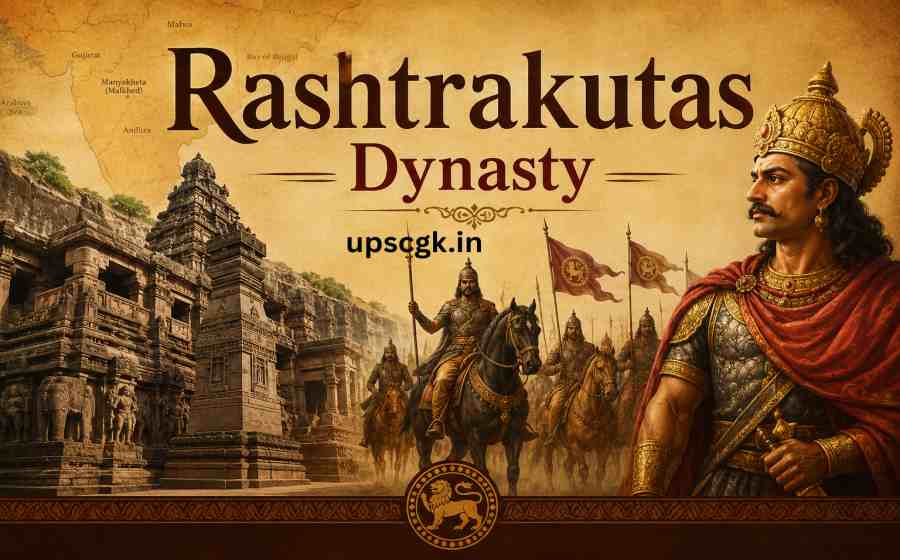
Explore the political achievements and cultural contributions of the Rashtrakutas Dynasty, one of the most powerful empires of medieval India.
Rashtrakutas Dynasty
The Rashtrakuta Dynasty was one of the most powerful and influential dynasties in medieval Indian history. Rising to prominence in the 8th century CE, the Rashtrakutas established a vast empire that extended across large parts of the Indian subcontinent. Known for their military strength, efficient administration, religious tolerance, and contributions to art and literature, the Rashtrakutas played a crucial role in shaping the political and cultural landscape of India.
Their rule marked an important phase in Indian history, especially in the Deccan region. The dynasty competed with powerful northern and southern kingdoms and became famous for its victories, diplomatic policies, and magnificent architectural achievements.
Table of Contents
Origin and Rise of the Rashtrakutas
The Rashtrakutas emerged in the Deccan region after defeating the Chalukyas of Badami. The founder of the imperial Rashtrakuta power was Dantidurga, who defeated the Chalukya king in the 8th century CE and established Rashtrakuta dominance.
Their capital was located at Manyakheta, present-day Malkhed in Karnataka. From this strategic center, the Rashtrakutas expanded their influence over large territories including Maharashtra, Karnataka, Andhra Pradesh, Gujarat, and parts of northern India.
The dynasty reached its peak under rulers like Krishna I, Dhruva Dharavarsha, and Govinda III.
Political Achievements of the Rashtrakutas
1. Expansion of a Vast Empire
One of the greatest political achievements of the Rashtrakutas was the creation of a powerful empire in peninsular India. Through military campaigns and strategic alliances, they expanded rapidly and controlled major trade routes and fertile regions.
Under Govinda III, the empire stretched from the Himalayas in the north to Cape Comorin in the south. His military campaigns defeated several rival kingdoms, making the Rashtrakutas one of the strongest powers in India during that period.
The dynasty also maintained control over important ports and trade centers, which strengthened their economic and political power.
2. Participation in the Tripartite Struggle
The Rashtrakutas played a major role in the famous Tripartite Struggle involving the Gurjara-Pratihara Dynasty, the Pala Dynasty, and the Rashtrakutas themselves.
The struggle was mainly for control over Kannauj, a politically significant city in northern India. Rashtrakuta rulers such as Dhruva and Govinda III successfully invaded northern India and challenged both the Palas and Pratiharas.
Their participation in this conflict demonstrated their military capability and established them as a pan-Indian power rather than just a regional kingdom.
3. Strong Military Administration
The Rashtrakutas maintained a well-organized army consisting of infantry, cavalry, elephants, and naval forces. Their military strength helped them suppress rebellions and defend their territories from external invasions.
They also appointed loyal feudatories and provincial governors to maintain law and order across the empire. This decentralized administrative system allowed efficient governance over distant regions.
The rulers encouraged capable commanders and maintained diplomatic relations with neighboring kingdoms to ensure political stability.
4. Efficient Administrative System
The Rashtrakutas developed a strong administrative structure that helped manage their vast empire effectively. The kingdom was divided into provinces called Rashtras, which were further divided into districts and villages.
Local administration was handled by village assemblies and officials, ensuring smooth governance at the grassroots level. Land revenue was the main source of income, and proper taxation systems were maintained for economic growth.
The administration promoted agriculture, irrigation, and trade, which improved the prosperity of the empire.
Contributions of the Rashtrakutas
1. Contribution to Architecture
The Rashtrakutas are especially remembered for their extraordinary contribution to Indian architecture. The most famous example is the magnificent Kailasa Temple at Ellora.
Built during the reign of Krishna I, the Kailasa Temple is a rock-cut temple dedicated to Lord Shiva. It is considered one of the greatest architectural wonders of ancient India. The temple was carved out of a single rock and displays exceptional artistic skill.
The Rashtrakutas also supported the construction of Jain and Buddhist monuments, reflecting their religious tolerance and cultural openness.
2. Promotion of Literature
The Rashtrakuta rulers were great patrons of literature and learning. Sanskrit and Kannada literature flourished during their rule.
One of the most famous rulers, Amoghavarsha I, was himself a scholar and author. He wrote the Kannada work Kavirajamarga, which is considered one of the earliest literary works in Kannada.
The court of the Rashtrakutas attracted poets, scholars, and philosophers from different parts of India. Their patronage contributed significantly to the growth of regional languages and classical literature.
3. Religious Tolerance
The Rashtrakutas followed a policy of religious tolerance. Although many rulers were followers of Hinduism, they also supported Jainism and Buddhism.
Several Jain scholars received royal patronage during this period. Temples and educational institutions belonging to different religions were constructed under Rashtrakuta rule.
This atmosphere of tolerance encouraged cultural harmony and intellectual development across the empire.
4. Growth of Trade and Economy
The Rashtrakutas encouraged both internal and overseas trade. Their control over western coastal ports helped establish trade links with Arab countries and other foreign regions.
Merchants traded textiles, spices, precious stones, and handicrafts. The prosperity of trade contributed to urban growth and economic stability.
Agriculture also flourished due to irrigation projects and proper land management systems introduced during their reign.
Decline of the Rashtrakutas
The decline of the Rashtrakuta Empire began in the late 10th century CE due to internal conflicts, succession disputes, and continuous wars with rival powers.
Eventually, the Western Chalukya Dynasty under Tailapa II overthrew the Rashtrakutas and established a new ruling power in the Deccan region.
Despite their decline, the legacy of the Rashtrakutas continued through their contributions to politics, architecture, literature, and administration.
Summary
The Rashtrakuta Dynasty was one of the most remarkable dynasties in Indian history. Their political achievements transformed them into a dominant power across the Indian subcontinent, while their cultural and architectural contributions enriched Indian civilization.
From the grand Kailasa Temple to the promotion of literature and religious harmony, the Rashtrakutas left a lasting impact on medieval India. Their achievements continue to be admired by historians, scholars, and travelers even today.
Also Check: History