Explore the administration and culture of the Chalukyas of Badami, their governance, art, architecture, religion and contribution to South Indian history.
Chalukyas of Badami
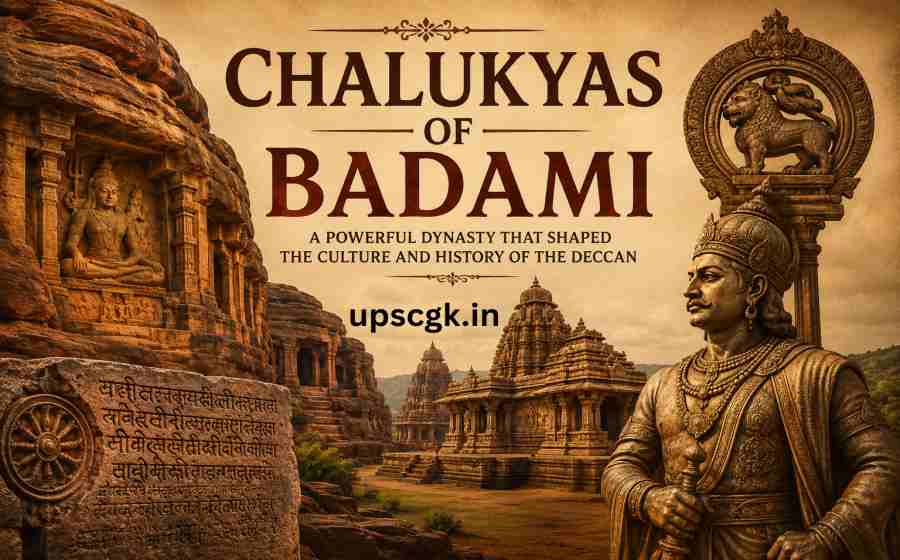
The Chalukyas of Badami were among the most influential dynasties of early medieval India. They ruled large parts of South and Central India between the 6th and 8th centuries CE and played a major role in shaping the political, cultural, and architectural history of the Deccan region. Their capital was located at Badami, in present-day Karnataka. Under their rule, the Deccan witnessed political stability, economic growth, and remarkable progress in art, literature, and temple architecture.
The foundation of the Chalukya dynasty was laid by Pulakeshin I around 543 CE. However, the dynasty achieved great fame under Pulakeshin II, one of the greatest rulers in Indian history. The Chalukyas frequently fought against powerful kingdoms such as the Pallavas, Pandyas, and Harshavardhana. Despite continuous wars, they successfully developed a strong administrative system and promoted a rich cultural environment.
Table of Contents
Administration of the Chalukyas of Badami
The Chalukyas established an efficient and organized administration that helped them govern their vast empire effectively. Their system combined strong central authority with local administration.
Central Administration
The king was the supreme authority in the Chalukya administration. He controlled military, judicial, and executive powers. The ruler was considered the protector of dharma and the welfare of the people. Kings often adopted grand titles such as “Maharajadhiraja” and “Parameshwara” to display their power and prestige.
The king was assisted by ministers and officials who handled different departments of administration. Important ministers advised the ruler on matters related to war, finance, diplomacy, and justice. The royal court was an important center of political activity.
Provincial Administration
The empire was divided into provinces called “Mandalas” or “Rashtras.” These provinces were governed by officials appointed by the king, often members of the royal family or trusted nobles. Provinces were further divided into districts known as “Vishayas,” and villages formed the basic administrative unit.
Village administration played a crucial role in governance. Village assemblies managed local affairs such as irrigation, land distribution, and tax collection. This decentralized system helped maintain order and ensured better communication between rulers and local communities.
Revenue System
Agriculture was the backbone of the Chalukya economy. The state collected land revenue from farmers, which formed the primary source of income. Taxes were also imposed on trade, professions, forests, and mines.
Irrigation received special attention from the rulers. Tanks, wells, and canals were constructed to improve agricultural production. Trade and commerce flourished due to internal stability and the strategic location of the kingdom.
Military Administration
The Chalukyas maintained a powerful military force consisting of infantry, cavalry, elephants, and chariots. The army was essential for protecting the kingdom and expanding territorial control. Pulakeshin II’s military achievements are especially remembered for defeating the north Indian ruler Harshavardhana near the Narmada River.
Feudatory chiefs also contributed troops during times of war. Forts were built at strategic locations to strengthen defense and maintain security.
Culture of the Chalukyas of Badami
The Chalukyas made remarkable contributions to Indian culture, especially in art, architecture, religion, and literature. Their reign is often considered a golden period for cultural development in the Deccan.
Art and Architecture
The Chalukyas are best known for their outstanding temple architecture. They developed a unique architectural style that combined elements of both North Indian Nagara and South Indian Dravida styles. This fusion later became known as the Vesara style.
Badami, Aihole, and Pattadakal became important centers of temple construction.
- Badami Cave Temples are famous for their rock-cut architecture and beautiful carvings dedicated to Hindu deities and Jain traditions.
- Aihole is often called the “Cradle of Indian Temple Architecture” because of the large number of experimental temple designs found there.
- Pattadakal, now a UNESCO World Heritage Site, contains magnificent temples that showcase the peak of Chalukyan architectural excellence.
The Virupaksha Temple at Pattadakal is considered one of the finest examples of early medieval Indian architecture.
Religion
The Chalukyas were followers of Hinduism, especially Shaivism and Vaishnavism. However, they were known for their religious tolerance. Jainism and Buddhism also received patronage during their rule.
Temples dedicated to Shiva, Vishnu, and Jain Tirthankaras were constructed across the kingdom. Religious scholars and saints were respected and often supported by the royal court.
This atmosphere of tolerance encouraged peaceful coexistence among different religious communities.
Literature and Education
The Chalukya period witnessed the growth of Sanskrit and Kannada literature. Sanskrit remained the language of administration and scholarship, while Kannada gradually developed as an important regional language.
Many poets, scholars, and writers received royal patronage. Ravikirti, the court poet of Pulakeshin II, composed the famous Aihole inscription, which provides valuable historical information about the dynasty.
Educational institutions attached to temples and monasteries promoted learning in subjects such as religion, philosophy, grammar, and mathematics.
Society and Economy
Society during the Chalukya period was organized according to the traditional varna system. Brahmins enjoyed high social status and often received land grants from rulers.
Trade and commerce flourished due to the kingdom’s connection with important trade routes. Merchants traded goods such as spices, textiles, precious stones, and handicrafts with foreign regions.
Urban centers developed around temples and trade routes, contributing to economic prosperity.
Decline of the Chalukyas
The continuous conflict with the Pallavas weakened the Chalukya Empire. In the 8th century, the Rashtrakutas under Dantidurga defeated the Chalukyas and ended their rule in Badami.
Although the dynasty declined politically, its cultural and architectural legacy continued to influence later South Indian kingdoms.
Summary
The Chalukyas of Badami played a vital role in the history of South India. Their strong administration ensured political stability and economic prosperity, while their cultural achievements left a lasting impact on Indian civilization. Their temples, art, and literature continue to attract historians, archaeologists, and tourists from around the world.
The dynasty successfully blended political power with cultural excellence, making the Chalukyas one of the most respected ruling houses in Indian history.
Also Check: History