Explore the life of Gautama Buddha, his key teachings like the Four Noble Truths and Eightfold Path and how Buddhism spread across Asia and the world.
Buddhism
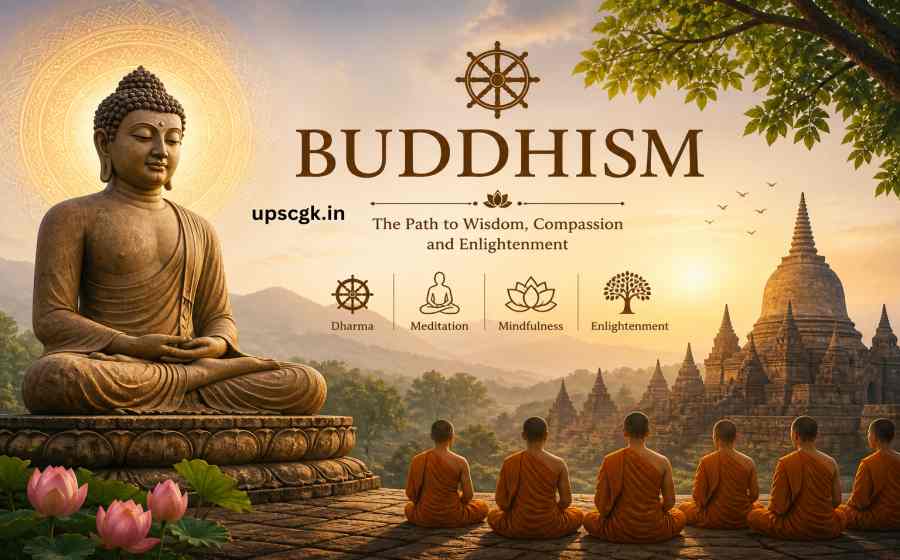
Buddhism is one of the world’s major religions and philosophical traditions, founded in the 6th century BCE by Gautama Buddha. It originated in the Indian subcontinent and gradually spread across Asia and beyond, influencing millions of people through its profound teachings on suffering, peace, and enlightenment.
Table of Contents
Life of Gautama Buddha
Gautama Buddha, originally named Siddhartha Gautama, was born around 563 BCE in Lumbini (present-day Nepal). He belonged to the Shakya clan, and his father, King Suddhodana, was a ruler. Siddhartha grew up in luxury, shielded from the harsh realities of life. His father ensured that he lived a life of comfort, hoping he would become a great king rather than a spiritual leader.
However, Siddhartha’s life changed when he encountered the “Four Sights” during his excursions outside the palace: an old man, a sick person, a dead body, and a wandering ascetic. These experiences deeply disturbed him and made him realize that suffering (dukkha) is an inevitable part of human life.
At the age of 29, Siddhartha renounced his royal life, leaving behind his wife and son in search of truth and liberation. This event is known as the “Great Renunciation.” He spent several years practicing extreme asceticism but found it ineffective. Eventually, he adopted the “Middle Way,” avoiding both luxury and severe austerity.
Siddhartha then meditated under the Bodhi tree at Bodh Gaya. After deep meditation, he attained enlightenment at the age of 35 and became known as the “Buddha,” meaning “The Enlightened One.” Following his enlightenment, he delivered his first sermon at Sarnath, known as the “Dharmachakra Pravartana” (Turning of the Wheel of Dharma).
For the next 45 years, Buddha traveled across northern India, teaching his philosophy to people from all walks of life. He passed away at the age of 80 in Kushinagar, an event referred to as “Mahaparinirvana.”
Core Teachings of Buddhism
Buddha’s teachings are simple yet deeply philosophical, focusing on understanding suffering and achieving liberation (nirvana).
1. Four Noble Truths
The foundation of Buddha religion lies in the Four Noble Truths:
- Dukkha: Life is full of suffering.
- Samudaya: Suffering is caused by desire (tanha).
- Nirodha: Suffering can be ended.
- Magga: The path to end suffering is the Eightfold Path.
These truths provide a practical framework for understanding human existence.
2. Eightfold Path
The Eightfold Path is the way to achieve enlightenment and is divided into three categories:
- Wisdom (Prajna): Right view, Right intention
- Ethical Conduct (Sila): Right speech, Right action, Right livelihood
- Mental Discipline (Samadhi): Right effort, Right mindfulness, Right concentration
This path emphasizes moral living, mental discipline, and wisdom.
3. Middle Way
Buddha rejected both extreme luxury and severe asceticism. Instead, he advocated the Middle Way, a balanced approach to life that leads to peace and enlightenment.
4. Karma and Rebirth
Buddha religion teaches that actions (karma) have consequences, influencing future lives. The cycle of birth, death, and rebirth (samsara) continues until one attains nirvana.
5. Nirvana
Nirvana is the ultimate goal in Buddhism. It represents liberation from suffering, desire, and the cycle of rebirth.
Expansion of Buddhism
After Buddha’s death, his teachings spread rapidly across India and beyond. The growth of Buddhism can be divided into several phases:
1. Early Spread in India
Buddha’s disciples and followers, known as the Sangha, played a crucial role in spreading his teachings. Monasteries became centers of learning and spiritual practice.
2. Role of Emperor Ashoka
The Mauryan Emperor Ashoka (3rd century BCE) was instrumental in the expansion of Buddhism. After the Kalinga War, he embraced Buddhism and promoted it across his empire. He sent missionaries to regions like Sri Lanka, Central Asia, and Southeast Asia.
3. Spread Across Asia
- Sri Lanka & Southeast Asia: Buddhism took root as Theravada Buddhism.
- China, Korea, Japan: Mahayana Buddhism became popular.
- Tibet & Mongolia: Vajrayana Buddhism developed with unique practices.
4. Trade Routes and Cultural Exchange
The Silk Road played a significant role in spreading Buddhism to Central Asia and China. Monks and traders carried Buddhist texts, art, and culture across regions.
5. Modern Global Presence
Today, Buddhism is practiced worldwide, especially in countries like Thailand, Myanmar, Japan, China, and Sri Lanka. It has also gained popularity in the West due to its emphasis on meditation and mindfulness.
Summary
Buddha religion, founded by Gautama Buddha, is not just a religion but a way of life that offers practical solutions to human suffering. Its teachings on compassion, mindfulness, and ethical living remain relevant even today. From its humble beginnings in ancient India to its global presence, Buddhism continues to inspire millions in their quest for peace and enlightenment.
Also Check: History