Explore Religion and Seals of the Indus Valley Civilization, uncover ancient beliefs, sacred symbols and spiritual practices of this early civilization.
Religion and Seals of the Indus Valley Civilization
The Indus Valley Civilization (IVC), one of the world’s earliest urban cultures (c. 2500–1900 BCE), flourished in regions of present-day Pakistan and northwest India. Despite its advanced urban planning, trade systems, and craftsmanship, its religious beliefs remain largely mysterious due to the undeciphered script. However, archaeological findings, especially seals, figurines, and structures, offer valuable insights into the spiritual life and symbolic practices of this ancient civilization.
Table of Contents
Nature of Religion in the Indus Valley Civilization
Unlike later civilizations such as the Vedic or Mesopotamian cultures, the Indus Valley Civilization did not leave behind large temples or clearly identifiable religious texts. This suggests that religion may not have been institutionalized or dominated by powerful priestly classes. Instead, it appears to have been more personal, symbolic, and closely connected with nature.
Religion in the Indus Valley Civilization is generally understood through material remains such as terracotta figurines, seals, amulets, and burial practices. These artifacts point to a belief system that emphasized fertility, nature worship, and possibly proto-Hindu concepts.
Worship of Mother Goddess
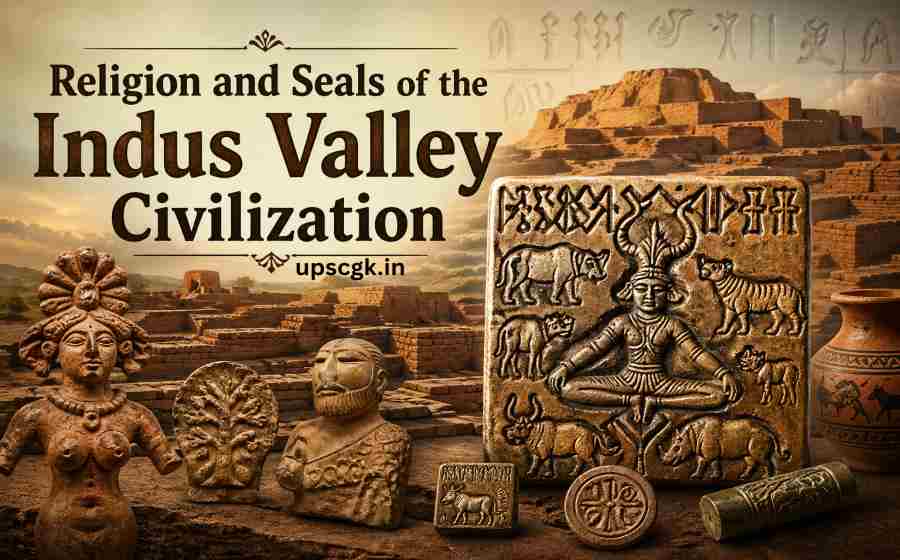
One of the most prominent aspects of Indus religion is the worship of a Mother Goddess. Numerous terracotta figurines of female forms have been discovered at sites like Harappa and Mohenjo-daro. These figurines often depict a woman with exaggerated features such as wide hips and breasts, symbolizing fertility and motherhood.
This suggests that fertility worship was central to their religious beliefs. The Mother Goddess was likely seen as the source of life and prosperity, reflecting an agrarian society dependent on natural cycles.
Proto-Shiva or Pashupati Seal
One of the most famous discoveries is the “Pashupati Seal,” which depicts a horned figure seated in a yogic posture surrounded by animals. This figure is often identified as a proto-form of Lord Shiva, known as “Pashupati” or “Lord of Animals.”
The posture resembles meditation or yoga, indicating that early forms of yogic practices may have existed. The association with animals suggests reverence for wildlife and possibly a belief in a supreme deity connected to nature and life.
Animal Worship and Symbolism
Animals played a significant role in Indus religious symbolism. Seals frequently depict animals such as bulls, elephants, rhinoceroses, tigers, and mythical creatures like the unicorn. These animals may have had religious significance, serving as totems, symbols of power, or representations of deities.
The bull, in particular, appears prominently and may symbolize strength, fertility, or agricultural prosperity. The reverence for animals reflects a deep connection between humans and nature.
Sacred Trees and Nature Worship
Evidence also points to the worship of trees, especially the peepal tree. Some seals show figures standing beneath trees, suggesting that trees were considered sacred. Nature worship likely formed an essential part of their belief system, with elements like water, fire, and earth holding spiritual significance.
The presence of the Great Bath at Mohenjo-daro further supports the importance of water in religious rituals. It may have been used for ritual purification, similar to practices seen in later Indian traditions.
The Role of Seals in Religion
Seals are among the most important artifacts of the Indus Valley Civilization. Typically made of steatite, these small, square objects feature engraved animal figures, human forms, and script. Over 2,000 seals have been discovered, and they serve both economic and religious purposes.
From a religious perspective, seals likely acted as amulets or talismans. The symbols engraved on them may have been used for protection, identity, or spiritual significance. The recurring motifs suggest standardized beliefs and shared cultural symbolism across the civilization.
Script and Religious Mystery
The Indus script, found on seals and tablets, remains undeciphered despite extensive research. This has limited our understanding of their religious practices. If deciphered, it could reveal prayers, hymns, or names of deities, providing deeper insights into their belief system.
Until then, interpretations rely heavily on visual symbols and comparisons with later traditions.
Burial Practices and Belief in Afterlife
Burial practices also hint at religious beliefs. The dead were usually buried in a north-south orientation, sometimes with pottery, ornaments, and tools. This indicates a belief in life after death, where such items might be needed.
However, there is no clear evidence of elaborate tombs or mummification, suggesting a relatively simple approach to death and the afterlife.
Absence of Temples
One striking feature of the Indus Valley Civilization is the absence of large temples or monumental religious structures. This could mean that religious practices were conducted in homes or open spaces rather than centralized institutions.
Alternatively, it is possible that temples were made of perishable materials that did not survive over time.
Symbolism in Seals
The symbolism in seals is rich and complex. Common elements include:
- Animals representing power or divinity
- Geometric patterns symbolizing order or cosmic balance
- Human figures in ritualistic poses
- Mythical creatures indicating imagination and spiritual beliefs
These symbols likely conveyed messages understood by the people but remain largely speculative today.
Summary
The religion of the Indus Valley Civilization was deeply symbolic, nature-oriented, and centered around fertility and harmony with the environment. While the absence of written records limits our understanding, seals and artifacts provide a fascinating glimpse into their spiritual world.
The seals, in particular, act as a bridge between the material and spiritual aspects of their society, reflecting beliefs that may have influenced later Indian traditions. As research continues and technology advances, future discoveries may finally unlock the secrets of this ancient and enigmatic civilization.
Also Check: History