Explore the Trade and Economy of the Indus Valley Civilization, including internal markets, external trade links with Mesopotamia and key economic features.
Trade and Economy of the Indus Valley Civilization
The Indus Valley Civilization, also known as the Harappan Civilization, flourished around 2500 BCE in the northwestern regions of the Indian subcontinent. It was one of the earliest urban civilizations in the world, alongside Mesopotamia and Egypt. A key reason behind its prosperity and urban success was its well-organized and advanced economic system. Trade, both internal and external, played a central role in shaping the economy of this civilization.
Table of Contents
Economic Structure and Basis
The economy of the Indus Valley Civilization was primarily based on agriculture, supplemented by trade, craft production, and animal husbandry. The fertile plains of the Indus River provided ideal conditions for growing crops such as wheat, barley, peas, and cotton. In fact, the Indus people are among the earliest known cultivators of cotton.
Apart from agriculture, the economy was supported by skilled artisans who produced a variety of goods including pottery, beads, jewelry, tools, and textiles. These goods were traded within the civilization and also exported to distant regions.
Internal Trade System
Internal trade refers to the exchange of goods within the cities and regions of the Indus Valley Civilization. The civilization had a highly developed urban network, including cities like Harappa, Mohenjo-daro, and Dholavira.
Key Features of Internal Trade:
1. Standardized Weights and Measures
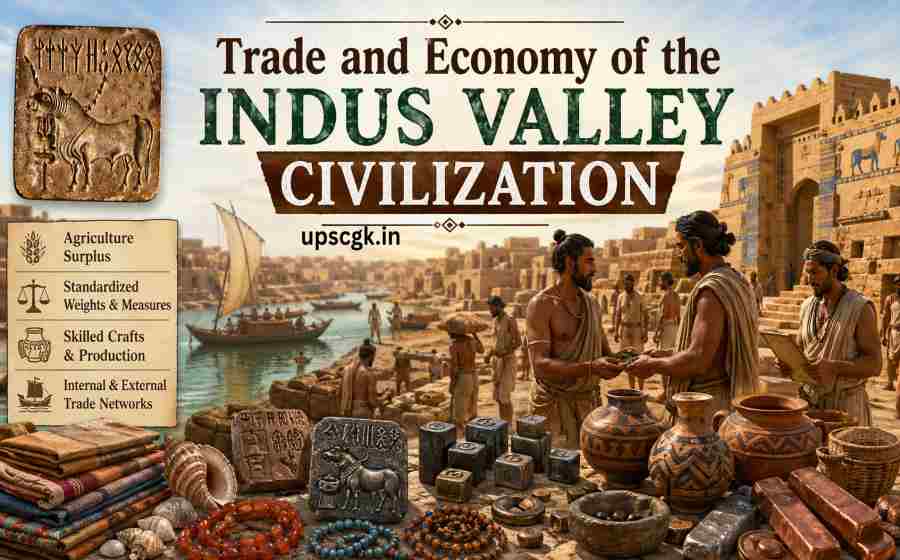
One of the most remarkable aspects of internal trade was the use of standardized weights and measures. Cubical weights made of chert were used across different cities, indicating a uniform system of trade and economic regulation.
2. Well-Planned Cities and Markets
The cities were systematically planned with streets, drainage systems, and designated areas that likely functioned as marketplaces. This organization facilitated smooth trade and movement of goods.
3. Barter System
There is no clear evidence of coinage in the Indus Valley Civilization. Trade was likely conducted through the barter system, where goods were exchanged directly without the use of money.
4. Craft Specialization
Different regions specialized in specific crafts. For example, bead-making centers have been found in places like Lothal. Such specialization increased efficiency and supported trade networks within the civilization.
External Trade System
The Indus Valley Civilization maintained active trade relations with distant regions, making it part of an early international trade network.
Trade with Mesopotamia
One of the most significant external trade links was with Mesopotamia. Archaeological evidence, including seals and artifacts, suggests that the Indus people traded extensively with Mesopotamian cities.
The Mesopotamians referred to the Indus region as “Meluhha.” Items such as carnelian beads, ivory, cotton textiles, and pottery were exported from the Indus Valley, while imports likely included silver, tin, and other raw materials.
Trade Routes
1. Land Routes
Trade routes connected the Indus cities to regions like Afghanistan, Iran, and Central Asia. These routes were used to transport valuable resources such as lapis lazuli and metals.
2. Maritime Trade
The presence of dockyards at Lothal indicates that maritime trade was well-developed. Goods were transported via ships across the Arabian Sea, connecting the Indus Valley to regions in the Persian Gulf.
Major Trade Commodities
Exports:
- Cotton textiles
- Beads (carnelian, agate)
- Ivory products
- Pottery
- Shell items
Imports:
- Metals like tin and copper
- Precious stones
- Silver and gold
- Lapis lazuli (from Afghanistan)
Role of Seals in Trade
Seals were an important part of the trade system. Made mostly of steatite, these seals had inscriptions and animal motifs. They were likely used for identification, authentication of goods, and administrative purposes. The discovery of Indus seals in Mesopotamia further confirms long-distance trade relations.
Economic Administration
Although no written records have been fully deciphered, the uniformity in weights, measures, and urban planning suggests a strong central authority or administrative system that regulated trade and economic activities. This ensured consistency, fairness, and efficiency in economic transactions.
Summary
The trade and economy of the Indus Valley Civilization were highly advanced for their time. With a strong agricultural base, skilled craftsmanship, and extensive trade networks, both internal and external, the civilization achieved remarkable economic prosperity. Its standardized systems, organized cities and international trade connections highlight a level of sophistication that continues to fascinate historians and archaeologists today.
Understanding this economic system not only provides insight into the daily lives of the Harappan people but also demonstrates how early civilizations laid the foundation for modern economic practices.
Also Check: History