Understand checks and balances, their meaning, key principles, examples and role in preventing misuse of power in a democratic government.
Checks and Balances
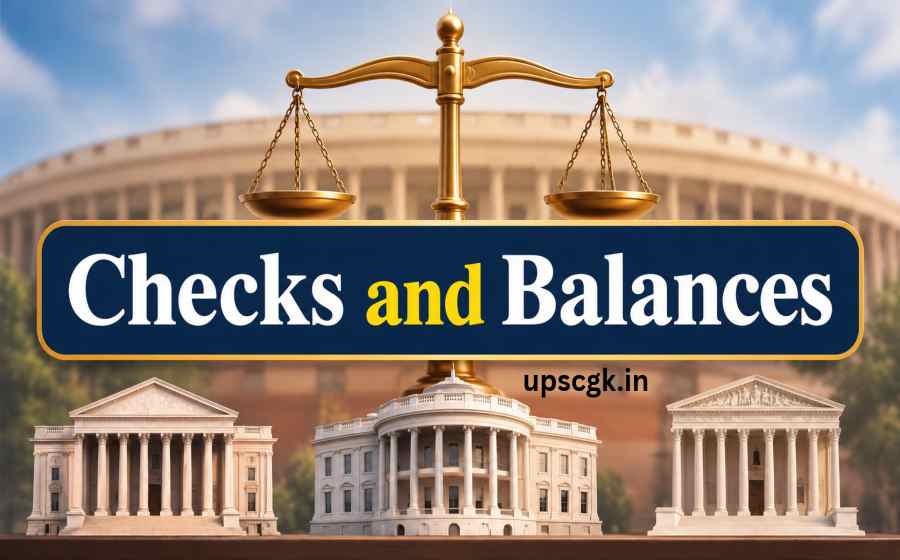
Checks and balances are essential principles of democratic government that prevent the misuse and concentration of political power. They ensure that no single branch of government becomes too powerful or exercises authority without accountability. In a democracy, government institutions must work within constitutional limits while respecting the rights and freedoms of citizens.
The principle of checks and balances is closely connected with the separation of powers. While separation of powers distributes government responsibilities among different branches, checks and balances allow these branches to supervise, restrict and influence one another. This system helps maintain accountability, transparency and the rule of law.
Table of Contents
Meaning of Checks and Balances
Checks and balances refer to a constitutional system in which different branches of government have specific powers to monitor and limit the activities of one another. The main objective is to prevent any institution or individual from exercising unlimited authority.
In a typical democratic system, government power is divided among three major branches:
- Legislature: Makes laws and represents the people.
- Executive: Implements laws and manages government administration.
- Judiciary: Interprets laws and ensures that government actions follow the Constitution.
Each branch has its own responsibilities, but its powers are not entirely independent. Different constitutional mechanisms allow one branch to check the authority of another.
For example, a legislature may question the executive’s decisions, while the judiciary may review government actions to determine whether they violate constitutional provisions.
Origin and Development of the Principle
The idea of checks and balances developed from the broader political philosophy of limiting government power. Political thinkers argued that concentrating authority in one person or institution could threaten individual liberty and lead to authoritarian rule.
The French political philosopher Montesquieu played an important role in developing the theory of separation of powers. In his famous work The Spirit of the Laws (1748), he argued that political liberty requires the division of government authority among different institutions.
The principle of checks and balances became particularly influential in the formation of the United States Constitution of 1787. The American constitutional system established separate legislative, executive and judicial branches, each with powers to limit the others.
Today, checks and balances are important features of many constitutional democracies, although their institutional arrangements differ from country to country.
Key Principles of Checks and Balances
The system of checks and balances operates through several important principles.
1. Limited Government Power
No government institution should possess unlimited authority. Every branch must exercise its powers according to constitutional provisions and legal restrictions.
2. Mutual Accountability
Each branch is accountable through constitutional mechanisms. This prevents institutions from acting entirely without supervision.
3. Constitutional Supremacy
The Constitution is the highest legal authority. All branches of government must operate within its framework.
4. Judicial Independence
An independent judiciary protects constitutional rights and examines whether legislative and executive actions comply with the law.
5. Prevention of Arbitrary Decisions
Government decisions should follow established legal procedures rather than the personal interests or wishes of powerful individuals.
How Checks and Balances Work
Checks and balances operate through different constitutional powers given to government institutions.
1. Legislature Checks the Executive
The legislature exercises control over the executive through parliamentary debates, questions, financial approval and other accountability mechanisms.
In a parliamentary democracy like India, the Council of Ministers is collectively responsible to the Lok Sabha. The government must maintain the confidence of the elected lower house to remain in office.
Parliamentary committees also examine government policies, expenditure and administrative functioning.
2. Executive Checks the Legislature
In certain constitutional systems, the executive has powers that influence the functioning of the legislature.
For example, in the United States, the President can veto legislation passed by Congress. However, Congress can override a presidential veto through the constitutionally prescribed process.
In parliamentary systems, the executive may also have a role in summoning and proroguing Parliament, subject to constitutional rules and conventions.
3. Judiciary Checks the Legislature and Executive
The judiciary protects constitutional supremacy through judicial review.
In India, the Supreme Court and High Courts can examine laws and government actions. If a law violates the Constitution, courts can declare it unconstitutional, subject to their jurisdiction and established legal principles.
Judicial review is an important mechanism for protecting fundamental rights and preventing arbitrary government action.
Checks and Balances in the Indian Constitution
India follows a parliamentary democratic system based on the separation of powers with constitutional checks and balances. The three branches have distinct responsibilities, but their functions sometimes overlap.
Important examples include:
- Parliamentary control: Parliament holds the executive accountable through questions, debates, motions and financial control.
- Judicial review: Articles 13, 32 and 226 provide important constitutional foundations for judicial protection of rights and review of government action.
- Executive accountability: Under Article 75(3), the Union Council of Ministers is collectively responsible to the Lok Sabha.
- Presidential powers: The President has constitutional functions relating to legislation, appointments and the functioning of the Union government.
- Constitutional limitations: Parliament’s power to amend the Constitution is subject to the basic structure doctrine established by the Supreme Court.
In the landmark Kesavananda Bharati v. State of Kerala (1973) judgment, the Supreme Court established that Parliament cannot alter the basic structure of the Constitution through constitutional amendments.
This decision is an important example of constitutional checks on legislative power.
Importance of Checks and Balances in Democracy
Checks and balances play a significant role in maintaining democratic governance. Their importance can be understood through the following points:
1. Prevents Abuse of Power
It prevents any branch of government from exercising excessive authority and protects citizens from arbitrary decisions.
2. Protects Fundamental Rights
An independent judiciary and constitutional safeguards help protect individual freedoms and prevent violations of fundamental rights.
3. Strengthens Accountability
Government institutions remain answerable for their decisions and actions. Legislative scrutiny and judicial review help ensure responsible governance.
4. Maintains the Rule of Law
Checks and balances ensure that government authorities follow constitutional provisions and established laws rather than acting according to personal interests.
5. Promotes Transparency
Public scrutiny, parliamentary debates and independent institutions help make government decisions more transparent.
6. Protects Democratic Institutions
It prevents the concentration of power and helps preserve the independence and effectiveness of democratic institutions.
Challenges and Limitations of Checks and Balances
Despite its importance, the system of checks and balances also faces certain challenges.
- Institutional Conflicts: Disagreements between government branches can delay important decisions.
- Political Influence: Political pressure may weaken the independence of constitutional institutions.
- Excessive Delays: Too many restrictions and approval procedures can slow down policymaking.
- Weak Accountability: Checks become ineffective when institutions fail to exercise their constitutional responsibilities.
Therefore, democratic governments must maintain a balance between institutional independence and effective administration.
Summary
Checks and balances are fundamental to a healthy democracy because they prevent the concentration and misuse of government power. By ensuring accountability among the legislature, executive and judiciary, this system protects constitutional values, individual rights and the rule of law.
In India, constitutional provisions, judicial review, parliamentary accountability and the basic structure doctrine help maintain this balance. Ultimately, the success of democracy depends not only on free and fair elections but also on strong institutions that respect constitutional limits and remain accountable to the people.
Also Check: Political Science