Understand separation of powers, its meaning, principles and importance in democracy, including how legislative, executive and judicial powers work.
Separation of Powers
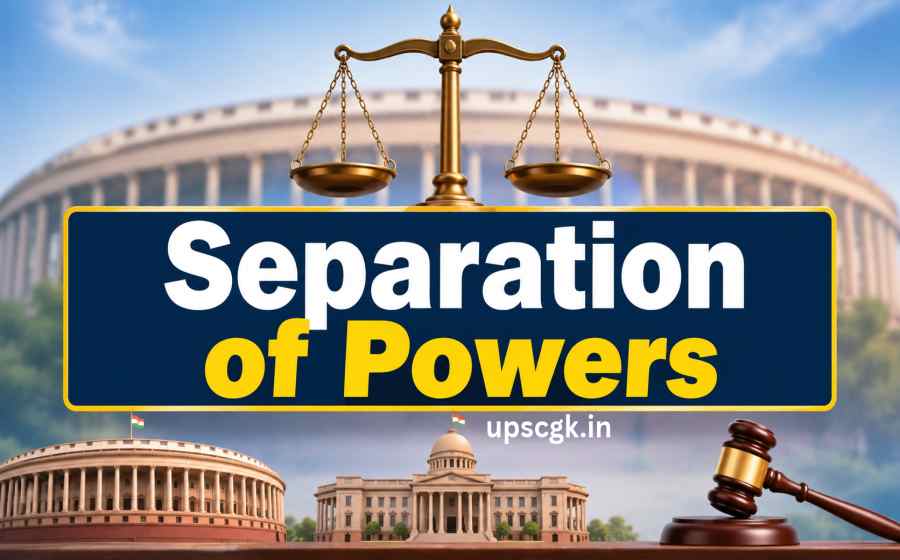
Separation of Powers is one of the fundamental principles of modern democratic government. It ensures that government authority is divided among different organs so that no single institution becomes too powerful. This principle promotes accountability, prevents misuse of authority and protects the rights and freedoms of citizens.
In a democratic country, the government generally performs three major functions: making laws, implementing laws and interpreting laws. These functions are assigned to three important organs: the Legislature, the Executive and the Judiciary. The separation of powers helps maintain a balance among these institutions and supports the effective functioning of democracy.
Table of Contents
Meaning of Separation of Powers
Separation of Powers refers to the division of government responsibilities among three independent organs: the Legislature, the Executive and the Judiciary. Each organ performs its specific functions and is expected to operate within its constitutional limits.
The concept aims to prevent the concentration of political power in one person or institution. When different institutions exercise different responsibilities, they can monitor one another and reduce the possibility of arbitrary decisions.
The principle is closely associated with the French political philosopher Montesquieu, who explained it in his famous work The Spirit of the Laws (1748). He argued that liberty could not be protected if legislative, executive and judicial powers were concentrated in the same hands.
Three Main Organs of Government
The principle of separation of powers identifies three major organs of government, each with distinct responsibilities.
1. Legislature
The Legislature is responsible for making laws, discussing public policies and representing the interests of citizens. In democratic systems, its members are generally elected directly or indirectly by the people.
Its major functions include:
- Making, amending and repealing laws.
- Approving government budgets and public expenditure.
- Discussing important national issues.
- Holding the Executive accountable through parliamentary procedures.
In India, Parliament consists of the President, the Lok Sabha and the Rajya Sabha.
2. Executive
The Executive is responsible for implementing and enforcing laws passed by the Legislature. It manages the administration of the country and makes important policy decisions within the constitutional framework.
Its major functions include:
- Implementing laws and government policies.
- Maintaining law and order.
- Managing public administration.
- Conducting foreign relations.
- Ensuring the delivery of public services.
In India, the Union Executive consists of the President, the Vice-President, the Prime Minister, the Council of Ministers and the Attorney General of India, as provided under the Constitution.
3. Judiciary
The Judiciary is responsible for interpreting laws, resolving disputes and protecting constitutional rights. It also ensures that government institutions act according to the Constitution.
Its major functions include:
- Interpreting the Constitution and laws.
- Settling disputes between individuals and institutions.
- Protecting fundamental rights.
- Reviewing the constitutional validity of laws and executive actions through judicial review.
In India, the Supreme Court is the highest judicial authority, followed by High Courts and subordinate courts.
Principles of Separation of Powers
The doctrine of separation of powers is based on several important principles that help maintain a balanced system of government.
1. Division of Functions: Government responsibilities should be distributed among the Legislature, Executive and Judiciary so that each organ performs its designated duties.
2. Independence of Organs: Each institution should have sufficient independence to perform its constitutional responsibilities without unnecessary interference from other organs.
3. Checks and Balances: Government institutions should have mechanisms to monitor and control one another. This prevents the misuse and concentration of power.
4. Prevention of Arbitrary Authority: No individual or institution should exercise unlimited governmental power. Every organ must function within constitutional boundaries.
5. Accountability: Each organ must remain accountable under the Constitution and follow established legal procedures while performing its responsibilities.
Importance of Separation of Powers
Separation of Powers plays an essential role in maintaining democratic governance and constitutional stability.
1. Prevents Concentration of Power: It distributes authority among different institutions and reduces the risk of dictatorship or authoritarian rule.
2. Protects Fundamental Rights: An independent judiciary can protect citizens against unconstitutional laws and arbitrary government actions.
3. Strengthens Democracy: It ensures that government institutions perform their responsibilities within defined limits and remain accountable.
4. Promotes Judicial Independence: It helps courts make impartial decisions without improper political or executive pressure.
5. Ensures Accountability: Through checks and balances, each organ can question or review certain actions of the others.
6. Improves Administrative Efficiency: Clear responsibilities help institutions focus on their respective functions and improve the overall working of government.
Separation of Powers in the Indian Constitution
The Indian Constitution does not follow the doctrine of separation of powers in its strict or absolute form. Instead, it adopts a system of functional separation combined with checks and balances.
The three organs have clearly defined responsibilities, but certain functions overlap to ensure effective governance.
Some important constitutional provisions related to this principle include:
- Article 50: Directs the State to separate the judiciary from the executive in public services.
- Article 121: Restricts parliamentary discussion on the conduct of Supreme Court and High Court judges, except during proceedings for their removal.
- Article 211: Places a similar restriction on State Legislatures regarding the conduct of judges.
- Articles 32 and 226: Empower the Supreme Court and High Courts to protect fundamental rights and exercise judicial review.
The landmark Kesavananda Bharati v. State of Kerala (1973) case recognised constitutional limitations on Parliament’s power to amend the Constitution. The separation of powers is also recognised as an essential feature of India’s constitutional framework.
In the Supreme Court Advocates-on-Record Association v. Union of India (2015) case, the Supreme Court emphasised that strict separation is neither possible nor desirable in modern governance, but accountability among the three organs must be maintained.
Thus, India’s constitutional system focuses on cooperation, functional independence and checks and balances rather than complete separation.
Limitations of the Doctrine of Separation of Powers
Although the doctrine is essential for democracy, it has certain limitations:
- Possibility of Conflict: Differences between government institutions may create conflicts and delay important decisions.
- Administrative Delays: Excessive institutional restrictions can slow down policymaking and implementation.
- Functional Overlapping: In modern governments, the functions of different organs sometimes overlap, making complete separation difficult.
- Risk of Institutional Overreach: Any organ may attempt to exercise authority beyond its constitutional responsibilities.
- Coordination Challenges: Effective governance requires cooperation among all three organs, which may become difficult when institutional relationships are strained.
Summary
Separation of Powers is an essential principle of democratic government that prevents the concentration of authority and protects individual liberty. By distributing responsibilities among the Legislature, Executive and Judiciary, it promotes accountability, transparency and constitutional governance.
India follows a flexible system of separation of powers supported by checks and balances rather than a rigid division of authority. Maintaining a proper balance among the three organs is necessary to protect democracy, uphold the rule of law and ensure effective governance.
Also Check: Political Science