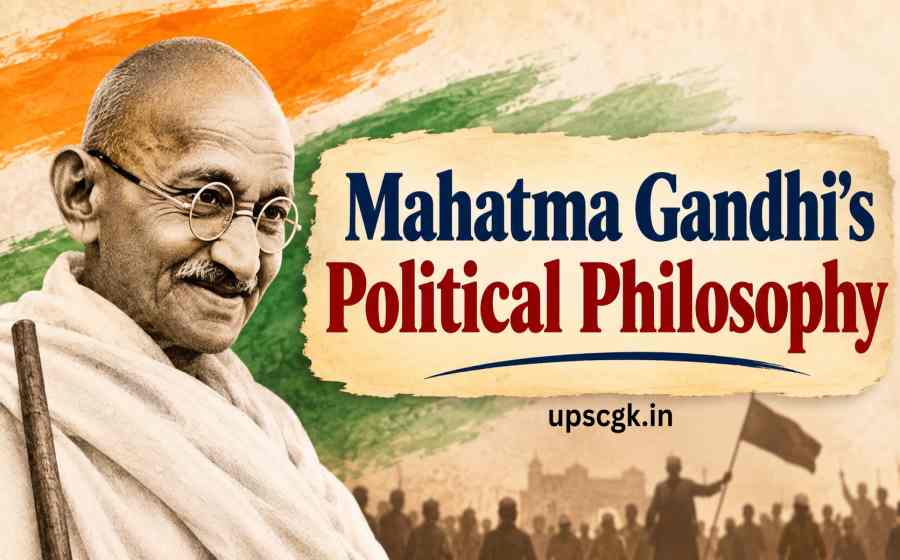
Explore Mahatma Gandhis political philosophy, including Swaraj, Satyagraha and Ahimsa and their role in India’s freedom struggle and social transformation.
Mahatma Gandhis Political Philosophy
Mahatma Gandhi was one of the most influential political thinkers and leaders of modern India. His political philosophy was based on truth, non-violence, self-discipline, moral responsibility and the empowerment of ordinary people. Unlike political thinkers who primarily focused on state power, military strength or economic development, Gandhi believed that genuine political freedom must begin with individual character and social transformation.
Gandhi’s political ideas were closely connected with India’s freedom struggle against British colonial rule. Three important concepts formed the foundation of his political philosophy: Swaraj (self-rule), Satyagraha (truth-force) and Ahimsa (non-violence). These principles influenced India’s independence movement and continue to be discussed in debates about democracy, social justice and peaceful resistance.
Table of Contents
Swaraj – The Concept of Self-Rule
Swaraj was one of the central ideas of Gandhi’s political philosophy. The term generally means self-rule or self-government. However, Gandhi understood Swaraj as something much broader than the transfer of political power from British rulers to Indian leaders.
For Gandhi, true Swaraj meant individual freedom, self-control, moral responsibility and collective self-government. He believed that people could not achieve genuine independence without overcoming fear, dependence and social divisions.
In his 1909 work Hind Swaraj, Gandhi criticised modern civilisation and argued that political independence alone would not guarantee a just society. He emphasised the importance of ethical living, local self-sufficiency and responsible citizenship.
Gandhi also supported decentralised political institutions and village self-government. He envisioned villages as relatively self-reliant communities where people could participate directly in decision-making.
Major features of Gandhi’s Swaraj:
- Political independence from colonial rule.
- Individual self-discipline and moral responsibility.
- Village-level self-government and decentralisation.
- Economic self-reliance and local production.
- Freedom from social discrimination and exploitation.
Thus, Gandhi’s Swaraj represented both national independence and personal responsibility.
Satyagraha – The Power of Truth and Non-Violent Resistance
Satyagraha was Gandhi’s distinctive method of political and social struggle. The word combines Satya (truth) and Agraha (insistence or firmness). It is commonly understood as holding firmly to truth or the force of truth.
Gandhi developed Satyagraha during his struggle against racial discrimination in South Africa. He believed that injustice should be opposed through courage, peaceful resistance and moral persuasion rather than violence.
According to Gandhi, a Satyagrahi should resist unjust laws without hatred towards opponents. Instead of physically harming the wrongdoer, the individual should willingly accept suffering while remaining committed to truth.
Satyagraha became an important instrument of India’s freedom movement.
Important examples of Satyagraha in India:
- Champaran Satyagraha (1917): Gandhi supported indigo cultivators in Bihar who faced exploitation under the colonial plantation system.
- Ahmedabad Mill Strike (1918): He supported textile workers in their dispute over wages.
- Kheda Satyagraha (1918): He led a campaign demanding revenue relief for farmers affected by crop failure.
- Salt Satyagraha (1930): Gandhi led the Dandi March to challenge the British salt monopoly and salt tax.
These movements demonstrated how organised non-violent resistance could challenge colonial authority and mobilise ordinary people.
Ahimsa – The Principle of Non-Violence
Ahimsa, meaning non-violence, was another fundamental principle of Gandhi’s political philosophy. Although the concept existed in ancient Indian religious and philosophical traditions, Gandhi developed it into a practical method of political action.
For Gandhi, Ahimsa meant much more than avoiding physical violence. It also required avoiding hatred, discrimination and harmful intentions towards others.
He believed that violence could not establish lasting peace or justice because it often created further resentment and conflict. Instead, he advocated compassion, tolerance, understanding and respect for human dignity.
Gandhi considered Ahimsa inseparable from truth. In his philosophy, truth was the ultimate objective, while non-violence was the means of pursuing it.
His commitment to non-violence influenced mass movements, including the Non-Cooperation Movement and the Civil Disobedience Movement.
Key principles of Ahimsa:
- Rejecting physical violence and hatred.
- Respecting the dignity of every individual.
- Practising tolerance and compassion.
- Resolving conflicts through peaceful methods.
- Opposing injustice without hatred towards opponents.
Gandhi believed that non-violence required courage and discipline rather than weakness or passivity.
Sarvodaya – Welfare of All
Sarvodaya, meaning the welfare or upliftment of all, was an important social objective of Gandhi’s political philosophy. He believed that a good political and economic system should benefit every section of society, particularly the poor and disadvantaged.
Gandhi opposed social inequality, untouchability, economic exploitation and discrimination. He advocated equality, communal harmony, dignity of labour and the improvement of village communities.
His idea of Sarvodaya was closely connected with his belief that individual progress should contribute to the welfare of the entire society.
Swadeshi and Economic Self-Reliance
Gandhi also emphasised Swadeshi, which encouraged people to use locally produced goods and support domestic industries.
He promoted Khadi (hand-spun and hand-woven cloth) as a symbol of economic independence and resistance to British economic exploitation. The spinning wheel became an important symbol of India’s freedom movement.
Gandhi believed that economic development should focus on human welfare rather than unlimited industrial expansion. He supported village industries, local production and decentralised economic activities to create employment and reduce dependence on external systems.
Influence of Gandhi’s Political Philosophy
Gandhi’s political philosophy had a significant influence on India’s independence movement. His methods encouraged mass participation and provided a framework for resisting colonial authority through peaceful action.
His ideas also influenced international civil rights and anti-colonial movements. Leaders such as Martin Luther King Jr. and Nelson Mandela drew inspiration from Gandhian principles of non-violent resistance, although their political contexts and methods differed.
Gandhi’s philosophy continues to be studied in discussions about democracy, human rights, peace, social equality and political resistance.
Criticism of Gandhi’s Political Philosophy
Despite its influence, Gandhi’s political philosophy has also faced criticism. Some thinkers questioned whether non-violence could effectively address every form of oppression. B. R. Ambedkar, for example, strongly criticised Gandhi’s approach to caste and untouchability, arguing for more fundamental social and political rights for oppressed communities.
Gandhi’s preference for village-based economic organisation and his criticism of large-scale industrialisation have also been debated in the context of modern economic development.
Summary
Mahatma Gandhi’s political philosophy combined morality, politics and social responsibility. His concepts of Swaraj, Satyagraha and Ahimsa provided an alternative approach to political struggle based on self-rule, truth and non-violence.
Through these principles, Gandhi transformed India’s freedom struggle into a mass movement and influenced peaceful resistance movements across the world. His ideas of Sarvodaya, Swadeshi and decentralisation further reflected his vision of an independent and socially responsible society.
Although some aspects of his philosophy continue to face criticism and debate, Gandhi’s contribution to political thought remains significant in understanding India’s national movement and the development of non-violent political resistance.
Also Check: Political Science