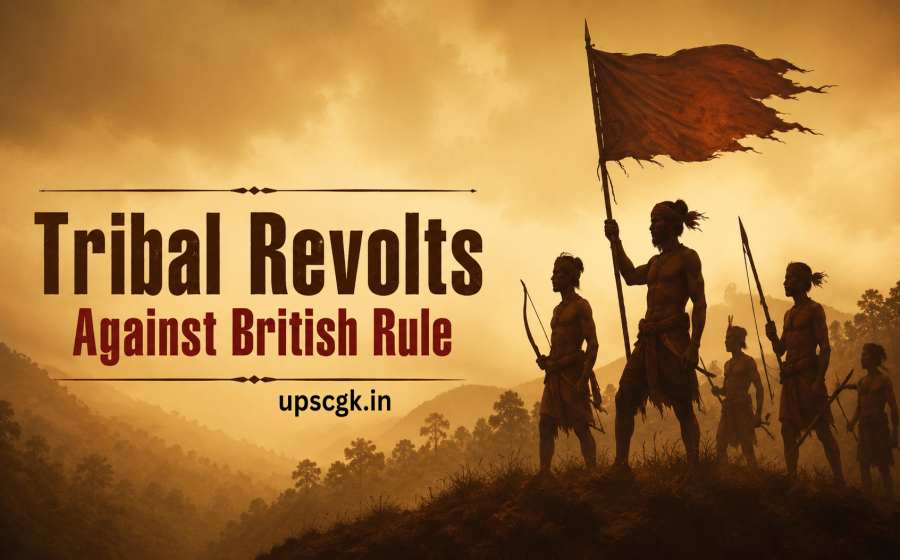
Tribal Revolts Against British Rule marked India’s early resistance to colonial rule. Learn their causes, key leaders, major uprisings and lasting impact.
Tribal Revolts Against British Rule
The tribal revolts against British rule were among the earliest organized movements of resistance against colonial exploitation in India. Long before the Revolt of 1857 and the rise of the Indian National Congress, tribal communities across different regions challenged British authority to protect their land, forests, traditions, and livelihoods. These uprisings reflected the determination of indigenous communities to preserve their identity and resist unjust policies imposed by the colonial administration.
Although many of these revolts were localized and lacked coordination, they significantly weakened British control in several regions and inspired future freedom movements.
Table of Contents
Background of Tribal Resistance
Before British rule, tribal communities enjoyed considerable autonomy over forests, hills, and agricultural lands. Their traditional way of life depended on hunting, shifting cultivation, forest produce, and community ownership of resources.
The arrival of the British East India Company disrupted this balance through new land revenue systems, forest regulations, and administrative interference. These changes deprived tribal people of their traditional rights and exposed them to exploitation by landlords, moneylenders, traders, and government officials.
As a result, several tribal communities organized armed resistance against British rule throughout the eighteenth and nineteenth centuries.
Major Causes of Tribal Revolts
1. Loss of Traditional Land Rights
The British introduced new land settlements that transferred tribal lands to zamindars, landlords, and private owners. Tribals who had cultivated these lands for generations suddenly became tenants or laborers.
2. Exploitation by Moneylenders
Moneylenders charged extremely high interest rates, forcing tribal families into debt. Many lost their lands due to unpaid loans.
3. Restrictive Forest Policies
British forest laws declared large forest areas as government property. Tribals were prohibited from collecting forest produce, grazing cattle, or practicing shifting cultivation, which directly affected their livelihood.
4. Heavy Taxation
Excessive land revenue and taxes increased the economic burden on tribal communities already facing poverty.
5. Cultural and Religious Interference
Colonial administrators and missionaries often interfered with tribal customs, traditions, and religious practices, creating resentment among indigenous populations.
6. Administrative Oppression
Corrupt officials, police harassment, forced labor, and discrimination intensified tribal dissatisfaction with British rule.
Important Tribal Revolts Against British Rule
1. Chuar Rebellion (1766–1809)
The Chuar Rebellion occurred in the Jungle Mahals of present-day West Bengal.
Causes
- High land revenue demands
- Loss of traditional rights
- Economic hardships
Features
- Led mainly by tribal chiefs and local zamindars.
- Guerrilla warfare was widely used.
- Continued intermittently for several decades.
Significance
It was one of the earliest tribal uprisings against British administration.
2. Bhil Revolt (1818–1831)
The Bhils of the Western Ghats and Central India revolted after British expansion into their territories.
Causes
- Loss of traditional authority
- Economic exploitation
- British administrative interference
Outcome
Although suppressed, the revolt forced the British to adopt conciliatory policies toward the Bhils.
3. Kol Uprising (1831–1832)
The Kol tribes of Chotanagpur (present-day Jharkhand) launched a violent rebellion against British rule.
Causes
- Transfer of tribal lands to outsiders
- Exploitation by moneylenders
- Oppressive revenue policies
Features
The rebels attacked police stations, government offices, and wealthy landlords.
Result
The British eventually crushed the uprising using military force.
4. Khond Revolt (1837–1856)
The Khonds of Odisha resisted British attempts to interfere with their traditional customs and administration.
Causes
- British interference in tribal governance
- Restriction of traditional practices
- Increased taxation
Importance
The revolt continued for nearly two decades, demonstrating sustained resistance against colonial authority.
5. Santhal Rebellion (1855–1856)
The Santhal Rebellion remains one of the largest tribal uprisings before the Revolt of 1857.
Leaders
- Sidhu Murmu
- Kanhu Murmu
- Chand Murmu
- Bhairav Murmu
Causes
- Exploitation by zamindars
- Oppression by moneylenders
- Heavy taxes
- Land alienation
Features
Nearly 50,000 Santhals participated in the rebellion. They established their own administration in several villages and openly challenged British authority.
Outcome
The British brutally suppressed the revolt, killing thousands of tribal people.
Significance
Following the uprising, the British created the Santhal Pargana district to address administrative concerns.
6. Munda Ulgulan (1899–1900)
The Munda rebellion, also called Ulgulan (The Great Tumult), was one of the most significant tribal movements.
Leader
Birsa Munda
Causes
- Land alienation
- Forced labor (Beth Begari)
- Exploitation by landlords
- Forest restrictions
Features
Birsa Munda inspired tribal communities through social reform and religious revival while calling for the establishment of tribal self-rule.
Outcome
Although Birsa Munda was arrested and died in prison in 1900, his movement influenced later land reforms.
Importance
The movement eventually contributed to the enactment of the Chotanagpur Tenancy Act (1908), which protected tribal land rights.
7. Rampa Rebellion (1922–1924)
The Rampa Rebellion took place in the forest regions of present-day Andhra Pradesh.
Leader
Alluri Sitarama Raju
Causes
- Restrictive forest laws
- Forced labor
- Colonial exploitation
Features
The rebels attacked police stations, captured weapons, and adopted guerrilla warfare.
Result
The British executed Alluri Sitarama Raju in 1924, but he became a legendary freedom fighter.
Common Features of Tribal Revolts
- Localized in nature
- Led by charismatic tribal leaders
- Primarily aimed at protecting land and forests
- Used guerrilla warfare due to difficult terrain
- Faced severe British military repression
- Motivated by economic, social, and cultural grievances
- Lacked coordination with other anti-colonial movements
Reasons for Their Failure
Several factors limited the success of tribal revolts:
- Absence of national-level unity
- Poor communication among tribal groups
- Inferior weapons compared to the British army
- Limited financial resources
- Lack of external political support
- Superior military strength of the British
Significance of Tribal Revolts
Despite being suppressed, tribal revolts played an important role in India’s anti-colonial struggle.
Their significance includes:
- They represented some of the earliest organized resistance to British rule.
- They highlighted the exploitative nature of colonial land and forest policies.
- They inspired later peasant and nationalist movements.
- They brought attention to tribal rights over forests and land.
- Some revolts led to administrative and legal reforms protecting tribal interests.
- They remain symbols of indigenous resistance, courage, and self-respect.
Summary
The tribal revolts against British rule occupy a significant place in India’s history of resistance against colonialism. Though these movements were regional and lacked national coordination, they reflected the deep dissatisfaction of indigenous communities with British exploitation. Leaders like Birsa Munda, Sidhu Murmu, Kanhu Murmu, and Alluri Sitarama Raju became enduring symbols of courage and sacrifice. Their struggles not only defended tribal identity and resources but also laid an early foundation for India’s larger freedom movement. Today, these revolts continue to remind us of the importance of protecting the rights, culture, and dignity of tribal communities while recognizing their invaluable contribution to India’s struggle for independence.
Also Check: History