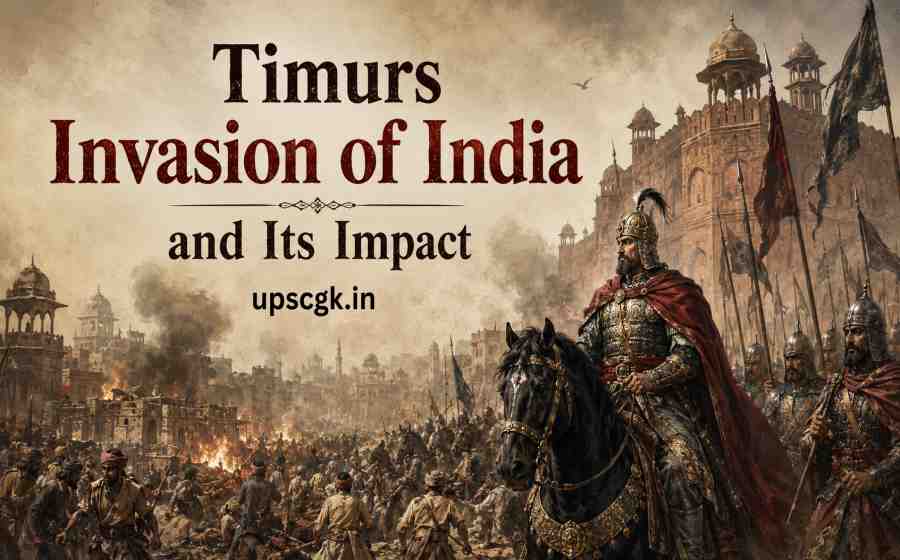
Explore Timurs Invasion of India (1398), its causes, major events, consequences and lasting impact on the Delhi Sultanate and Indian history.
Timurs Invasion of India
The invasion of India by Timur (Tamerlane) in 1398 CE remains one of the most devastating military campaigns in medieval Indian history. Timur, the ruler of the Timurid Empire in Central Asia, was a brilliant military strategist known for his ruthless conquests across Persia, Central Asia, and the Middle East. His invasion of India was motivated by wealth, religious justification, and political ambition. Although he stayed in India for only a short period, the destruction caused by his campaign weakened the Delhi Sultanate beyond recovery and changed the course of Indian history.
The invasion exposed the declining strength of the Tughlaq dynasty, led to widespread economic and social disruption, and paved the way for the rise of new regional kingdoms. It also indirectly contributed to the eventual establishment of the Mughal Empire over a century later.
Table of Contents
Background of Timur
Timur was born in 1336 CE near Samarkand in present-day Uzbekistan. He established a vast empire extending from Central Asia to parts of Persia, Iraq, and Syria. Claiming to be the successor of Genghis Khan’s military legacy, Timur became one of the greatest conquerors of the medieval world.
Although not a direct descendant of Genghis Khan, he strengthened his legitimacy through marriage alliances and military success. His empire became famous for its administrative efficiency, cultural patronage, and military discipline, but also for its extraordinary brutality during campaigns.
Reasons for Timur’s Invasion of India
Several factors motivated Timur to invade India.
1. Enormous Wealth of India
India was widely known for its prosperous cities, flourishing trade, and wealthy temples. The Delhi Sultanate possessed immense treasures accumulated through taxation and commerce. Timur viewed India as an ideal target for plunder.
2. Weakness of the Delhi Sultanate
During the reign of Nasir-ud-Din Mahmud Tughlaq, the Delhi Sultanate had become politically unstable. Provincial governors had gained autonomy, internal rebellions were frequent, and the central administration had lost its authority. Timur recognized this weakness and planned his invasion accordingly.
3. Religious Motivation
Timur justified his invasion as a campaign against non-Muslims and rulers whom he considered insufficiently committed to Islamic principles. Although religion was used as a justification, economic gain remained one of his primary objectives.
4. Expansion of His Empire
Like many medieval conquerors, Timur sought to enhance his prestige by extending his influence into new territories and demonstrating his military supremacy.
Course of the Invasion
Timur crossed the Indus River in September 1398 and rapidly advanced through Punjab. Several towns and settlements were captured and devastated along his route.
His army defeated local resistance with remarkable speed due to superior cavalry tactics and disciplined military organization.
As Timur approached Delhi, Sultan Mahmud Tughlaq assembled an army supported by war elephants. However, Timur devised effective strategies to neutralize the elephants, including frightening them with camels carrying burning materials.
The decisive Battle of Delhi took place in December 1398, resulting in a crushing defeat for the Delhi Sultanate. Timur entered Delhi victorious shortly afterward.
Massacre and Plunder of Delhi
The capture of Delhi was followed by one of the darkest episodes in Indian history. Timur ordered widespread massacres after unrest broke out in the city. Contemporary accounts describe the large-scale killing of civilians, destruction of markets, and looting of homes.
Gold, silver, jewels, precious textiles, skilled artisans, and valuable manuscripts were carried away to Samarkand. Many craftsmen and architects were forcibly taken to Central Asia, where they contributed to Timur’s ambitious building projects.
The city, once one of the richest capitals in Asia, was left devastated.
Immediate Consequences
Collapse of Central Authority
The Delhi Sultanate suffered a severe blow from which it never fully recovered. Administrative institutions weakened considerably, and the authority of the Tughlaq rulers declined rapidly.
Economic Destruction
The invasion caused extensive damage to agriculture, trade, and urban markets. Commercial activity declined, tax collection became difficult, and many productive regions were abandoned.
Population Decline
Thousands of people lost their lives during battles and massacres. Many survivors fled the affected regions, leading to depopulation in several areas around Delhi.
Spread of Famine and Disease
The destruction of crops, food supplies, and civic infrastructure created conditions for famine and epidemics. The suffering continued long after Timur had returned to Central Asia.
Long-Term Impact
End of the Tughlaq Dynasty
Although the Tughlaq dynasty continued briefly after the invasion, its authority had been irreparably damaged. The dynasty soon disappeared from the political scene.
Rise of Regional Kingdoms
As the Delhi Sultanate weakened, regional powers such as Gujarat, Malwa, Jaunpur, Bengal, and the Deccan kingdoms became increasingly independent and influential.
Establishment of the Sayyid Dynasty
In 1414 CE, the Sayyid dynasty came to power in Delhi. Its founder, Khizr Khan, claimed legitimacy partly through his association with Timur.
Influence on the Mughal Empire
Timur’s invasion created a historical link between Central Asia and northern India. More importantly, Babur, the founder of the Mughal Empire in 1526 CE, was a direct descendant of Timur. Babur proudly traced his ancestry to Timur, strengthening his claim over India.
Psychological Impact
The invasion shattered the prestige of the Delhi Sultanate. It demonstrated that even India’s strongest medieval kingdom could be defeated by an organized foreign army, encouraging future invasions from Central Asia.
Historical Significance
Historians generally view Timur’s invasion as a turning point in medieval Indian history. Unlike earlier rulers who aimed to establish long-term administration, Timur sought immediate wealth and military glory. His campaign was essentially a large-scale raid rather than an attempt to govern India.
Despite its short duration, the invasion accelerated the political fragmentation of northern India. The weakening of centralized authority eventually allowed new dynasties and regional states to emerge.
Timur’s campaign also illustrates the vulnerability of politically divided states to external aggression. The inability of the Delhi Sultanate to present a united military response highlighted the dangers of administrative decay and internal conflict.
Summary
Timur’s invasion of India in 1398 CE was one of the most destructive events in medieval Indian history. Driven by the desire for wealth, political prestige, and religious justification, Timur inflicted massive destruction upon Delhi and surrounding regions. The invasion weakened the Delhi Sultanate beyond recovery, devastated the economy, and accelerated the rise of independent regional kingdoms.
Although Timur returned to Central Asia shortly after his victory, the consequences of his invasion continued to shape Indian politics for decades. The collapse of Tughlaq authority, the emergence of new dynasties, and the later establishment of the Mughal Empire all bear the imprint of this historic event.
Also Check: History