Explore the Round Table Conferences, their key debates, major leaders, outcomes and lasting role in shaping India’s constitutional and political future.
Round Table Conferences
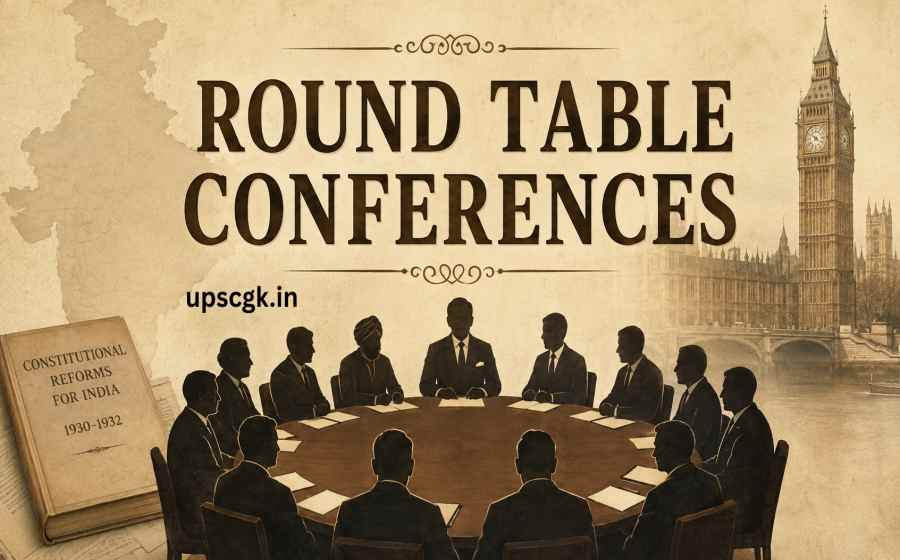
The Round Table Conferences were a series of three important constitutional conferences held in London between 1930 and 1932. They were organised by the British government to discuss the future constitutional structure of India and to find a political solution to the growing demand for self-government.
These conferences came at a critical stage of the Indian freedom struggle. The Indian National Congress had intensified its demand for independence, while various political and social groups raised questions about representation, minority rights, federalism and the future relationship between British India and the princely states.
Although the Round Table Conferences did not produce an immediate political settlement, they played an important role in the constitutional developments that eventually led to the Government of India Act, 1935.
Table of Contents
Background of the Round Table Conferences
The demand for constitutional reforms in India had been increasing steadily during the early twentieth century. The Government of India Act, 1919 had introduced the system of dyarchy in the provinces, but Indian political leaders considered these reforms inadequate.
Another major development was the appointment of the Simon Commission in 1927. The commission was strongly opposed by Indian political organisations because it did not include a single Indian member. The widespread protests against the Simon Commission demonstrated the growing strength of Indian nationalism.
In response to political pressure, the British government decided to hold discussions with representatives of different Indian communities and political groups. The aim was to consider a new constitutional framework for India.
The Round Table Conferences were therefore organised in London under the British government. Representatives of British India, princely states, minority communities and other interest groups were invited to participate.
The central issues included:
- The future constitutional structure of India.
- The establishment of a federal system.
- Provincial autonomy.
- Representation of minorities.
- The position of the princely states.
- The distribution of powers between the central and provincial governments.
- The possibility of granting India greater self-government.
First Round Table Conference, 1930–31
The First Round Table Conference began in London in November 1930 and continued into early 1931. It was attended by representatives of the British government, Indian princely states, minority communities and several political groups.
However, the most important political organisation in British India, the Indian National Congress, did not participate. At that time, the Congress was involved in the Civil Disobedience Movement, which had been launched under the leadership of Mahatma Gandhi.
The absence of the Congress significantly weakened the representative character of the conference. Nevertheless, an important area of agreement emerged regarding the idea of an All-India Federation.
The proposed federation was expected to include both:
- British Indian provinces, and
- Indian princely states.
The question of how such a federation would function, however, remained unresolved. There were also major disagreements regarding minority representation and constitutional safeguards.
The First Round Table Conference ended without a final settlement. However, the discussions created the basis for further negotiations.
Gandhi-Irwin Pact and the Road to the Second Conference
After the First Round Table Conference, efforts were made to bring the Congress into constitutional negotiations. This resulted in the Gandhi-Irwin Pact, signed in March 1931.
Under the agreement, the Congress agreed to suspend the Civil Disobedience Movement, while the government agreed to release many political prisoners and make certain concessions.
One of the most important outcomes of the pact was that Mahatma Gandhi agreed to represent the Indian National Congress at the Second Round Table Conference.
This created hope that the next conference might achieve a broader political settlement.
Second Round Table Conference, 1931
The Second Round Table Conference was held in London from September to December 1931. Mahatma Gandhi attended as the sole representative of the Indian National Congress.
The conference witnessed intense debates on the constitutional future of India. Gandhi argued for a united India and opposed excessive political divisions based on religious and social identities.
The most difficult issue was the question of minority representation. Different communities demanded constitutional safeguards and separate political representation.
The debate became particularly important in relation to the representation of the Depressed Classes, later known as the Scheduled Castes. Dr. B. R. Ambedkar argued for separate political safeguards to ensure that historically disadvantaged communities could elect their own representatives.
Gandhi, however, opposed separate electorates for the Depressed Classes, believing that such arrangements would further divide Hindu society.
The conference failed to achieve agreement on these important issues. There were also disagreements concerning:
- The powers of the proposed central government.
- The structure of the federation.
- Representation of minorities.
- The future of responsible government in India.
As a result, the Second Round Table Conference ended without producing a constitutional settlement.
After returning to India, Gandhi resumed political opposition to British rule, and the Civil Disobedience Movement entered another phase.
Communal Award and the Poona Pact
The disagreements over minority representation continued after the Second Round Table Conference.
In 1932, British Prime Minister Ramsay MacDonald announced the Communal Award, which provided separate electorates for several communities, including the Depressed Classes.
Mahatma Gandhi strongly opposed the proposal of separate electorates for the Depressed Classes and began a fast while imprisoned in Yerwada Jail.
This led to negotiations between Gandhi and Dr. B. R. Ambedkar. The result was the Poona Pact of 1932.
Under the agreement, separate electorates for the Depressed Classes were abandoned. Instead, a system of reserved seats within joint electorates was accepted.
The Poona Pact became an important development in the political representation of historically disadvantaged sections of Indian society.
Third Round Table Conference, 1932
The Third Round Table Conference was held in London in late 1932.
By this time, the political atmosphere had changed considerably. The Indian National Congress did not participate, and the conference lacked the involvement of major nationalist representatives.
The discussions mainly focused on finalising the constitutional proposals that had emerged from the earlier conferences.
Although the Third Round Table Conference was less significant politically than the previous two, it contributed to the preparation of the British government’s constitutional proposals for India.
These discussions were later reflected in the White Paper on Indian Constitutional Reforms, which eventually became the basis for further parliamentary discussions in Britain.
Major Outcomes of the Round Table Conferences
The Round Table Conferences did not achieve an agreement between the British government and Indian nationalist leaders. However, they had several important consequences.
1. Idea of an All-India Federation
One of the major constitutional ideas discussed during the conferences was the establishment of an All-India Federation consisting of British Indian provinces and princely states.
Although the proposed federation did not fully materialise as originally planned, the idea influenced later constitutional reforms.
2. Provincial Autonomy
The discussions strengthened the demand for greater powers for provincial governments. This idea was later incorporated into the Government of India Act, 1935.
3. Minority Representation
The conferences highlighted the complexity of India’s social and political diversity. Questions concerning separate electorates, reserved seats and political safeguards became central to constitutional discussions.
4. Government of India Act, 1935
Perhaps the most significant constitutional consequence of the Round Table Conferences was their influence on the Government of India Act, 1935.
The Act introduced:
- Provincial autonomy.
- A proposed All-India Federation.
- Greater participation of Indians in provincial administration.
- A detailed federal structure, although the federal scheme was never fully implemented.
Thus, many constitutional ideas discussed during the Round Table Conferences found expression in the 1935 Act.
Why Did the Round Table Conferences Fail?
The conferences failed to produce a final political settlement for several reasons.
First, there was a fundamental difference between the British government’s approach and the demands of Indian nationalists. While Indian leaders increasingly demanded self-government and freedom, the British government remained focused on maintaining imperial control.
Second, the absence of the Congress from the First and Third Conferences weakened their representative nature.
Third, disagreements over minority representation created deep political divisions. Different communities had different concerns regarding political safeguards and representation.
Finally, the British government’s constitutional proposals did not satisfy the larger nationalist demand for complete independence.
Significance of the Round Table Conferences
The Round Table Conferences occupy an important place in the history of India’s constitutional and political development. They demonstrated that the Indian question could no longer be addressed without involving a wide range of Indian political and social groups.
They also brought important constitutional issues into public discussion, including federalism, provincial autonomy, minority rights and representative government.
For the Indian national movement, the conferences revealed the limitations of constitutional negotiations under colonial rule. At the same time, they helped shape the constitutional framework that influenced later developments.
The discussions eventually contributed to the Government of India Act, 1935, which became an important constitutional milestone before independence.
Summary
The Round Table Conferences of 1930–32 were a major attempt by the British government to determine India’s constitutional future through negotiation. While the conferences failed to produce an agreement acceptable to all major political groups, they generated important debates on federalism, provincial autonomy and minority representation.
Their greatest legacy was their influence on the Government of India Act, 1935 and the broader constitutional evolution of India. The Round Table Conferences are especially important because they connect the Civil Disobedience Movement, Gandhi-Irwin Pact, Communal Award, Poona Pact and the constitutional reforms of 1935 into one significant phase of India’s freedom struggle.
Also Check: History