
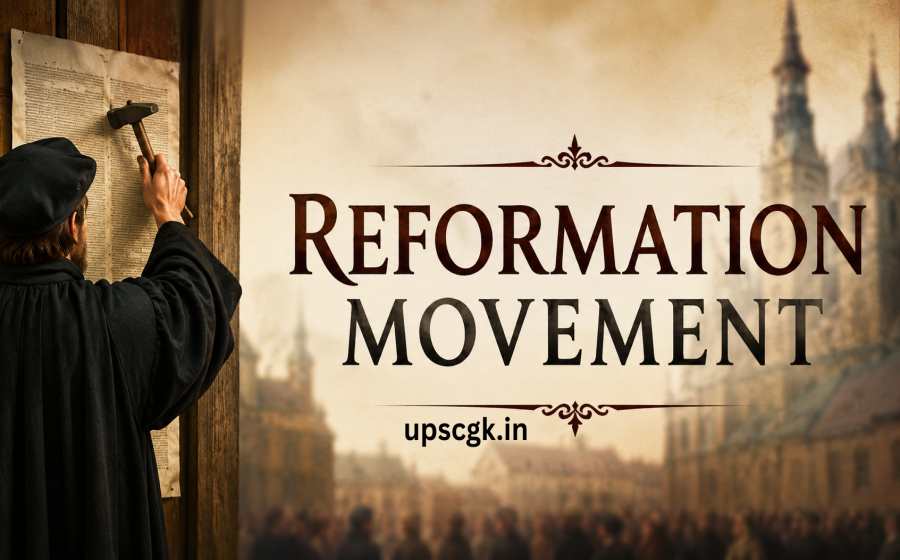
Learn about the Reformation Movement, Martin Luther’s role, causes, major events and its impact on religion, politics, education and European society.
Reformation Movement
The Reformation Movement was one of the most significant religious and social transformations in European history. Beginning in the early sixteenth century, it challenged the authority of the Roman Catholic Church and led to the emergence of Protestant Christianity. At the center of this movement stood Martin Luther, a German monk, theologian, and scholar whose criticism of Church practices sparked a revolution that reshaped Europe.
The Reformation not only changed religious beliefs but also influenced politics, education, culture, and individual freedom. It weakened the monopoly of the Catholic Church and encouraged people to think independently about faith and religious authority.
Table of Contents
Background of the Reformation
Before the Reformation, the Roman Catholic Church was the most powerful religious institution in Europe. It exercised enormous influence over both spiritual and political matters. Popes often played important roles in government affairs, and Church leaders possessed great wealth and power.
However, by the fifteenth and sixteenth centuries, many people had become dissatisfied with the Church. Several issues contributed to this dissatisfaction:
- Corruption among some Church officials.
- Sale of religious offices and positions.
- Luxurious lifestyles of clergy members.
- Heavy taxation imposed by the Church.
- Sale of indulgences, which were certificates claimed to reduce punishment for sins.
Many scholars and reformers believed that the Church had moved away from the teachings of Jesus Christ and the Bible. The Renaissance had also encouraged critical thinking, education, and the study of original religious texts, creating conditions favorable for reform.
Who Was Martin Luther?
Martin Luther was born on November 10, 1483, in Eisleben, Germany. He initially studied law but later became a monk and devoted himself to religious studies.
While reading the Bible, Luther became convinced that salvation could only be achieved through faith in God rather than through good works or the purchase of indulgences. He believed that the Church had distorted Christian teachings and needed reform.
As a professor of theology at the University of Wittenberg, Luther began openly criticizing certain Church practices and promoting a return to biblical teachings.
The Ninety-Five Theses
The event that marked the beginning of the Reformation occurred on October 31, 1517. Luther published his famous Ninety-Five Theses, a list of arguments criticizing the sale of indulgences and other Church abuses.
According to tradition, he posted these theses on the door of the Castle Church in Wittenberg. His intention was to start a scholarly debate, but the document quickly spread throughout Europe thanks to the recently invented printing press.
The Ninety-Five Theses challenged the authority of Church officials and questioned practices that Luther believed were not supported by scripture.
Main Teachings of Martin Luther
Luther introduced several important ideas that became the foundation of Protestant Christianity.
1. Salvation by Faith Alone
Luther argued that people are saved through faith in God rather than through good deeds, Church rituals, or purchased indulgences.
2. Authority of the Bible
He believed that the Bible was the ultimate source of religious authority, not Church traditions or papal decrees.
3. Priesthood of All Believers
Luther taught that every Christian could communicate directly with God without requiring a priest as an intermediary.
4. Simpler Religious Practices
He advocated reducing elaborate ceremonies and focusing on genuine faith and biblical teachings.
Conflict with the Catholic Church
Luther’s teachings attracted many followers but also provoked strong opposition from Church authorities. In 1520, Pope Leo X condemned Luther’s views and demanded that he withdraw them. Luther refused and publicly burned the papal document sent against him.
In 1521, he was summoned before the Diet of Worms, an assembly of political and religious leaders in the Holy Roman Empire. When ordered to renounce his teachings, Luther famously refused, insisting that he could not abandon beliefs supported by scripture and reason. As a result, he was declared an outlaw. However, several German princes protected him, allowing him to continue his work.
Translation of the Bible
One of Luther’s most important contributions was translating the Bible from Latin into German.
Before this, most ordinary people could not read the Bible because it was available mainly in Latin. Luther’s translation made scripture accessible to common people and encouraged literacy and education.
His work also helped standardize the German language and influenced literature and culture throughout Germany.
Spread of Protestantism
Luther’s ideas spread rapidly across Europe. Many rulers and communities supported reform because they wanted greater religious independence from Rome.
Different Protestant denominations emerged, including:
- Lutheranism
- Calvinism
- Anglicanism
- Presbyterianism
These groups shared certain beliefs but differed in their interpretations of Christian teachings.
The invention of the printing press played a crucial role in spreading reformist ideas, allowing books, pamphlets, and translations of the Bible to reach a large audience.
Impact of the Reformation
Religious Impact
The Reformation ended the religious unity of Western Europe and led to the rise of Protestant churches alongside the Catholic Church.
Political Impact
Many rulers gained greater control over religious affairs within their territories. The authority of the Pope was reduced in several regions.
Educational Impact
The movement encouraged literacy because people were urged to read the Bible themselves. Schools and universities expanded across Europe.
Social Impact
The Reformation promoted individual responsibility and encouraged people to question established authority.
Cultural Impact
Religious literature flourished, and local languages gained importance as religious texts were translated from Latin into vernacular languages.
Catholic Counter Reformation
In response to the Protestant challenge, the Catholic Church launched the Counter-Reformation. This movement aimed to eliminate corruption, improve discipline among clergy, and strengthen Catholic teachings.
Important reforms were introduced through the Council of Trent (1545-1563), which clarified Catholic doctrine and improved Church administration. The Counter-Reformation helped revive Catholicism and prevent further losses to Protestantism.
Summary
The Reformation Movement was a turning point in world history. Led by Martin Luther, it challenged the authority of the Catholic Church and transformed Christianity forever. By promoting faith, scripture, and individual religious responsibility, Luther inspired a movement that reshaped religion, politics, education, and society across Europe. The effects of the Reformation continue to influence the modern world, making it one of the most important events in human history.
Also Check: History