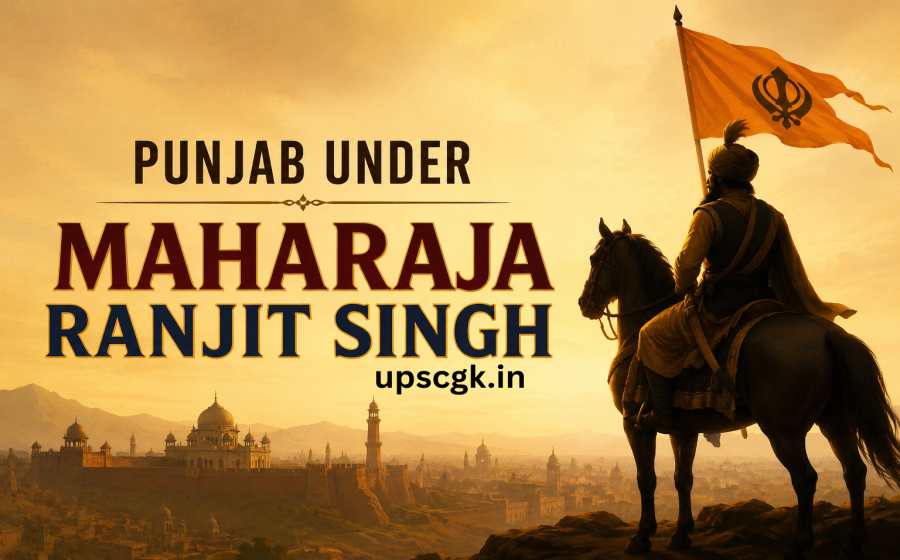
Explore Punjab Under Maharaja Ranjit Singh, the rise of the Sikh Empire, its administration, military reforms, diplomacy and historical significance.
Punjab Under Maharaja Ranjit Singh
Punjab under Maharaja Ranjit Singh represents one of the most remarkable chapters in Indian history. Known as the “Lion of Punjab,” Maharaja Ranjit Singh transformed a region divided among various Sikh misls (confederacies) into a powerful and united Sikh Empire. His reign from 1801 to 1839 brought political stability, military strength, economic prosperity, and religious harmony to Punjab.
At a time when the Mughal Empire was declining and the British East India Company was steadily expanding its influence across India, Ranjit Singh successfully established an independent kingdom that resisted foreign domination. His visionary leadership, modern military reforms, and inclusive administration made Punjab one of the strongest states in the Indian subcontinent during the early nineteenth century.
Table of Contents
Background: Rise of Maharaja Ranjit Singh
Ranjit Singh was born in 1780 into the Sukerchakia Misl, one of the twelve major Sikh confederacies. He became the chief of the misl at a young age after the death of his father, Maha Singh.
By displaying exceptional military skill and diplomatic wisdom, he gradually united the Sikh misls under his leadership. In 1799, he captured Lahore, and in 1801, he proclaimed himself the Maharaja of the Sikh Empire, marking the beginning of a centralized and independent Sikh kingdom. His coronation symbolized the political unification of Punjab and the emergence of a powerful regional state.
Expansion of the Sikh Empire
Maharaja Ranjit Singh expanded his kingdom through both military campaigns and diplomatic alliances.
His major territorial achievements included:
- Capture of Lahore (1799)
- Annexation of Amritsar (1802)
- Conquest of Multan (1818)
- Capture of Kashmir (1819)
- Annexation of Peshawar (1834)
- Control over parts of Jammu, Hazara, and the North-West Frontier
At its peak, the Sikh Empire stretched from the Khyber Pass in the west to the Sutlej River in the east, making it one of the largest and most powerful Indian kingdoms of the time.
Treaty of Amritsar (1809)
One of the most significant diplomatic achievements during Ranjit Singh’s reign was the Treaty of Amritsar signed with the British East India Company in 1809.
Key Features
- The British recognized Ranjit Singh as the ruler of Punjab west of the Sutlej River.
- Ranjit Singh agreed not to expand east of the Sutlej.
- The treaty established peaceful relations between the Sikh Empire and the British for several decades.
This agreement allowed Maharaja Ranjit Singh to focus on expanding his empire toward the northwest rather than confronting the British directly.
Military Reforms
One of the greatest strengths of Maharaja Ranjit Singh was his modern and disciplined army.
Modernization of the Army
He recruited several European officers, especially from France and Italy, to modernize his forces.
Notable officers included:
- Jean-François Allard
- Jean-Baptiste Ventura
- Paolo Avitabile
- Claude Auguste Court
These officers trained Sikh soldiers in modern European military techniques.
Features of the Sikh Army
- Well-organized infantry
- Strong cavalry
- Powerful artillery
- Regular payment of soldiers
- Strict discipline
- Modern weapons and ammunition
The Fauj-i-Khas, an elite military unit trained on European lines, became one of the finest armies in Asia.
Efficient Administration
Maharaja Ranjit Singh established an efficient and centralized administration.
Provincial Administration
The empire was divided into several provinces governed by appointed officials responsible for:
- Revenue collection
- Law and order
- Military administration
- Judicial functions
Local officials ensured smooth governance while remaining accountable to the Maharaja.
Revenue System
Agriculture formed the backbone of Punjab’s economy.
The government collected land revenue while ensuring that taxation remained moderate. Farmers generally enjoyed peace and security, leading to increased agricultural productivity.
Religious Policy
One of the most admired aspects of Maharaja Ranjit Singh’s rule was his policy of religious tolerance.
Although he was a devout Sikh, he respected all religions equally.
His administration included:
- Hindus
- Sikhs
- Muslims
- Europeans
He donated generously to:
- Sikh Gurdwaras
- Hindu temples
- Muslim mosques
He even prohibited the destruction of religious places and encouraged communal harmony.
This inclusive approach earned him the respect of people from different faiths.
Economic Prosperity
Punjab witnessed remarkable economic growth during Ranjit Singh’s reign.
Agriculture
Peaceful conditions encouraged cultivation.
The government promoted:
- Irrigation
- Farming
- Land development
Trade
Punjab became an important center for trade between:
- Central Asia
- Afghanistan
- Kashmir
- Northern India
The state maintained secure trade routes, boosting commerce and revenue.
Industry
Local industries flourished, including:
- Shawl weaving
- Metalwork
- Arms manufacturing
- Handicrafts
Lahore and Amritsar emerged as prosperous commercial centers.
Patronage of Art and Culture
Maharaja Ranjit Singh actively promoted art, architecture, and literature.
He restored many historical monuments and encouraged the construction of:
- Gurudwaras
- Forts
- Gardens
- Palaces
One of his most famous contributions was the beautification of the Golden Temple in Amritsar by covering its upper structure with gold, giving it the magnificent appearance it retains today.
His court attracted scholars, artists, musicians, and craftsmen from different parts of Asia.
Foreign Policy
Ranjit Singh followed a balanced foreign policy.
He maintained friendly relations with:
- British East India Company
- Afghanistan
- Nepal
- Central Asian rulers
Rather than engaging in unnecessary wars with the British, he focused on strengthening Punjab internally while securing the empire’s western frontiers against Afghan invasions.
His diplomatic skill prevented large-scale conflicts during his lifetime.
Death and Decline of the Sikh Empire
Maharaja Ranjit Singh died in 1839.
After his death:
- Weak successors failed to maintain unity.
- Court politics and internal rivalries increased.
- Military discipline declined.
- Power struggles weakened the administration.
The British East India Company exploited these weaknesses.
The empire ultimately collapsed after the First Anglo-Sikh War (1845–46) and the Second Anglo-Sikh War (1848–49), leading to the annexation of Punjab by the British in 1849.
Historical Significance
Punjab under Maharaja Ranjit Singh occupies a unique place in Indian history for several reasons:
- Created a strong and united Sikh Empire.
- Successfully resisted British expansion during his lifetime.
- Introduced modern military reforms.
- Promoted religious tolerance and secular governance.
- Strengthened agriculture, trade, and industry.
- Preserved stability in North-West India for nearly four decades.
- Demonstrated effective diplomacy alongside military strength.
His reign is often regarded as the last great example of an independent Indian kingdom before British rule spread across the entire subcontinent.
Summary
Punjab under Maharaja Ranjit Singh was a period of political unity, military excellence, economic prosperity, and religious harmony. Through his exceptional leadership, he transformed a fragmented region into one of the most powerful empires in India. His ability to combine modern military reforms with efficient administration and inclusive governance made him one of the greatest rulers in Indian history. Although the Sikh Empire declined after his death, Maharaja Ranjit Singh’s legacy continues to inspire historians.
Also Check: History