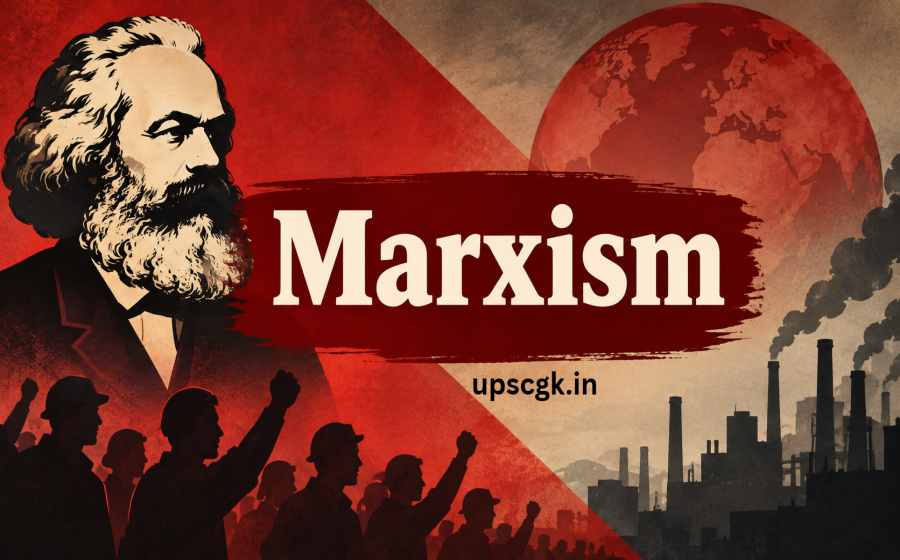
Explore Marxism, its core ideas, class struggle and historical materialism and understand how Marx’s theory explains society, capitalism and social change.
Marxism
Marxism is one of the most influential political, social and economic theories of the modern era. Developed primarily through the works of Karl Marx and Friedrich Engels, it seeks to explain how societies are organized, why social inequalities arise, and how economic structures influence political and social life. Marx’s writings combined philosophical analysis, political theory and an extensive study of capitalism. Historical materialism became a central part of his approach to understanding social development.
Marxism is not limited to an economic theory. It also provides a framework for examining social classes, political institutions, ideology, labour, property and historical change. Although Marxism has been interpreted in many different ways by later thinkers and movements, several concepts remain central to the tradition, particularly class struggle, historical materialism, exploitation, surplus value, alienation and the critique of capitalism.
Table of Contents
What is Marxism?
Marxism refers to the body of ideas associated with Karl Marx and Friedrich Engels and the many intellectual traditions that developed from their writings. Marx was born in 1818 and died in 1883, while Engels was an important collaborator and contributor to the development and dissemination of Marxist thought.
At its core, Marxism examines society through the relationship between economic organization and social relations. Marx argued that the way people produce and distribute material goods has a major influence on the structure of society. Different economic systems create different relationships between social groups and different forms of class organization.
Marx’s analysis of capitalism focused particularly on wage labour, private ownership of the means of production, capital accumulation and the relationship between workers and capitalists.
Core Ideas of Marxism
1. Material Conditions and Economic Life
A central feature of Marxist thought is the importance given to material conditions. Marx did not view political and social institutions as completely independent of the economic organization of society.
Production requires resources, technology, labour and social arrangements governing ownership and control. These relationships influence the wider organization of society. This approach challenged explanations of history that treated ideas alone as the primary force behind social change.
2. Class Division
Marxism views class as an important feature of societies in which productive resources are unequally controlled. A class is not simply a group of people with similar incomes. In Marx’s analysis, classes are fundamentally connected to their relationship with the process of production.
Under capitalism, the bourgeoisie are associated with ownership and control of the means of production, while the proletariat consists primarily of wage workers who sell their labour power. The relationship between these groups is central to Marx’s analysis of capitalism.
3. Exploitation and Surplus Value
Marx’s critique of capitalism includes the concept of exploitation. Workers sell their labour power in exchange for wages, while the goods and services produced through labour can generate value beyond what workers receive as wages.
Marx’s theory of surplus value attempts to explain how capitalist profit is connected to the production process and the relationship between labour and capital. The theory became an important part of his analysis of capitalist economic relations.
4. Alienation
Another important concept is alienation, particularly in Marx’s early writings. Alienation describes a situation in which workers become separated from important aspects of their productive activity and human potential.
In capitalist production, Marx associated alienation with the organization of labour and the social relationships surrounding production. His analysis was concerned not simply with working conditions but also with how particular economic arrangements can shape people’s relationship with their work, products and other members of society.
Class Struggle
Class struggle is one of the best-known concepts associated with Marxism. Marx and Engels argued that conflicts between classes have played an important role in historical development.
Different classes can have conflicting interests because they occupy different positions within the system of production. In capitalism, for example, capitalists seek to organize production and accumulate capital, while workers depend on wages for their livelihood. This creates a structural tension between capital and labour.
Marx’s understanding of class struggle is broader than open revolution or violent conflict. Competition over wages, working conditions, working hours, ownership, political influence and control over production can all be connected to class relations.
Class consciousness is also significant. Marxist thought considers the possibility that workers may increasingly recognize common interests and develop collective political organization. Such developments were viewed as important to the transformation of class relations.
Historical Materialism
Historical materialism is Marx’s approach to explaining historical development through material and economic conditions. It does not mean that economics mechanically determines every event. Rather, it emphasizes the importance of production, economic organization, social relations and conflicts in understanding how societies change.
According to this approach, societies develop particular modes of production, combining productive forces such as technology, labour and productive knowledge with social relations concerning ownership and production. Changes within these relationships can contribute to wider social transformation.
Historical materialism therefore asks questions such as:
- How is production organized?
- Who controls productive resources?
- Who performs productive labour?
- How are goods and wealth distributed?
- What social classes emerge from these arrangements?
- What contradictions develop within the economic system?
These questions allow historical change to be examined through the material organization of society rather than through political events alone.
Base and Superstructure
A frequently used framework for explaining Marxist historical analysis is the distinction between base and superstructure.
The economic base refers broadly to the productive organization and social relations surrounding economic life. The superstructure encompasses political, legal, cultural and ideological institutions and practices.
Marx and Engels emphasized connections between economic organization and wider social institutions. However, the relationship should not simply be understood as a one-way mechanical process. Later Marxist thinkers have debated extensively how economic, political, cultural and ideological factors influence one another.
Marxism and Capitalism
Capitalism was the principal economic system examined by Marx in his mature economic writings. He studied its mechanisms, including wage labour, commodity production, private ownership, competition and capital accumulation.
Marx argued that capitalism had transformed production on a vast scale but also created significant social contradictions. The capitalist relationship between those who own productive assets and those who depend primarily on wage labour became a central element of his analysis.
His critique was therefore not simply a rejection of industrial development or technological progress. Instead, Marx focused strongly on the social relations through which production and technological development were organized.
Marxism, Ideology and the State
Marxist analysis also considers the role of political institutions and ideology. Ideology can help explain why existing social arrangements may appear natural, normal or inevitable even when they benefit particular groups.
Marx and Engels connected dominant ideas with the material and social conditions in which those ideas develop. Later interpretations have explored how law, political institutions, culture and other forms of social consciousness can contribute to the stability of class-divided societies.
Marx also developed a critical analysis of the modern state and its relationship with economic and social structures. However, Marx did not provide one simple, fully developed theory of the state, and interpretations of his political writings vary considerably.
Marxism and Social Change
For Marx, social change emerges from contradictions within existing forms of social organization. When productive forces develop in ways that conflict with established social relations, pressures for transformation can arise.
Historical materialism therefore treats social systems as historically changing rather than permanent. Feudalism, capitalism and other forms of social organization can be studied as historically specific arrangements rather than as unchanging features of human society.
Marx and Engels associated capitalism with the development of conditions that could eventually produce major social transformation. Marx discussed the possibility of a transition toward a classless society, although he deliberately provided limited detail about a precise institutional blueprint for a future communist society.
Major Contributions of Marxism
Marxism has had a significant influence on political theory, sociology, economics, history and social criticism. Its major contributions include:
- Highlighting the importance of economic structures in understanding society.
- Providing a systematic analysis of social class and class conflict.
- Examining exploitation and the relationship between labour and capital.
- Developing historical materialism as an approach to social and historical change.
- Drawing attention to the relationship between economic power and political institutions.
- Offering concepts such as alienation, ideology and surplus value for analysing modern society.
- Encouraging the study of inequality as a structural rather than purely individual problem.
At the same time, Marxist theories have generated extensive debate. Critics have questioned aspects of Marx’s predictions, the degree to which economic factors determine political and cultural developments, and whether class remains the primary basis for explaining modern social inequality. Different Marxist traditions have also developed substantially different interpretations of Marx’s original ideas.
Summary
Marxism is a broad and influential tradition of political, social and economic thought centered on the study of material conditions, production, class relations and historical change. Class struggle explains the conflict of interests that can arise between groups occupying different positions in the productive system, while historical materialism provides a framework for understanding how changes in production and social relations contribute to broader historical transformations.
Marx’s analysis of capitalism, labour, exploitation, alienation and ideology continues to influence debates about economic inequality, political power and social organization. Although Marxism has been interpreted and developed in many different directions, its central questions about who controls productive resources, how wealth is produced and distributed, and how economic relationships shape society remain important subjects in political and social theory.
Also Check: Political Science