Allahabad High Court Hijab Ruling examines religious freedom, Article 25, school uniforms, essential religious practices and institutional discipline.
Allahabad High Court Hijab Ruling
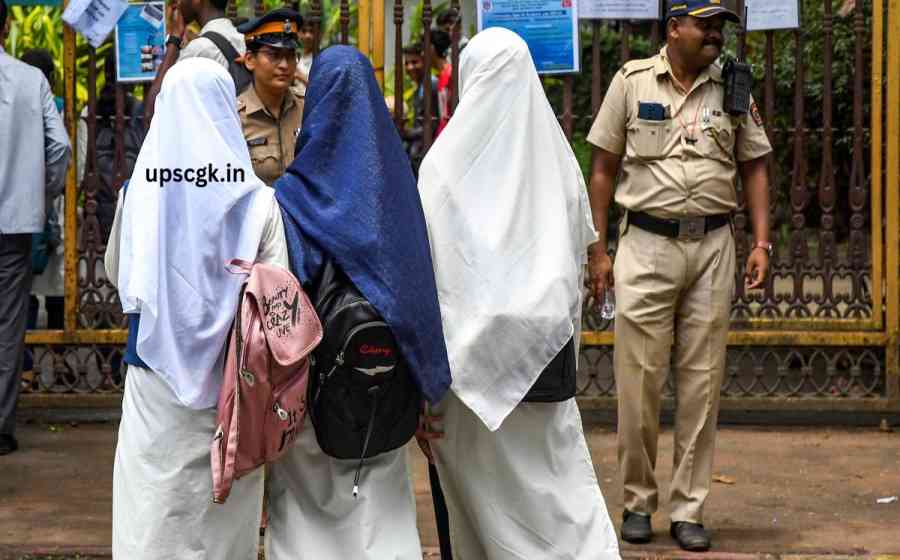
The Allahabad High Court’s recent decision in Sukaina Rizvi v. State of U.P. and Others (2026) has brought the debate over religious freedom, school uniforms and institutional discipline back into focus. The case involved a minor student of Tagore Public School in Attarsuiya, Prayagraj, who sought permission to wear a headscarf along with the prescribed school uniform.
A Division Bench comprising Justice J.J. Munir and Justice Indrajeet Shukla dismissed the petition. The judgment, delivered on August 21, 2026, held that the student had not placed sufficient material before the Court to establish that wearing a headscarf inside the classroom was an essential religious practice protected under Article 25 of the Constitution.
Table of Contents
What Was the Dispute?
The student, Sukaina Rizvi, had studied at Tagore Public School from Class VI to Class X and stated that she had been permitted to wear a headscarf during those years. After completing Class X, she sought admission to Class XI and wanted to continue wearing the headscarf along with the school’s prescribed uniform.
According to reports on the judgment, the school treated the additional headscarf as inconsistent with its uniform policy. The student approached the Allahabad High Court through her mother, seeking directions that would allow her to continue wearing it. The Court ultimately declined to interfere with the school’s uniform policy.
Article 25 and Freedom of Religion
Article 25 of the Constitution guarantees freedom of conscience and the right to freely profess, practise and propagate religion. However, this freedom is not absolute. It is subject to public order, morality and health, as well as other provisions of Part III of the Constitution.
The dispute therefore required the Court to balance an individual’s religious freedom with the authority of an educational institution to establish rules for its students.
The Court’s reasoning highlights an important constitutional distinction: the existence of a religious belief does not automatically mean that every practice associated with that belief receives the same level of constitutional protection.
The Essential Religious Practice Test
One of the central issues in the case was the Essential Religious Practice (ERP) test.
Under this judicial approach, courts examine whether a claimed religious practice is essential or integral to a particular religion. A practice that is merely optional, personal or customary may not receive the same protection as one considered essential to the faith.
In Sukaina Rizvi, the Allahabad High Court observed that the petitioner had not placed sufficient pleading, authoritative religious material or other evidence to establish that wearing a headscarf inside the classroom was obligatory in such a manner that non-observance would alter the fundamental character of her faith.
Thus, the Court did not treat an individual’s assertion of religious preference as automatically overriding a generally applicable institutional dress code.
School Uniform and Institutional Discipline
The judgment also emphasizes the purpose of a uniform. A uniform is intended to create a common appearance among students and reinforce institutional identity and discipline.
The Court reasoned that if individual students could depart from the prescribed uniform on subjective grounds, even to a limited extent, the authority to determine school discipline could gradually shift from the institution to individual students.
This reasoning places considerable importance on the institution’s ability to maintain a consistent dress policy, provided that the policy itself is applied fairly and without discrimination.
The case is particularly relevant because Tagore Public School is a private, unaided CBSE-affiliated institution. The Court noted the school’s institutional status while considering the extent of governmental and administrative control over its affairs.
Previous Judicial Precedents
The Allahabad High Court’s approach can be understood in the context of earlier decisions concerning religious attire in educational institutions.
Fathima Thasneem Case
In Fathima Thasneem v. State of Kerala (2018), the Kerala High Court dealt with Muslim students seeking permission to wear a headscarf and full-sleeved shirts that were not part of their school’s prescribed uniform.
The Court held that individual rights had to be balanced against the institution’s right to manage and administer itself. It concluded that the students could not impose their individual preference on the institution and dismissed the petition.
Fathema Hussain Sayed Case
In Fathema Hussain Sayed v. Bharat Education Society (2002), the Bombay High Court considered a challenge by a Muslim student regarding restrictions on wearing a headscarf at school.
The Court concluded, in the specific circumstances of that case, that preventing the student from wearing a headscarf did not violate Article 25. The decision also considered the fact that the student was studying in an all-girls section.
Karnataka Hijab Case
The issue received national attention in the Karnataka hijab litigation. In Aishat Shifa v. State of Karnataka (2022), the Supreme Court delivered a split verdict. Justice Hemant Gupta upheld the restrictions challenged before the Court, while Justice Sudhanshu Dhulia took a different view. Because of the split verdict, the matter required further consideration rather than producing a single majority ruling on the broader constitutional question.
The Allahabad High Court referred to this legal background while considering the student’s claim.
Equality and the Rights of Students
The controversy also raises questions under the broader constitutional principle of equality.
Supporters of uniform policies argue that a common dress code can reduce visible differences among students and promote discipline, institutional identity and a shared educational environment. At the same time, religious freedom and individual dignity remain important constitutional values.
For minors, the issue becomes especially delicate because schools operate as spaces where education, parental choices, personal identity and institutional rules intersect.
The constitutional challenge is therefore not simply about whether a student can wear a particular item of clothing. It concerns how Indian constitutional law balances individual freedom with rules designed to apply equally across an institution.
Does Previous Permission Create a Legal Right?
An important aspect of the dispute was the student’s claim that she had previously worn the headscarf at the same school without objection.
However, the Court did not treat earlier tolerance as creating a permanent or enforceable right to continue departing from the prescribed uniform. The fact that an institution may have permitted a practice in the past does not necessarily prevent it from enforcing its stated rules later, particularly when the institution seeks to apply its dress code consistently.
This distinction is important in administrative and constitutional law: past practice and legal entitlement are not always identical.
Key Facts
The Sukaina Rizvi judgment connects with several important areas of the UPSC syllabus:
- Article 25: Freedom of conscience and freedom to profess, practise and propagate religion.
- Essential Religious Practice: Judicial examination of whether a claimed religious practice is integral to a faith.
- Equality: Requirement that institutional rules should not operate in an arbitrary or discriminatory manner.
- Secularism: Maintaining a religion-neutral public and educational environment.
- Institutional Autonomy: The ability of educational institutions to establish and implement reasonable internal rules.
- Fundamental Rights: Balancing competing rights rather than treating individual freedoms as unlimited.
- Education and Children: Balancing parental and religious preferences with institutional discipline and the educational environment.
Way Forward
The controversy demonstrates the need for clear and transparent school policies. Educational institutions should communicate dress-code requirements at the time of admission and apply them consistently to avoid uncertainty and disputes.
At the same time, institutions should consider reasonable accommodations wherever they do not undermine safety, discipline or the essential purpose of a uniform. Courts, meanwhile, must carefully distinguish between genuine religious obligations, personal preferences and institutional requirements.
The broader constitutional objective should be to protect religious freedom while preserving equality, non-discrimination and an orderly educational environment.
Summary
The Allahabad High Court’s decision in Sukaina Rizvi v. State of U.P. (2026) adds another important chapter to India’s continuing debate over religious attire and educational institutions. The judgment places emphasis on the essential religious practice doctrine and the authority of a private educational institution to enforce a uniform policy.
Also Check: Current Affairs