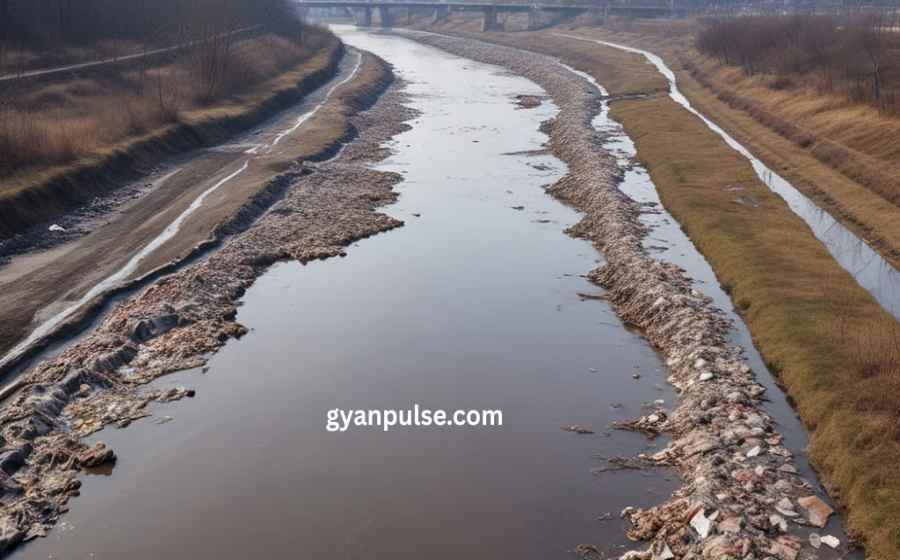
Jojari River Pollution: Supreme Court bans construction within 100 metres and restricts polluting activities within 500 metres in Rajasthan.
Jojari River Pollution
The Supreme Court of India has taken a significant step to protect Rajasthan’s Jojari River from further ecological degradation. On 24 August 2026, the Court directed that no construction or development activity should be permitted within 100 metres of the edge of the river as an interim protective measure. It also prohibited hazardous industries and other activities capable of causing pollution within 500 metres on either side of the river’s existing flood line or present flow path.
The restrictions are temporary and will remain effective until a scientific exercise determines the High Flood Line (HFL) and appropriate ecological buffer zones along the river. The order reflects the Court’s concern that unregulated construction and industrial activities could further damage the river ecosystem while scientific demarcation is still pending.
Table of Contents
Background of the Jojari River Pollution Case
The matter is being considered under Suo Motu Writ Petition (Civil) No. 8 of 2025, titled In Re: 2 Million Lives At Risk, Contamination in Jojari River, Rajasthan. The Supreme Court initiated proceedings after taking suo motu cognizance of a documentary highlighting severe contamination of the Jojari River. The case was registered in September 2025.
The proceedings have focused on the wider environmental problems associated with industrial pollution in western Rajasthan. The concerns extend beyond the Jojari to the interconnected Jojari–Bandi–Luni river system, including contamination of water bodies, untreated industrial effluents, degradation of groundwater and agricultural land, and possible encroachments on riverbeds and floodplains.
Why Has the 100-Metre Construction Ban Been Imposed?
The Supreme Court considered an immediate protective zone necessary because the scientific identification of the river’s flood-prone areas and ecological buffers has not yet been completed.
A fixed 100-metre restriction provides a measurable interim safeguard against construction close to the river. Such a measure can help prevent further encroachment and reduce the risk that development activities will interfere with the river’s natural flow and surrounding ecosystem.
The Court has therefore linked the temporary restriction to the broader scientific exercise of identifying the High Flood Line and appropriate ecological buffer zones. Once this exercise is completed, the protective framework can be based on scientifically determined boundaries rather than an interim distance.
500-Metre Restriction on Polluting Activities
The Court has also imposed a wider restriction on activities that may cause pollution. Hazardous industries and other pollution-causing activities have been barred within 500 metres on either side of the river’s existing flood line or present flow path.
This distinction is important. The 100-metre rule primarily addresses construction and development, while the wider 500-metre zone is intended to protect the river from potentially harmful industrial and other polluting activities.
The order demonstrates the importance of controlling pollution at the riverbank as well as within the broader area that can influence the river’s ecological health.
Supreme Court’s Earlier Directions on River Restoration
The latest interim restriction is part of a broader series of judicial directions concerning environmental degradation in Rajasthan.
In its 7 August 2026 judgment, the Supreme Court examined reports concerning the Jojari–Bandi–Luni river system and noted serious environmental concerns, including untreated industrial discharge, groundwater degradation, damage to agricultural areas and wildlife habitats, possible encroachments, and shortcomings in regulatory enforcement.
The Court also directed the Rajasthan government to establish an Integrated Coordination Group, headed by the Chief Secretary, to coordinate action concerning contamination of the Jojari, Bandi and Luni rivers. It further directed the state to establish an independent River Commission or River Rejuvenation Authority for the restoration of polluted river systems.
The Court clarified that the Integrated Coordination Group is an internal government mechanism and does not replace or override the High-Level Ecosystem Oversight Committee already involved in monitoring the environmental situation.
Role of the High Flood Line
The concept of the High Flood Line is central to the Supreme Court’s approach.
The High Flood Line indicates the level or boundary associated with the maximum extent of flooding considered for a river or watercourse. Identifying this line is important for regulating development on floodplains and determining areas that require greater environmental protection.
Without proper demarcation, construction and industrial activities may take place in areas vulnerable to flooding or ecologically connected with the river. The Court has therefore emphasized scientific assessment before a permanent system of riverbank and floodplain regulation is finalized.
Significance for Environmental Governance
The Jojari River case highlights the growing importance of judicial intervention in cases involving serious environmental degradation. It also illustrates how environmental protection may require coordination between courts, government departments, scientific institutions and regulatory authorities.
The Supreme Court’s directions combine immediate preventive measures with a longer-term scientific and institutional approach. The temporary 100-metre construction restriction provides immediate protection, while the determination of the High Flood Line and ecological buffers is intended to create a more evidence-based regulatory framework.
The case also emphasizes that river pollution is not simply a water-quality issue. Industrial contamination can affect groundwater, agriculture, wildlife habitats, public health and livelihoods, making river restoration a broader ecological and governance challenge.
Important Facts
- River: Jojari River, Rajasthan
- Case: In Re: 2 Million Lives At Risk, Contamination in Jojari River, Rajasthan
- Case Number: Suo Motu Writ Petition (Civil) No. 8 of 2025
- Construction restriction: No construction or development within 100 metres of the Jojari River’s edge as an interim measure.
- Pollution restriction: Hazardous and pollution-causing activities restricted within 500 metres on either side of the existing flood line or present flow path.
- Key environmental concept: High Flood Line and ecological buffer zones.
- Other rivers involved: Jojari, Bandi and Luni.
- Important judicial mechanism: Suo motu proceedings.
- Long-term objective: River restoration, pollution control and ecological protection.
Summary
The Supreme Court’s interim restrictions on the Jojari River represent an important environmental protection measure aimed at preventing further damage while scientific assessments are undertaken. The 100-metre construction ban and 500-metre restriction on polluting activities provide immediate safeguards for the river ecosystem.
Also Check: Current Affairs