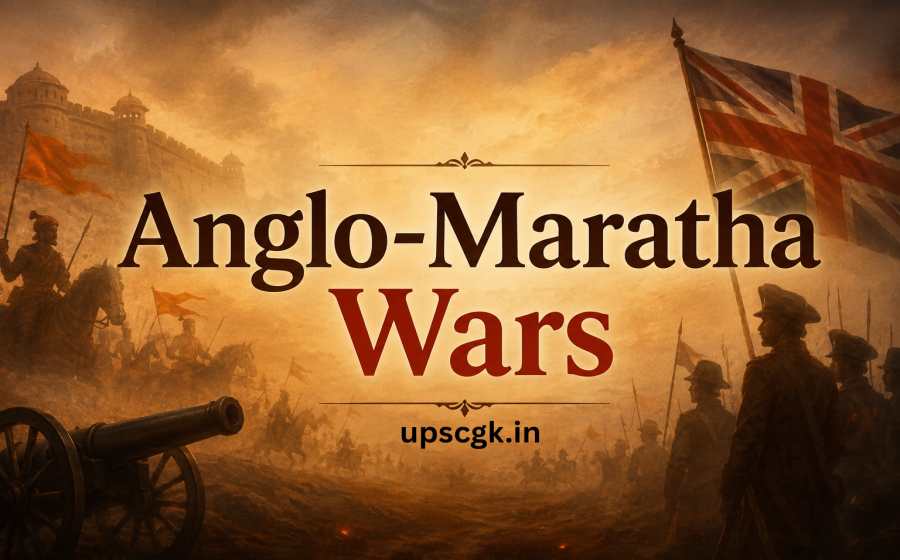
Discover how the Anglo-Maratha Wars led to British expansion in India, weakened the Maratha Confederacy and established British political dominance.
Anglo-Maratha Wars
The Anglo-Maratha Wars (1775–1818) were a series of three major conflicts fought between the British East India Company and the Maratha Confederacy. These wars played a decisive role in shaping modern Indian history by ending Maratha dominance and paving the way for British political supremacy over most of the Indian subcontinent. After the decline of the Mughal Empire, the Marathas had emerged as the strongest indigenous power in India. However, internal rivalries, political instability, and the military strength of the British eventually led to their downfall.
The Anglo-Maratha Wars are considered a turning point because they transformed the East India Company from a regional trading power into the dominant political authority in India.
Table of Contents
Background of the Maratha Confederacy
The Maratha Empire reached its peak under the leadership of the Peshwas, who expanded their influence across large parts of India during the eighteenth century. After the Third Battle of Panipat (1761), although the Marathas suffered a severe setback, they gradually regained strength and formed a powerful confederacy consisting of several semi-independent chiefs.
The major Maratha houses included:
- Peshwa of Pune
- Scindia of Gwalior
- Holkar of Indore
- Bhonsle of Nagpur
- Gaekwad of Baroda
Despite their military power, these chiefs frequently competed with one another for influence, creating divisions that the British successfully exploited.
Causes of the Anglo-Maratha Wars
Several factors contributed to the outbreak of these wars:
1. British Expansionist Policy
The British East India Company sought to expand its territories and secure political control over India. The Maratha Confederacy stood as the biggest obstacle to British ambitions.
2. Internal Rivalries
The Maratha chiefs often fought among themselves over succession disputes and territorial claims. These conflicts weakened the unity of the confederacy.
3. Treaty Politics
The British frequently interfered in Indian politics by supporting rival claimants to power in exchange for political concessions.
4. Military Superiority
The East India Company possessed disciplined armies, modern artillery, and experienced commanders, giving them an increasing advantage over traditional Indian forces.
First Anglo-Maratha War (1775–1782)
The First Anglo-Maratha War began because of a succession dispute after the death of Peshwa Madhavrao I.
Main Cause
Raghunath Rao (Raghoba), seeking the office of Peshwa, entered into the Treaty of Surat (1775) with the British. In return for military assistance, he promised to hand over certain territories.
However, most Maratha chiefs opposed this arrangement and supported the infant Peshwa Madhavrao II.
Important Events
- British forces initially achieved limited success.
- The Marathas united against the British.
- The British suffered defeats due to strong Maratha resistance.
- Both sides eventually agreed to negotiate.
Treaty of Salbai (1782)
The war ended with the Treaty of Salbai, under which:
- Madhavrao II was recognized as the Peshwa.
- Raghunath Rao lost British support.
- Peace was established between the British and the Marathas for nearly two decades.
The treaty temporarily restored balance but did not eliminate future conflicts.
Second Anglo-Maratha War (1803–1805)
The Second Anglo-Maratha War proved far more significant for British expansion.
Immediate Cause
The rivalry between the Holkars and Scindias resulted in the defeat of Peshwa Baji Rao II.
Unable to defend his position, Baji Rao II sought British protection and signed the Treaty of Bassein (1802).
Treaty of Bassein
Under this agreement:
- The Peshwa accepted British subsidiary forces.
- British troops were permanently stationed in Maratha territory.
- The Peshwa surrendered control over foreign affairs.
Many Maratha chiefs considered this treaty a betrayal of Maratha independence.
Major Battles
The British fought several decisive battles:
- Battle of Assaye
- Battle of Argaon
- Battle of Laswari
British commanders, particularly Arthur Wellesley (later the Duke of Wellington), secured major victories.
Results
- Scindia and Bhonsle accepted British dominance.
- Large territories came under Company control.
- British influence increased dramatically in central and western India.
Third Anglo-Maratha War (1817–1818)
The Third Anglo-Maratha War marked the final collapse of Maratha power.
Causes
- Growing dissatisfaction with British interference.
- Opposition to the subsidiary alliance system.
- Attempts by the Peshwa to restore Maratha independence.
Major Developments
The British launched coordinated military campaigns against various Maratha chiefs.
Important battles included:
- Battle of Khadki
- Battle of Koregaon
- Battle of Sitabuldi
- Battle of Mahidpur
The Marathas were defeated one after another.
End of the War
By 1818:
- Peshwa Baji Rao II surrendered.
- The office of Peshwa was abolished.
- Most Maratha territories were annexed.
- Remaining rulers became British allies under subsidiary alliances.
This victory firmly established British supremacy in India.
Reasons for British Victory
Several factors explain the success of the British during the Anglo-Maratha Wars.
Strong Military Organization
The British army had:
- Better training
- Modern artillery
- Efficient command structure
- Reliable logistics
Maratha Disunity
The Maratha chiefs rarely fought together. Internal rivalries prevented coordinated resistance.
Superior Diplomacy
The British successfully used treaties, alliances, and political negotiations to isolate different Maratha rulers.
Economic Resources
The East India Company had access to greater financial resources, enabling it to sustain prolonged military campaigns.
Consequences of the Anglo-Maratha Wars
The wars had far-reaching consequences for India.
End of Maratha Dominance
The Maratha Confederacy ceased to exist as the principal political power in India.
British Political Supremacy
The British East India Company became the dominant authority over most of the Indian subcontinent.
Expansion of Subsidiary Alliance
Many Indian states accepted British protection under subsidiary alliances, reducing their political independence.
Decline of Indigenous Powers
The defeat of the Marathas removed the last major Indian challenge to British expansion before the rise of the Sikh Empire.
Administrative Changes
The British reorganized newly acquired territories, expanded revenue systems, and strengthened their administrative machinery.
Historical Significance
The Anglo-Maratha Wars marked the beginning of a new political era in India. After defeating Mysore under Tipu Sultan and later overcoming the Marathas, the British East India Company faced no major Indian power capable of resisting its expansion.
The wars demonstrated that political disunity among Indian states greatly benefited the British strategy of “divide and rule.” They also accelerated the spread of British administration, legal institutions, military reforms, and economic policies across India.
The abolition of the Peshwa’s office in 1818 symbolized the end of one of India’s most influential political systems and confirmed British control over western and central India. These developments ultimately laid the foundation for nearly a century of British colonial rule before the Revolt of 1857 and the later Indian freedom movement.
Summary
The Anglo-Maratha Wars were among the most decisive conflicts in Indian history. Through three successive wars, the British East India Company defeated the powerful Maratha Confederacy, ending indigenous political dominance over much of India. Internal divisions among the Maratha chiefs, combined with British military efficiency and diplomatic strategy, enabled the Company to establish unmatched authority. The expansion of British power following these wars reshaped India’s political landscape and laid the groundwork for colonial rule that continued until India’s independence in 1947.
Also Check: History