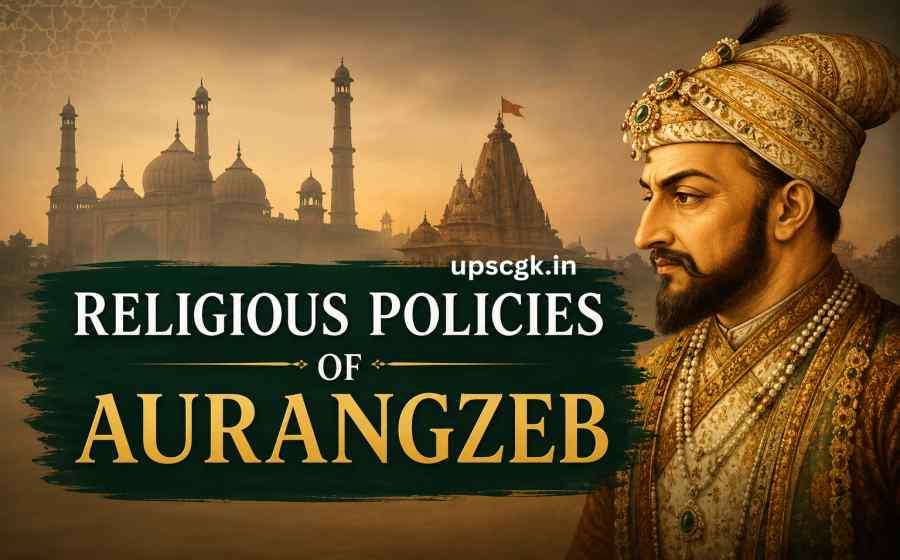
Learn about Religious Policies of Aurangzeb, including temple policies, Jizya tax, Islamic reforms and their impact on the Mughal Empire.
Religious Policies of Aurangzeb
Aurangzeb (1658–1707), the sixth Mughal emperor, was one of the most influential and controversial rulers in Indian history. His reign marked the territorial expansion of the Mughal Empire to its greatest extent, but it also witnessed growing political and religious tensions. Unlike his predecessors, particularly Akbar, who promoted religious tolerance and harmony, Aurangzeb adopted policies that reflected a stronger commitment to Islamic principles.
Historians have debated whether Aurangzeb’s religious policies were motivated solely by faith or influenced by political and administrative considerations. While some scholars view him as an orthodox Muslim ruler who attempted to govern according to Islamic law, others argue that many of his actions were driven by the need to consolidate power. Regardless of the motivation, his religious policies had a lasting impact on the Mughal Empire and Indian history.
Table of Contents
Background of Aurangzeb’s Religious Outlook
Aurangzeb was deeply devoted to Islam and followed Sunni Islamic traditions. He lived a simple lifestyle compared to earlier Mughal emperors and personally copied the Quran to earn money for his burial expenses. He believed that a ruler should govern according to the principles of Islamic law (Sharia).
Unlike Akbar, who encouraged religious discussions among scholars of different faiths and introduced the policy of Sulh-i-Kul (Universal Peace), Aurangzeb preferred strict adherence to Islamic teachings. This difference shaped many of his administrative and religious decisions during his reign.
Reimposition of the Jizya Tax
One of the most significant religious measures introduced by Aurangzeb was the reimposition of the Jizya tax in 1679.
Jizya was a tax imposed on non-Muslims under Islamic law in return for state protection and exemption from military service. Akbar had abolished this tax in 1564 as part of his policy of religious tolerance. Aurangzeb restored it after more than a century.
Objectives of Reimposing Jizya
- To follow Islamic traditions.
- To strengthen the support of orthodox Muslim scholars (Ulema).
- To increase state revenue during expensive military campaigns.
Impact
The restoration of Jizya caused dissatisfaction among many Hindu communities and was viewed as discriminatory. It also became a symbol of religious division during Aurangzeb’s rule.
Temple Policies
Aurangzeb’s policy toward Hindu temples remains one of the most debated aspects of his reign.
Demolition of Some Temples
Historical records show that certain temples were demolished under Aurangzeb’s orders. Prominent examples include:
- Vishwanath Temple at Varanasi.
- Keshava Rai Temple at Mathura.
These temples were often replaced with mosques.
Protection of Other Temples
Modern historical research also indicates that Aurangzeb granted land and financial support to several temples and Hindu religious institutions. In many cases, local temples continued to function without interference.
Therefore, historians argue that temple destruction was not a universal policy but often occurred in regions associated with political rebellions or resistance against Mughal authority.
Promotion of Islamic Law
Aurangzeb strengthened the implementation of Sharia throughout the empire. One of his most important contributions was the compilation of the Fatawa-i-Alamgiri, a comprehensive collection of Islamic legal principles prepared by leading scholars. The code served as a guide for judges and administrators dealing with legal matters according to Islamic law.
Administrative Changes
- Greater influence of Islamic scholars in governance.
- Appointment of officials familiar with Islamic jurisprudence.
- Increased emphasis on religious courts.
Restrictions on Certain Practices
Aurangzeb introduced several restrictions based on his religious beliefs.
Ban on Court Music
Music had flourished under earlier Mughal rulers such as Akbar, Jahangir, and Shah Jahan. Aurangzeb officially discontinued royal patronage of music at the imperial court.
Although court musicians lost royal support, music continued to flourish under regional kingdoms and noble families.
Ban on Certain Festivals
Some public celebrations and practices considered un-Islamic by orthodox scholars were discouraged or restricted.
Moral Regulations
Aurangzeb appointed officials known as Muhtasibs to supervise public morality and ensure compliance with Islamic regulations.
Their responsibilities included:
- Preventing gambling.
- Discouraging alcohol consumption.
- Monitoring public conduct.
- Enforcing religious laws.
Policy Towards Non-Muslims
Despite his orthodox image, Aurangzeb continued to employ many Hindus in the Mughal administration.
Rajputs, Marathas, Kayasthas, and other Hindu communities remained important contributors to the imperial bureaucracy.
However, relations with several Rajput rulers deteriorated due to political disputes, especially after the succession issue in Marwar.
The prolonged conflicts with the Marathas under Shivaji and later Maratha leaders were primarily political, although religious differences further complicated these relations.
Relations with Sikh Gurus
Aurangzeb’s reign also witnessed growing tensions with the Sikh community.
The execution of Guru Tegh Bahadur in 1675 became a turning point in Sikh history. According to Sikh tradition, Guru Tegh Bahadur sacrificed his life defending religious freedom.
His execution inspired the later militarization of the Sikh community under Guru Gobind Singh, leading to the formation of the Khalsa in 1699.
These developments significantly influenced the future political landscape of northern India.
Historians’ Views
Historians continue to debate Aurangzeb’s religious policies.
Traditional View
Many early historians portrayed Aurangzeb as an intolerant ruler whose religious orthodoxy weakened the unity of the Mughal Empire.
Revisionist View
Modern scholars argue that his decisions were often influenced by political circumstances rather than pure religious intolerance.
For example:
- Many temple demolitions occurred in regions experiencing rebellion.
- Hindu officials continued to occupy important administrative positions.
- Grants to several Hindu temples have been documented.
This suggests that Aurangzeb’s policies combined both religious conviction and political strategy.
Impact of Aurangzeb’s Religious Policies
Aurangzeb’s religious measures produced both immediate and long-term consequences.
Positive Aspects
- Strengthened the influence of Islamic law in administration.
- Won the support of orthodox Muslim scholars.
- Promoted religious discipline within sections of the empire.
Negative Aspects
- Increased resentment among sections of the Hindu population.
- Weakened relations with Rajputs and other regional powers.
- Contributed to the rise of resistance movements, including the Marathas, Sikhs, and Jats.
- Reduced the spirit of religious accommodation established under Akbar.
Many historians believe that these developments, combined with prolonged military campaigns and economic pressures, contributed to the gradual decline of the Mughal Empire after Aurangzeb’s death.
Summary
Aurangzeb’s religious policies remain one of the most debated subjects in Indian history. His commitment to Islamic orthodoxy shaped several administrative decisions, including the reimposition of Jizya, promotion of Sharia, restrictions on certain cultural practices, and actions against some temples. At the same time, evidence shows that he continued to employ Hindu officials and, in some cases, supported Hindu religious institutions, reflecting the complexity of his rule.
Rather than viewing Aurangzeb solely through the lens of religious intolerance or political pragmatism, historians increasingly emphasize the need to understand his policies within the broader context of Mughal governance, regional politics, and imperial challenges. His reign ultimately illustrates how religious beliefs, political authority, and administrative needs intersected in shaping one of the longest and most significant periods of Mughal history.
Also Check: History