Explore Rajput Mughal Relations, from Akbar’s alliances to Aurangzeb’s conflicts and their lasting impact on medieval India’s politics and culture.
Rajput Mughal Relations
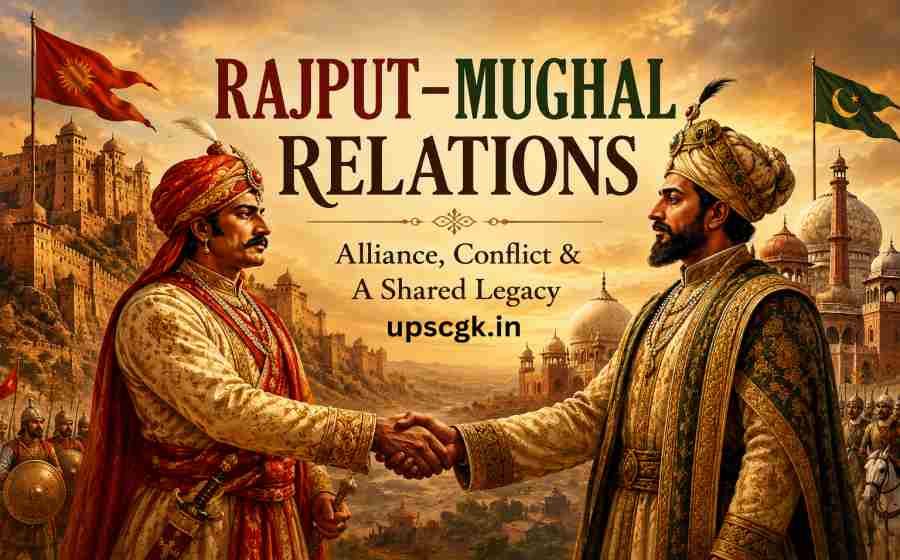
Rajput-Mughal relations played a significant role in shaping the political, military, and cultural history of medieval India. The relationship between the Rajput kingdoms and the Mughal Empire was marked by both cooperation and conflict. While some Rajput rulers accepted Mughal supremacy and became trusted allies, others fiercely resisted Mughal expansion to preserve their independence. These interactions not only strengthened the Mughal Empire but also influenced the administrative, military, and cultural landscape of India.
Table of Contents
Who Were the Rajputs?
The Rajputs were a group of powerful warrior clans that ruled several kingdoms across present-day Rajasthan, Gujarat, Madhya Pradesh, and parts of northern India. They were known for their bravery, loyalty, and strong sense of honor. Prominent Rajput states included Mewar, Marwar, Amber (Jaipur), Bikaner, Bundi, and Jaisalmer.
Before the rise of the Mughal Empire, Rajput kingdoms frequently fought among themselves, making them vulnerable to larger imperial powers.
Beginning of Rajput-Mughal Relations
The foundation of Rajput-Mughal relations was laid during the reign of Emperor Akbar (1556–1605). Unlike his predecessors, Akbar adopted a policy of diplomacy and cooperation rather than relying solely on military conquest.
His objective was to integrate the Rajput rulers into the Mughal administration while allowing them considerable autonomy over their kingdoms.
Akbar’s Policy Towards the Rajputs
Akbar’s Rajput policy is considered one of the most successful political strategies in Indian history.
1. Matrimonial Alliances
Akbar established matrimonial alliances with several Rajput royal families. His marriage to the princess of Amber, commonly known as Harka Bai (often referred to as Jodha Bai in popular tradition), strengthened relations with the Kachwaha Rajputs.
These alliances helped build trust between the Mughal court and Rajput rulers.
2. Religious Tolerance
Akbar followed a policy of religious tolerance and abolished the pilgrimage tax and the Jizya tax on non-Muslims. He respected Rajput customs and allowed Hindu nobles to practice their religion freely.
This inclusive approach encouraged many Rajput rulers to join the Mughal administration.
3. Inclusion in the Mughal Administration
Rajput rulers were appointed to high positions in the Mughal government through the Mansabdari System. Many Rajput nobles served as governors, military commanders, and trusted advisors.
Some notable Rajput nobles included:
- Raja Bhagwant Das
- Raja Man Singh
- Rai Singh of Bikaner
Their military skills greatly strengthened the Mughal Empire.
Rajput States That Allied with the Mughals
Several Rajput kingdoms voluntarily accepted Mughal suzerainty.
Amber (Jaipur)
Amber became Akbar’s closest Rajput ally. Raja Bharmal accepted Mughal authority, and his son Raja Bhagwant Das and grandson Raja Man Singh became prominent Mughal generals.
Bikaner
The rulers of Bikaner established friendly relations with the Mughal court and actively participated in imperial campaigns.
Jaisalmer
The rulers of Jaisalmer also entered into alliances with the Mughals and maintained peaceful relations.
These alliances brought political stability, military support, and economic benefits to both sides.
Resistance by Mewar
Not all Rajput rulers accepted Mughal authority.
The kingdom of Mewar, under Maharana Pratap, became the strongest symbol of Rajput resistance.
Battle of Haldighati (1576)
The Battle of Haldighati was fought between the Mughal forces led by Raja Man Singh and the army of Maharana Pratap.
Although the Mughals won the battlefield, Maharana Pratap escaped and continued his struggle through guerrilla warfare. He later recovered several territories in Mewar and remained an enduring symbol of courage and independence.
Rajput Mughal Relations During Jahangir
Emperor Jahangir largely continued Akbar’s policy of maintaining cordial relations with the Rajputs.
A major development occurred when Mewar finally reached a settlement with the Mughal Empire.
In 1615, Maharana Amar Singh I signed a treaty with Jahangir. According to the agreement:
- Mewar accepted Mughal suzerainty.
- The ruler of Mewar was not required to attend the Mughal court personally.
- No matrimonial alliance was imposed upon the Sisodia rulers.
This agreement preserved the dignity of Mewar while ensuring peace.
Rajput Mughal Relations During Shah Jahan
During Shah Jahan’s reign, Rajput nobles continued to occupy important administrative and military positions.
Rajput generals participated in Mughal campaigns in the Deccan and Central Asia. Relations remained largely peaceful, although occasional political disputes arose.
Overall, Rajput loyalty remained an important pillar of Mughal power.
Rajput-Mughal Relations During Aurangzeb
Relations deteriorated significantly under Emperor Aurangzeb.
Several factors contributed to growing tensions:
Religious Policies
Aurangzeb reimposed the Jizya tax and adopted policies that were perceived as less accommodating toward non-Muslims.
Marwar Succession Dispute
Following the death of Raja Jaswant Singh of Marwar in 1678, Aurangzeb attempted to bring Marwar under direct Mughal control. This led to prolonged resistance led by Durgadas Rathore, who defended the rights of Jaswant Singh’s heir.
Conflict with Mewar
The Sisodia rulers of Mewar also opposed Aurangzeb’s expansionist policies, leading to renewed warfare.
These conflicts weakened Mughal authority and reduced Rajput support for the empire.
Impact of Rajput-Mughal Relations
The relationship between the Rajputs and the Mughals had lasting consequences.
Political Impact
- Strengthened the Mughal Empire during Akbar, Jahangir, and Shah Jahan.
- Integrated powerful regional kingdoms into the imperial administration.
- Reduced internal conflicts in northern India for several decades.
Military Impact
- Rajput warriors became an essential part of the Mughal army.
- Their participation helped expand the empire into Gujarat, Bengal, and the Deccan.
Administrative Impact
- Rajput nobles efficiently governed important provinces.
- Their inclusion enhanced the stability and effectiveness of the Mughal administration.
Cultural Impact
The close association between Rajputs and Mughals promoted cultural exchange.
This period witnessed:
- Development of Indo-Islamic architecture.
- Growth of Mughal painting influenced by Rajput artistic traditions.
- Exchange of customs, traditions, and courtly practices.
Reasons for the Decline of Rajput-Mughal Relations
Several factors led to the weakening of these relations:
- Aurangzeb’s religious and political policies.
- Attempts to interfere in Rajput succession matters.
- Increased military conflicts with Marwar and Mewar.
- Declining trust between the Rajput rulers and the Mughal court.
As Rajput cooperation diminished, the Mughal Empire gradually lost one of its strongest military and political allies.
Summary
Rajput-Mughal relations were a defining feature of medieval Indian history. Under Akbar, diplomacy, religious tolerance, and political inclusion created a stable partnership that greatly strengthened the Mughal Empire. This cooperation continued under Jahangir and Shah Jahan, contributing to imperial expansion and administrative efficiency. However, under Aurangzeb, strained relations, succession disputes, and changing religious policies led to growing resistance from major Rajput states. The decline of this alliance weakened Mughal authority and marked an important turning point in the empire’s history. Understanding Rajput-Mughal relations provides valuable insight into the complex balance of cooperation and conflict that shaped India’s medieval political landscape.
Also Check: History