Explore the cultural contributions of the Vijayanagara Empire, including magnificent temples, literature, music, dance and lasting impact on Indian heritage.
Cultural Contributions of the Vijayanagara Empire
The Vijayanagara Empire (1336–1646 CE) stands as one of the greatest empires in Indian history, not only for its military strength and economic prosperity but also for its extraordinary cultural achievements. Founded by Harihara I and Bukka Raya I on the banks of the Tungabhadra River, the empire became a beacon of Hindu culture during a period of political instability in southern India. Its capital, Hampi, emerged as one of the world’s most magnificent cities, attracting merchants, scholars, artists, and travelers from across Asia and Europe.
The rulers of Vijayanagara actively supported literature, architecture, music, dance, painting, and religious institutions. Their patronage transformed South India into a vibrant center of artistic excellence. Even centuries after the empire’s decline following the Battle of Talikota (1565), its cultural legacy continues to influence Indian traditions, temple architecture, classical arts, and literature.
Table of Contents
Promotion of Temple Architecture
One of the most remarkable cultural contributions of the Vijayanagara Empire was the development of a distinctive style of temple architecture.
The rulers renovated ancient temples and constructed magnificent new ones dedicated to Hindu deities such as Shiva, Vishnu, and Virupaksha. Their architectural style combined earlier Chola, Pandya, Hoysala, and Chalukya traditions while introducing unique innovations.
Key features of Vijayanagara architecture included:
- Towering gopurams (gateway towers) adorned with intricate sculptures.
- Massive stone pillars featuring carvings of horses, elephants, warriors, and mythical creatures.
- Spacious temple courtyards for religious gatherings.
- Beautifully carved mandapas (pillared halls).
- Ornate stone chariots and musical pillars.
Some of the finest examples include:
- Virupaksha Temple
- Vittala Temple
- Hazara Rama Temple
- Krishna Temple
- Achyutaraya Temple
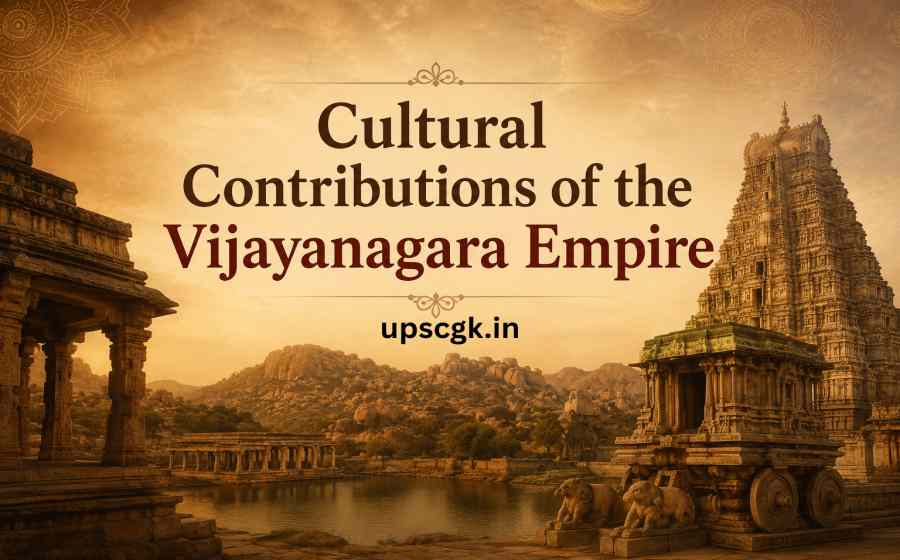
The famous Stone Chariot and the musical pillars of the Vittala Temple remain masterpieces of Indian architecture and engineering.
Development of Sculpture
The Vijayanagara period witnessed exceptional growth in stone sculpture.
Temple walls, pillars, gateways, and halls were decorated with detailed carvings depicting:
- Episodes from the Ramayana and Mahabharata
- Stories from the Puranas
- Gods and goddesses
- Royal processions
- Dancers and musicians
- Animals and mythical creatures
Unlike earlier styles that emphasized religious imagery alone, Vijayanagara sculptors also portrayed scenes from everyday life, providing valuable insights into the social and cultural practices of the period.
These sculptures reflected remarkable artistic precision and demonstrated the advanced craftsmanship of the empire.
Flourishing of Literature
The Vijayanagara Empire became one of India’s greatest centers of literary activity.
Kings generously supported scholars writing in multiple languages, including:
- Sanskrit
- Telugu
- Kannada
- Tamil
Telugu Literature
The reign of Krishnadevaraya (1509–1529 CE) marked the golden age of Telugu literature.
He himself authored the celebrated work Amuktamalyada, which combines devotion, political wisdom, and poetic excellence.
His royal court included the famous Ashtadiggajas (Eight Great Scholars), among whom Allasani Peddana earned the title “Andhra Kavita Pitamaha” (Father of Telugu Poetry).
Their literary works enriched Telugu language and established its classical status.
Sanskrit Literature
Several scholars composed philosophical, religious, and poetic works in Sanskrit under royal patronage.
Commentaries on Hindu scriptures, devotional literature, and works on political thought flourished during this period.
Kannada and Tamil Literature
Kannada and Tamil scholars also received generous patronage.
Poetry, devotional hymns, grammar, and historical works enriched regional literary traditions and strengthened local languages.
Patronage of Music
Music occupied an important place in Vijayanagara society.
Royal courts regularly organized musical performances during festivals, religious ceremonies, and state celebrations.
The empire played a major role in the evolution of Carnatic classical music.
One of the greatest musicians associated with this era was Purandara Dasa, widely regarded as the “Father of Carnatic Music.”
His contributions included:
- Standardization of music lessons
- Composition of thousands of devotional songs
- Development of systematic methods for music education
Many of his teaching methods continue to form the foundation of Carnatic music training today.
Encouragement of Dance
Classical dance traditions flourished under royal patronage.
Temples served not only as places of worship but also as centers for cultural performances.
Dancers regularly performed during festivals and religious ceremonies.
Several dance traditions that later evolved into forms such as Bharatanatyam received encouragement during this period.
Temple sculptures depicting graceful dancers provide evidence of the importance of dance in Vijayanagara culture.
Growth of Painting
Painting also flourished during the Vijayanagara period.
Artists decorated temple walls, palace interiors, and ceilings with colorful murals illustrating:
- Hindu mythology
- Royal ceremonies
- Religious processions
- Court life
- Nature and animals
The murals at the Virupaksha Temple and Lepakshi Temple remain among the finest surviving examples of Vijayanagara painting.
Their vivid colors, expressive figures, and intricate detailing continue to attract historians and art lovers.
Religious Harmony and Cultural Integration
Although the Vijayanagara rulers strongly supported Hindu traditions, they generally adopted a policy of religious tolerance.
Temples received generous grants, while scholars and saints from different Hindu sects enjoyed royal patronage.
Vaishnavism, Shaivism, and Shaktism flourished simultaneously.
Foreign travelers also noted the presence of Muslim merchants and traders in the empire’s thriving cities, reflecting its cosmopolitan character.
This atmosphere encouraged cultural exchange while preserving India’s diverse religious traditions.
Support for Education and Scholarship
Education received significant encouragement during the Vijayanagara period.
Temples functioned as important centers of learning where students studied:
- Sanskrit
- Philosophy
- Mathematics
- Astronomy
- Grammar
- Religious texts
Scholars engaged in debates and discussions, contributing to the intellectual life of the empire.
Royal patronage ensured that learning remained closely connected with cultural and religious institutions.
Urban Planning and Civic Development
The capital city of Hampi demonstrated remarkable urban planning.
The city featured:
- Wide roads
- Organized marketplaces
- Water tanks
- Irrigation canals
- Gardens
- Fortifications
- Public halls
Foreign travelers such as Niccolò de’ Conti, Domingo Paes, and Fernão Nuniz described Hampi as one of the largest and wealthiest cities of its time.
Its planned layout reflected both practical governance and aesthetic excellence.
Influence on South Indian Culture
The cultural achievements of the Vijayanagara Empire continued long after its political decline.
Its influence can still be seen in:
- South Indian temple architecture
- Carnatic music traditions
- Classical dance forms
- Telugu and Kannada literature
- Religious festivals
- Sculpture and mural painting
Many later kingdoms, including the Nayakas of Madurai and Tanjore, adopted and expanded Vijayanagara artistic traditions.
Today, the ruins of Hampi, recognized as a UNESCO World Heritage Site, preserve the grandeur of this remarkable civilization and attract visitors from around the world.
Summary
The Vijayanagara Empire occupies a distinguished place in Indian history as a guardian and promoter of art, literature, religion, and culture. Through magnificent temples, exquisite sculptures, flourishing literature, classical music, dance, painting, and advanced urban planning, the empire created a cultural renaissance that shaped South India’s identity for centuries. Its rulers recognized that true greatness lay not only in military victories but also in nurturing knowledge, creativity, and spiritual traditions. The enduring legacy of Vijayanagara continues to inspire historians, artists, and scholars, making it one of the brightest chapters in India’s rich cultural heritage.
Also Check: History