Learn how Sardar Patel led the integration of princely states after Independence and unified India into one nation through diplomacy, strategy and leadership.
Integration of Princely States
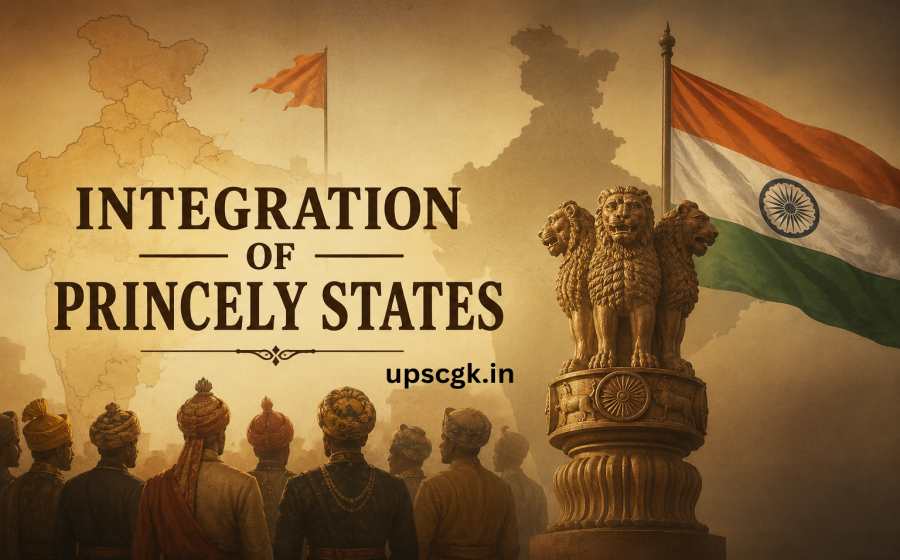
The integration of princely states was one of the most significant achievements in the history of independent India. When India gained independence on 15 August 1947, the country faced a major challenge: the existence of more than 560 princely states that were not directly governed by the British. These states had their own rulers and enjoyed varying degrees of autonomy under British paramountcy. The successful integration of these states into the Indian Union was largely due to the vision, determination, and leadership of Sardar Vallabhbhai Patel, who is rightly remembered as the “Iron Man of India.”
Table of Contents
Background of the Princely States
Before independence, British India consisted of two political entities: British-administered provinces and princely states. While the provinces were directly controlled by the British government, the princely states were ruled by Indian princes, kings, nawabs, and maharajas. These rulers acknowledged British supremacy but maintained internal autonomy.
At the time of independence, there were approximately 565 princely states spread across the Indian subcontinent. With the end of British rule, the British government announced that the princely states would no longer be under British paramountcy. They were given the option to join India, join Pakistan, or remain independent.
This situation posed a serious threat to India’s unity and territorial integrity. If the princely states had chosen independence, the newly formed nation could have been fragmented into numerous small kingdoms and territories.
Sardar Patel’s Vision for a United India
As the first Deputy Prime Minister and Home Minister of independent India, Sardar Patel recognized the dangers of political fragmentation. He believed that national unity was essential for India’s security, economic development, and political stability.
Patel viewed the integration of princely states not merely as an administrative task but as a nation-building mission. His goal was to create a strong and united India where all regions functioned under a common national framework.
To achieve this objective, Patel worked closely with V. P. Menon, a senior civil servant and constitutional expert. Together, they devised a practical and effective strategy for persuading rulers to join the Indian Union.
Instrument of Accession
The primary tool used for integration was the Instrument of Accession. Under this agreement, princely states agreed to transfer control over defense, foreign affairs, and communications to the Government of India while retaining authority over internal matters.
Patel and V. P. Menon personally met many rulers and assured them that their interests, privileges, and titles would be protected if they joined India. Their diplomatic approach, combined with political realism, convinced most rulers to sign the agreement.
As a result, the majority of princely states acceded to India before or shortly after independence.
Challenges Faced During Integration
Although many rulers willingly joined India, some states created significant challenges. Three states in particular, Junagadh, Hyderabad, and Jammu & Kashmir, became major issues for the Indian government.
Junagadh
Junagadh had a Muslim ruler but a predominantly Hindu population. Despite being geographically surrounded by Indian territory, the Nawab chose to join Pakistan in 1947.
This decision triggered widespread public unrest. The Indian government intervened, and a plebiscite was conducted in 1948. The people overwhelmingly voted in favor of joining India, leading to Junagadh’s integration into the Indian Union.
Hyderabad
Hyderabad State was one of the largest and most powerful princely states. Its ruler, the Nizam, wanted to remain independent rather than join India.
Negotiations continued for months, but the situation deteriorated due to internal unrest and the activities of armed groups. In September 1948, the Indian government launched a military operation known as Operation Polo.
The operation lasted only a few days and resulted in Hyderabad’s accession to India. This action demonstrated Patel’s determination to preserve national unity when diplomatic efforts failed.
Jammu and Kashmir
Jammu and Kashmir presented a unique challenge. Its ruler, Maharaja Hari Singh, initially wanted to remain independent. However, following an invasion by tribal forces supported from Pakistan in October 1947, the Maharaja sought military assistance from India. In return, he signed the Instrument of Accession, making Jammu and Kashmir part of India.
The issue later evolved into a complex international dispute, but the accession itself was a crucial step in India’s territorial consolidation.
Merger and Administrative Reorganization
After accession, the Government of India focused on merging smaller states into larger administrative units. Many tiny princely states lacked the resources and infrastructure necessary for effective governance.
Patel supervised the creation of unions of states and facilitated their gradual integration into the Indian administrative system. This process reduced political fragmentation and improved governance across the country.
The rulers were granted privy purses and certain privileges as compensation for surrendering their sovereign powers. This arrangement helped ensure a peaceful transition and minimized resistance.
Importance of the Integration
The integration of princely states was vital for India’s survival as a unified nation. It prevented political disintegration and strengthened the authority of the central government.
The successful merger of hundreds of states:
- Preserved India’s territorial unity.
- Strengthened national security.
- Promoted economic integration.
- Facilitated administrative efficiency.
- Laid the foundation for democratic governance.
Without this achievement, India might have faced prolonged instability and regional conflicts.
Legacy of Sardar Patel
Sardar Patel’s contribution to nation-building remains one of the greatest achievements in modern Indian history. Through diplomacy, persuasion, administrative skill, and decisive action when necessary, he succeeded in integrating hundreds of princely states into a single nation.
His leadership transformed a politically fragmented landscape into a united republic. Because of his role in unifying India, Patel is often compared to great nation-builders in world history and is widely regarded as the architect of India’s political integration.
Summary
The integration of princely states was a defining moment in India’s post-independence history. Faced with the possibility of fragmentation, Sardar Patel displayed extraordinary leadership and determination. Through the Instrument of Accession, diplomatic negotiations and strategic interventions, he ensured that the princely states became part of the Indian Union.
His efforts not only safeguarded India’s unity but also laid the foundation for a strong, stable, and democratic nation. The successful integration of the princely states remains one of the most remarkable achievements of independent India and a lasting testament to Sardar Patel’s vision and statesmanship.
Also Check: History