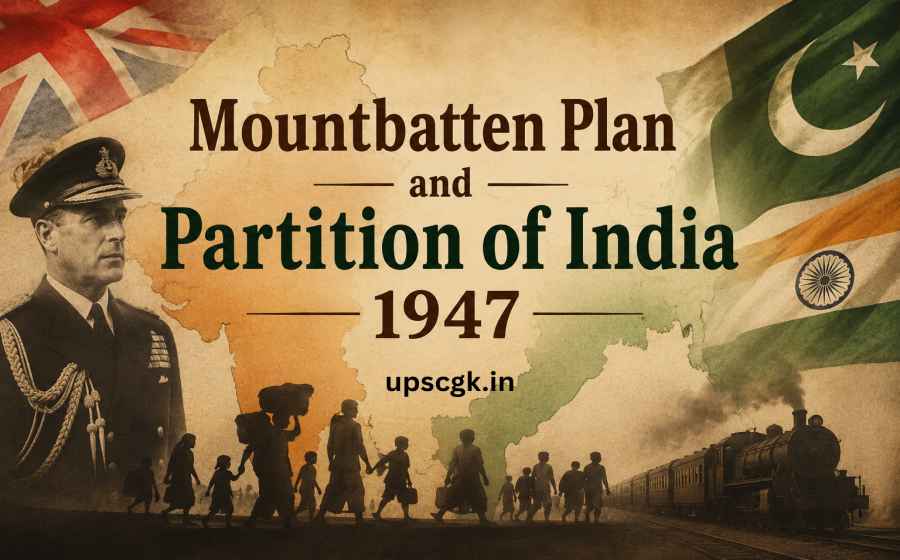
Mountbatten Plan and Partition of India 1947 marked the end of British rule, leading to India’s independence and the creation of India and Pakistan.
Mountbatten Plan and Partition of India 1947
The Mountbatten Plan, announced on 3 June 1947, was the final constitutional proposal that led to the partition of British India and the creation of two independent nations, India and Pakistan. It marked the end of nearly two centuries of British rule and paved the way for India’s independence on 15 August 1947. While the plan successfully transferred power, it also resulted in one of the largest and most tragic mass migrations in human history.
Table of Contents
Background of the Mountbatten Plan
By the mid-1940s, British rule in India had become increasingly difficult to maintain. The Second World War had weakened Britain economically and politically. At the same time, the Indian freedom movement had gained tremendous momentum under leaders such as Mahatma Gandhi, Jawaharlal Nehru, and Muhammad Ali Jinnah.
Earlier attempts to resolve India’s constitutional future, including the Cabinet Mission Plan of 1946, had failed. Differences between the Indian National Congress and the All-India Muslim League became increasingly severe. The Muslim League insisted on the creation of a separate Muslim-majority nation called Pakistan, while Congress initially favored a united India.
Communal tensions between Hindus and Muslims intensified across the country, leading to widespread violence. Realizing that a quick solution was necessary, the British government appointed Lord Louis Mountbatten as the last Viceroy of India in March 1947. His primary task was to oversee the transfer of power.
Why Was the Mountbatten Plan Introduced?
Several factors compelled Britain to introduce the Mountbatten Plan:
- Rising communal violence between Hindus and Muslims.
- Failure of the Cabinet Mission Plan.
- Growing demand for Pakistan by the Muslim League.
- Britain’s weakened position after World War II.
- Increasing pressure from the Indian independence movement.
- The need for a peaceful and orderly transfer of power.
Mountbatten concluded that partition was the only practical solution to avoid further political deadlock and violence.
Main Features of the Mountbatten Plan
The Mountbatten Plan was officially announced on 3 June 1947. Its major provisions included:
1. Partition of British India
The plan proposed the division of British India into two independent dominions:
- India
- Pakistan
Both countries would have the right to frame their own constitutions.
2. Creation of Pakistan
Pakistan would consist of Muslim-majority regions, including:
- West Punjab
- Sindh
- North-West Frontier Province (subject to a referendum)
- Baluchistan
- East Bengal
3. Partition of Punjab and Bengal
Punjab and Bengal had mixed populations of Hindus, Muslims, and Sikhs. The plan provided for the partition of these provinces based on the wishes of their legislative assemblies.
4. Boundary Commission
A Boundary Commission headed by Sir Cyril Radcliffe was established to determine the borders between India and Pakistan.
5. Referendums
Referendums were conducted in:
- North-West Frontier Province (NWFP)
- Sylhet district of Assam
The people voted on whether they wished to join India or Pakistan.
6. Princely States
The princely states were given the option to join either India or Pakistan based on geographical and political considerations.
7. Early Transfer of Power
The transfer of power was advanced from June 1948 to August 1947 to ensure a quicker resolution of the political crisis.
Acceptance of the Plan
The Mountbatten Plan was accepted by the Congress, the Muslim League, and the Sikh leadership, although many leaders had reservations.
Congress leaders believed that accepting partition was necessary to secure immediate independence and prevent prolonged civil conflict. The Muslim League accepted the plan because it fulfilled its long-standing demand for Pakistan.
The British Parliament subsequently passed the Indian Independence Act 1947 in July 1947, providing the legal framework for the creation of India and Pakistan.
Partition and Independence
The partition officially came into effect in August 1947.
- Pakistan became independent on 14 August 1947.
- India became independent on 15 August 1947.
The event marked the end of British colonial rule in the Indian subcontinent. However, the division triggered massive population movements as millions of Hindus and Sikhs migrated to India while millions of Muslims moved to Pakistan.
Consequences of Partition
Human Tragedy
Partition resulted in large-scale communal violence. Historians estimate that hundreds of thousands of people lost their lives, while millions were displaced from their homes.
Refugee Crisis
The migration of people across newly created borders created one of the largest refugee crises in world history.
Division of Resources
Assets, military forces, government institutions, and financial resources had to be divided between India and Pakistan.
Kashmir Issue
The partition left several territorial disputes unresolved, most notably the issue of Jammu and Kashmir, which continues to influence relations between the two countries.
Emergence of Two Nations
India emerged as a secular democratic republic, while Pakistan was established as a separate homeland for Muslims of the subcontinent.
Historical Significance
The Mountbatten Plan occupies a crucial place in Indian history because it brought an end to British colonial rule and led directly to independence. At the same time, it caused the partition of the subcontinent, resulting in immense human suffering and long-lasting political challenges. The plan remains one of the most debated events in modern South Asian history due to its far-reaching consequences.
Summary
The Mountbatten Plan of 1947 was the decisive step that shaped the future of the Indian subcontinent. It ended British rule and enabled the birth of two sovereign nations, India and Pakistan. While it achieved the goal of transferring power rapidly, it also triggered a painful partition marked by violence, displacement, and communal tensions. Understanding the Mountbatten Plan is essential for comprehending both India’s independence and the complex historical legacy that continues to influence South Asia today.
Also Check: History