Learn about the Deccan Sultanates, their formation, internal conflicts, wars with Vijayanagara and their role in shaping medieval Indian history.
Deccan Sultanates
The Deccan Sultanates were a group of five Muslim kingdoms that emerged in the Deccan region of India during the late medieval period. They played an important role in shaping the political, cultural, and military history of southern India. These kingdoms arose after the decline of the Bahmani Kingdom and became powerful regional states. Their history is marked by alliances, rivalries, wars, and cultural developments that significantly influenced Indian history.
The Deccan region, situated between northern and southern India, became an important center of political power during the medieval era. The rise of the Deccan Sultanates changed the balance of power in southern India and created an environment of continuous military competition.
Table of Contents
Formation of the Deccan Sultanates
The origin of the Deccan Sultanates can be traced to the weakening of the Bahmani Kingdom. The Bahmani rulers controlled a large territory in the Deccan from the fourteenth century. However, internal disputes, administrative problems, and conflicts among nobles weakened the kingdom over time.
The Bahmani Kingdom suffered from several issues, including rivalry between local nobles and foreign nobles. The administration became unstable due to corruption and political struggles. As central authority weakened, powerful provincial governors gained greater independence.
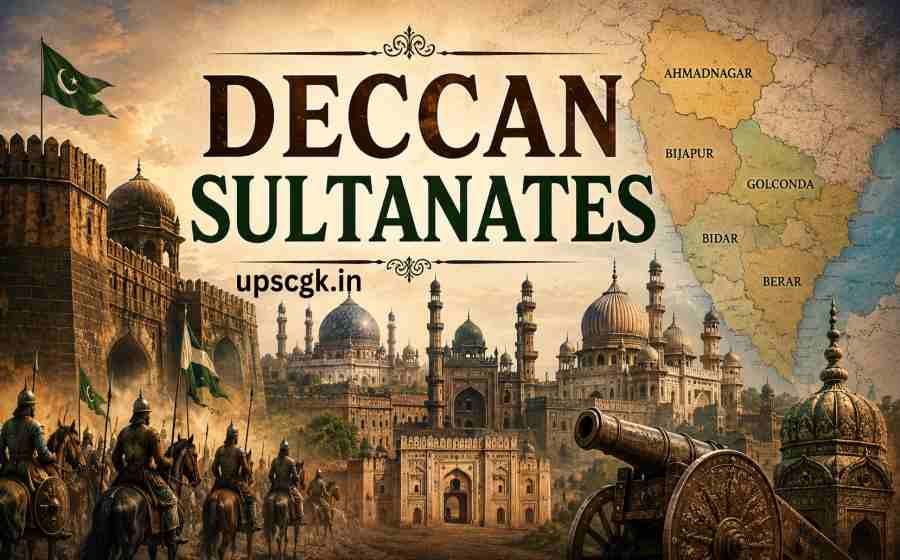
By the end of the fifteenth century, the Bahmani state gradually broke apart into five independent kingdoms known as the Deccan Sultanates. These were:
- Ahmadnagar Sultanate
- Bijapur Sultanate
- Golconda Sultanate
- Bidar Sultanate
- Berar Sultanate
Each kingdom was ruled by a separate dynasty and sought to expand its influence and territory.
The Ahmadnagar Sultanate was established by Malik Ahmad Nizam Shah. Bijapur came under the rule of the Adil Shahi dynasty. Golconda was ruled by the Qutb Shahi dynasty, while Bidar and Berar were controlled by their own ruling families.
Although these kingdoms shared a common origin, they often acted independently and competed with one another for political dominance.
Political Conditions in the Deccan
The Deccan region became politically unstable after the division of the Bahmani state. Since there was no strong central authority, the newly formed kingdoms frequently fought against each other.
Political competition was mainly driven by:
- Expansion of territory
- Control over trade routes
- Access to fertile land
- Military supremacy
- Desire for political influence
Rulers often formed temporary alliances for strategic purposes. However, these alliances frequently changed depending on political situations.
Major Conflicts Among the Sultanates
The Deccan Sultanates experienced numerous internal and external conflicts. Their rivalries shaped the history of medieval South India.
Conflicts Among Themselves
The five Sultanates constantly competed for power. Neighboring states frequently fought battles over borders and resources. Bijapur and Ahmadnagar often engaged in territorial disputes. Similarly, Golconda sought expansion toward neighboring territories. Political ambition and changing alliances created instability throughout the region.
Sometimes kingdoms united against a stronger opponent, but these partnerships usually lasted only for short periods. The continuous wars weakened their military and economic resources.
Conflict with Vijayanagara Empire
One of the most significant conflicts involving the Deccan Sultanates was their struggle against the powerful Vijayanagara Empire.
The Vijayanagara rulers controlled large parts of southern India and represented a major challenge to the Sultanates. Competition over fertile territories and strategic regions increased tensions.
Initially, the Sultanates fought separately against Vijayanagara but often failed to achieve major victories. They realized that unity was necessary to defeat such a strong opponent. As a result, several Sultanates temporarily formed an alliance against the Vijayanagara Empire.
Battle of Talikota
The most important event in the history of the Deccan Sultanates was the Battle of Talikota in 1565.
In this battle, Ahmadnagar, Bijapur, Golconda, and Bidar joined forces against the Vijayanagara Empire. Their combined military strength proved successful.
The Vijayanagara army suffered a major defeat, and its ruler was captured and killed during the conflict. The capital city of Vijayanagara was later destroyed and looted.
The Battle of Talikota had major consequences:
- Decline of Vijayanagara power
- Expansion of Sultanate influence
- Political changes in South India
- Increase in regional power struggles
The battle became one of the most important turning points in medieval Indian history.
Mughal Expansion and Decline of the Sultanates
Despite their victory over Vijayanagara, the Deccan Sultanates eventually faced a new challenge from the north.
The Mughal Empire gradually expanded toward the Deccan region. Mughal rulers aimed to bring the entire Indian subcontinent under their control.
The Sultanates were weakened by:
- Continuous internal wars
- Economic pressure
- Leadership problems
- Political instability
Because of these weaknesses, they struggled to resist Mughal expansion.
Ahmadnagar was among the first Sultanates to come under Mughal pressure. Over time, the remaining Sultanates also lost their independence.
By the seventeenth century, most of the Deccan Sultanates had been absorbed into larger empires.
Cultural Contributions of the Deccan Sultanates
Apart from warfare and politics, the Deccan Sultanates contributed significantly to art, architecture, literature, and culture.
Their rulers encouraged:
- Construction of mosques and palaces
- Development of Persian and local literature
- Growth of music and painting
- Cultural exchange between northern and southern traditions
The fusion of Persian, Islamic, and Indian traditions created a unique Deccan culture.
Architectural monuments built during this period continue to attract historians and tourists.
Summary
The Deccan Sultanates emerged from the decline of the Bahmani Kingdom and became powerful regional states in medieval India. Their history was shaped by political rivalries, military conflicts, and shifting alliances. Their wars against each other and against the Vijayanagara Empire changed the political landscape of South India. Although they eventually declined due to Mughal expansion and internal weaknesses, their cultural and historical influence remained significant. The Deccan Sultanates occupy an important place in Indian history because of their role in politics, warfare, and cultural development.
Also Check: History