
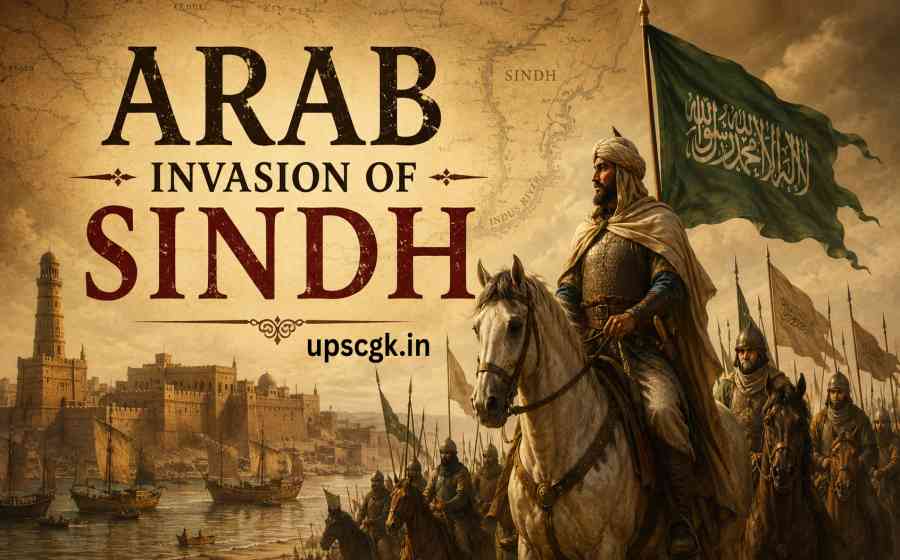
Explore Arab Invasion of Sindh, Muhammad bin Qasim’s conquest, key causes, major events and its lasting political and cultural impact.
Arab Invasion of Sindh
The Arab invasion of Sindh marked one of the most important events in the early medieval history of India. It represented the first successful Muslim military entry into the Indian subcontinent and established the foundation for future interactions between India and the Islamic world. The invasion was led by Muhammad bin Qasim in 712 CE during the rule of the Umayyad Caliphate. Though the conquest was geographically limited mainly to Sindh and neighboring regions, its effects influenced politics, trade, culture, and religion for many centuries.
The Arab conquest of Sindh is considered a turning point because it opened the doors for future Muslim invasions and introduced new cultural and administrative influences in India.
Table of Contents
Background of the Arab Invasion
During the 7th and early 8th centuries, Arab power expanded rapidly under the Umayyad Caliphate. Arab armies had already conquered large territories including Persia, Syria, Egypt, and parts of Central Asia. The rulers of the Umayyad Empire aimed to expand their territory and increase their influence through trade and military campaigns.
Sindh at that time was ruled by King Dahir of the Brahman dynasty. Sindh was an important region because of its strategic location. It connected India with Persia and Central Asia and had flourishing ports that supported trade activities.
According to historical accounts, the immediate cause of the invasion was an incident involving Arab merchant ships. Some ships carrying gifts and passengers from Sri Lanka to the Arab world were reportedly attacked by pirates near the Sindh coast. The Umayyad governor of Iraq, Hajjaj bin Yusuf, demanded compensation from King Dahir. Since the issue remained unresolved, Hajjaj decided to send military forces against Sindh.
Earlier military attempts failed, but later Hajjaj entrusted the campaign to his young relative Muhammad bin Qasim.
Muhammad bin Qasim and the Conquest of Sindh
Muhammad bin Qasim was a capable military commander despite being very young, believed to be around seventeen years old during the campaign. He organized a strong and disciplined army equipped with advanced military technology of the time.
In 712 CE, Muhammad bin Qasim entered Sindh with a large force consisting of cavalry, infantry, and siege weapons. His army used giant catapults, which gave them an advantage in attacking fortified cities.
The campaign progressed in several stages:
Capture of Debal
Debal was the first important city attacked by Muhammad bin Qasim. It was a major port city and held strategic importance. The Arab forces successfully captured Debal after intense fighting.
Conquest of Nerun and Sehwan
After Debal, Muhammad bin Qasim moved further and conquered several regions including Nerun and Sehwan. Some local rulers surrendered while others resisted.
Battle Against King Dahir
The most significant event of the campaign was the battle between Muhammad bin Qasim and King Dahir. The battle took place near the Indus River. King Dahir fought bravely but was ultimately defeated and killed.
Following Dahir’s death, Arab forces gained control over important cities including Brahmanabad and Multan.
Administrative Policies of Muhammad bin Qasim
After establishing control over Sindh, Muhammad bin Qasim adopted practical administrative measures. Rather than imposing harsh rule everywhere, he followed policies that helped maintain stability.
Some important administrative features included:
- Local officials were allowed to continue their duties.
- Religious communities received a degree of freedom.
- Taxes were collected systematically.
- Trade and economic activities were encouraged.
- Law and order were maintained through organized administration.
These policies helped the Arabs strengthen their control over the newly conquered region.
Impact of the Arab Invasion of Sindh
The Arab conquest had significant long-term consequences in Indian history.
Political Impact
Politically, the invasion marked the first establishment of Muslim rule in a part of India. Although Arab authority remained mostly restricted to Sindh, it demonstrated that Indian kingdoms could be vulnerable to foreign invasions.
The conquest also influenced later Turkish and Afghan rulers who launched invasions into India.
Economic Impact
Trade relations between India and the Arab world increased considerably. Sindh became an important center connecting Indian and Middle Eastern markets.
Exchange of goods such as:
- Spices
- Textiles
- Precious stones
- Agricultural products
became stronger after Arab rule.
Cultural Impact
The invasion promoted cultural interaction between Indian and Arab societies. Knowledge and ideas moved in both directions.
Important developments included:
- Spread of Indian mathematics to the Arab world
- Transfer of scientific knowledge
- Exchange of medical practices
- Growth of literary and intellectual contacts
Indian numerical systems later reached Europe through Arab scholars and played a major role in global mathematics.
Religious Impact
Islam entered the Indian subcontinent in an organized manner through the Arab conquest of Sindh. Although Islam had reached Indian coastal regions earlier through traders, the conquest helped establish Muslim communities on a larger scale.
Over time, Islamic traditions and ideas became part of India’s diverse social structure.
Social Impact
The interaction between local people and Arab settlers created social changes. New customs, languages, and traditions gradually emerged due to cultural exchange.
The process contributed to the development of a more diverse society in later periods.
Summary
The Arab invasion of Sindh led by Muhammad bin Qasim in 712 CE was an important event in Indian history. While its immediate political impact remained limited to Sindh and nearby areas, its long-term influence was far-reaching. The invasion created new political possibilities, strengthened trade relations, and encouraged cultural and intellectual exchange between India and the Islamic world.
The conquest of Sindh was not merely a military victory; it became the beginning of centuries of interaction that shaped many aspects of Indian civilization. Understanding this event helps explain the historical connections between India and the wider world and highlights its importance in the study of medieval Indian history.
Also Check: History