
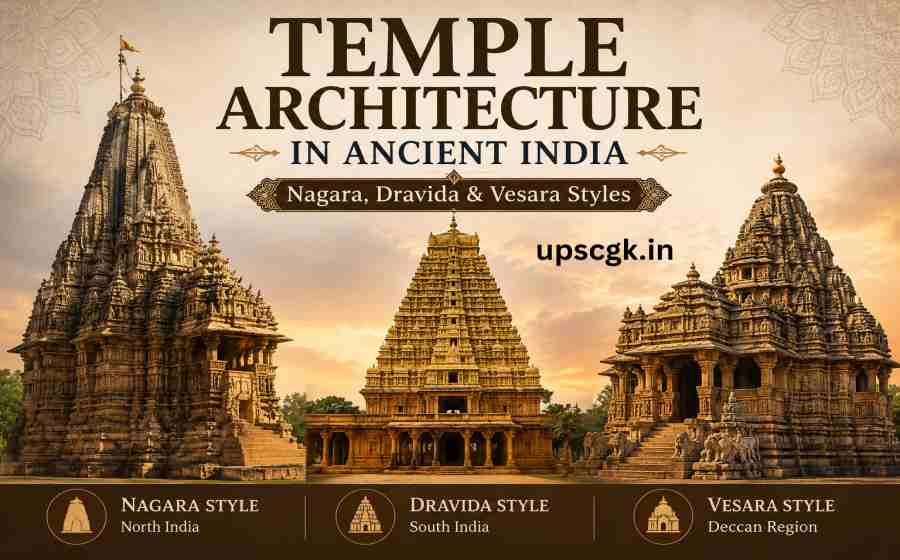
Discover the evolution of Temple Architecture in Ancient India with detailed insights into Nagara, Dravida and Vesara styles, their features and significance.
Temple Architecture in Ancient India
Temple architecture in Ancient India represents one of the most remarkable achievements of Indian civilization. Temples were not only places of worship but also centers of culture, education, social interaction, and artistic expression. Ancient Indian architects and craftsmen developed sophisticated construction techniques and unique artistic styles that reflected regional traditions and religious beliefs. Over time, different regions of India evolved distinct architectural patterns. Among these, the three major styles of temple architecture were Nagara, Dravida, and Vesara.
These styles developed over centuries and displayed exceptional creativity in design, sculpture, and engineering. The architecture of ancient temples provides valuable information about the social, religious, political, and cultural history of India.
Table of Contents
Origin and Development of Temple Architecture
In the early Vedic period, worship generally took place in open spaces and natural surroundings. Permanent temples were not common during that time. Gradually, with the growth of religious practices and the influence of Hinduism, Buddhism, and Jainism, structured places of worship began to emerge.
The Gupta period (approximately 4th–6th century CE) is often considered the beginning of classical temple architecture in India. During this period, architects developed important structural elements that later evolved into distinct regional styles. Rulers and dynasties patronized temple construction to promote religion and display their power and prosperity.
As kingdoms expanded in different regions, architectural techniques adapted to local geography, materials, and cultural influences, leading to the development of Nagara, Dravida, and Vesara styles.
Nagara Style of Temple Architecture
The Nagara style mainly developed in northern India and became the dominant architectural form in regions extending from the Himalayas to the Vindhya mountains.
Features of Nagara Style
- Curved Shikhara
- The most important feature is the tall and curved tower known as the Shikhara.
- It rises directly above the sanctum (Garbhagriha).
- Garbhagriha
- The central sacred chamber contains the main deity.
- Mandapa
- A hall or pavilion attached to the sanctum for devotees.
- No Large Boundary Walls
- Temples usually did not have large enclosure walls.
- Rich Sculptural Decoration
- Walls were covered with sculptures of gods, goddesses, celestial beings, and scenes from mythology.
Famous Examples of Nagara Style
- Khajuraho Temples, Madhya Pradesh
- Konark Sun Temple, Odisha
- Kandariya Mahadeva Temple
- Jagannath Temple, Puri
The Nagara style is known for its vertical appearance and detailed carvings that display the high artistic skill of ancient craftsmen.
Dravida Style of Temple Architecture
The Dravida style emerged in southern India and flourished under powerful dynasties such as the Pallavas, Cholas, Pandyas, and Vijayanagara rulers.
Features of Dravida Style
- Pyramid-shaped Tower
- The tower above the sanctum is called Vimana.
- It rises in a stepped pyramid form.
- Large Entrance Gateways
- Monumental gateways known as Gopurams became important elements.
- Temple Compounds
- Temples were usually enclosed within large walls.
- Water Tanks
- Many temple complexes included tanks or reservoirs used for rituals.
- Extensive Courtyards
- Multiple halls and courtyards were common.
Famous Examples of Dravida Style
- Brihadeeswara Temple, Tamil Nadu
- Shore Temple at Mahabalipuram
- Meenakshi Temple, Madurai
- Kailasanatha Temple
Dravida architecture demonstrates grandeur and systematic planning. The massive structures and detailed stone carvings reflect the prosperity of South Indian kingdoms.
Vesara Style of Temple Architecture
The Vesara style developed mainly in the Deccan region and represented a combination of Nagara and Dravida architectural traditions.
This style flourished under dynasties such as the Chalukyas and Hoysalas.
Features of Vesara Style
- Combination of Two Styles
- Incorporates characteristics from both Nagara and Dravida forms.
- Decorative Sculptures
- Extensive carvings and artistic details cover walls and pillars.
- Unique Temple Layouts
- Temples often have star-shaped or complex floor plans.
- Smaller Towers
- Towers may display mixed characteristics rather than following a single pattern.
- Detailed Pillar Work
- Pillars often contain elaborate designs and polished surfaces.
Famous Examples of Vesara Style
- Chennakesava Temple, Belur
- Hoysaleswara Temple, Halebidu
- Pattadakal Temples, Karnataka
The Vesara style represents experimentation and fusion in Indian architecture, showing how different cultural influences blended together.
Difference Between Nagara, Dravida and Vesara Styles
| Feature | Nagara | Dravida | Vesara |
|---|---|---|---|
| Region | North India | South India | Deccan Region |
| Tower Shape | Curved Shikhara | Pyramid-shaped Vimana | Mixed style |
| Entrance Gate | Smaller | Large Gopurams | Moderate |
| Boundary Wall | Usually absent | Present | Varies |
| Design | Vertical structure | Monumental layout | Hybrid design |
Importance of Ancient Temple Architecture
Temple architecture in Ancient India had significance beyond religion.
- Temples functioned as educational centers.
- They promoted art, sculpture, music, and dance.
- They contributed to economic activities through trade and donations.
- They reflected the political strength of rulers.
- They preserved cultural traditions and historical records.
Many inscriptions found in temples provide historians with valuable information about administration, society, and economy.
Summary
Temple architecture in Ancient India demonstrates the remarkable creativity and engineering abilities of ancient Indian civilizations. The Nagara, Dravida, and Vesara styles each developed distinct identities while reflecting regional culture and artistic traditions. Their magnificent structures continue to attract historians, architects, and tourists from around the world.
These temples are not merely stone structures; they are symbols of India’s rich heritage and cultural continuity. Studying these architectural traditions helps us understand the historical and artistic achievements that shaped Indian civilization.
Also Check: History