
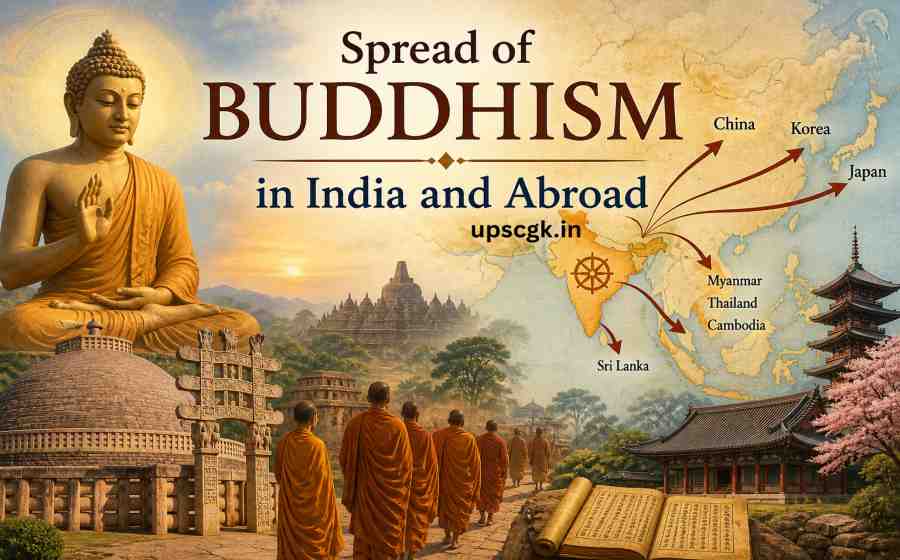
Explore the Spread of Buddhism in India and Abroad, its causes, key figures, routes and global impact in a clear and engaging way.
Spread of Buddhism in India and Abroad
Buddhism, one of the world’s major religions, originated in ancient India in the 6th century BCE with the teachings of Gautama Buddha. What began as a spiritual movement in the Gangetic plains gradually transformed into a global religion influencing vast regions across Asia and beyond. The spread of Buddhism was not accidental; it was driven by a combination of royal patronage, missionary zeal, trade routes, and its universal appeal.
Table of Contents
Spread of Buddhism in India
After attaining enlightenment at Bodh Gaya, Buddha began preaching his doctrine, known as the Dhamma. His teachings were simple, practical, and accessible to all sections of society, irrespective of caste or gender. This inclusivity made Buddhism popular among common people.
The early spread of Buddhism in India was facilitated by:
- Teachings in Vernacular Language: Buddha used local languages like Pali instead of Sanskrit, making his message understandable to the masses.
- Organized Sangha: The Buddhist monastic community (Sangha) played a crucial role in spreading teachings systematically.
- Urban Centers and Trade Routes: Buddhism flourished in cities like Rajgir, Vaishali, and Sarnath, which were also major trade hubs.
However, the most significant boost to Buddhism came during the reign of Ashoka the Great in the 3rd century BCE. After the Kalinga War, Ashoka embraced Buddhism and actively promoted it. He:
- Built stupas and viharas across the empire
- Sent missionaries to different regions
- Issued edicts promoting moral values and non-violence
Under Ashoka, Buddhism spread across almost the entire Indian subcontinent.
Spread of Buddhism Outside India
Buddhism did not remain confined to India. It expanded across Asia through various channels:
1. Sri Lanka
Ashoka sent his son Mahinda and daughter Sanghamitra to Sri Lanka. Buddhism was warmly received by King Devanampiya Tissa and soon became the dominant religion. The Theravada tradition flourished here.
2. Central Asia and Silk Route
Buddhist monks and traders carried the teachings along the famous Silk Route. Monasteries were established in regions like Bactria and Gandhara, where Greco-Buddhist art also developed.
3. China
Buddhism reached China around the 1st century CE. It gained popularity during the Han dynasty. Chinese travelers like Faxian and Xuanzang visited India to study Buddhist texts and carried them back, helping in translation and dissemination.
4. Korea and Japan
From China, Buddhism spread to Korea and then to Japan. In Japan, it blended with local traditions and became an integral part of culture and philosophy.
5. Southeast Asia
Buddhism spread to countries like Myanmar, Thailand, Cambodia, and Vietnam. Both Theravada and Mahayana traditions flourished in these regions.
Factors Responsible for the Spread of Buddhism
Several factors contributed to the widespread acceptance of Buddhism:
- Simplicity of Teachings: The Four Noble Truths and Eightfold Path were easy to understand and follow.
- Opposition to Ritualism: Buddhism rejected complex rituals and priestly dominance, appealing to common people.
- Royal Patronage: Kings like Ashoka and Kanishka supported and promoted Buddhism.
- Missionary Activities: Organized efforts by monks ensured systematic expansion.
- Trade and Travel: Merchants and travelers carried Buddhist ideas across regions.
Decline of Buddhism in India
Despite its early success, Buddhism began to decline in India around the 7th century CE due to:
- Revival of Hinduism and rise of Bhakti movement
- Lack of strong royal support after the Gupta period
- Invasions that led to destruction of monasteries like Nalanda
However, Buddhism continued to thrive outside India and remains a major global religion.
Summary
The spread of Buddhism from India to different parts of the world is a remarkable chapter in history. From the teachings of Gautama Buddha to the efforts of Ashoka and countless monks, Buddhism transformed into a global spiritual force. Its emphasis on peace, compassion, and moral living continues to inspire millions even today.
Also Check: History