
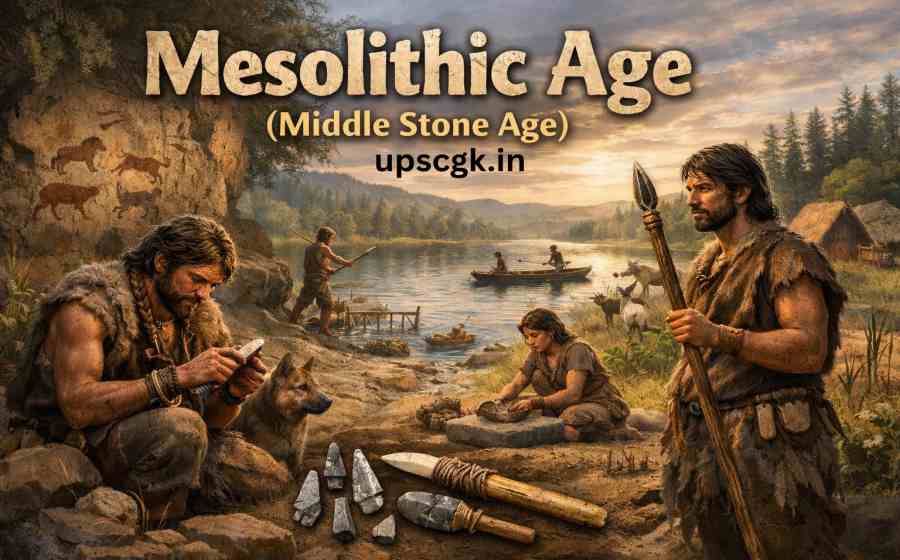
Explore the Mesolithic Age or Middle Stone Age, a transitional era marked by climate change and advancements in human lifestyle.
Mesolithic Age or Middle Stone Age
The Mesolithic Age, also known as the Middle Stone Age, represents a crucial transitional phase in the long journey of human civilization. It bridges the gap between the Paleolithic Age (Old Stone Age) and the Neolithic Age (New Stone Age). This period roughly dates from 10,000 BCE to 6,000 BCE, coinciding with significant climatic and environmental changes after the end of the last Ice Age.
Unlike earlier periods where humans lived in constant movement and depended entirely on hunting and gathering, the Mesolithic Age marks the beginning of human adaptation to a more stable and predictable environment. During this time, humans started experimenting with new survival strategies that laid the foundation for settled life in the Neolithic period.
Table of Contents
Environmental Changes and Human Adaptation
One of the defining factors of the Mesolithic Age was the improvement in climatic conditions. As glaciers melted and temperatures rose, forests expanded, rivers stabilized, and wildlife became more diverse. These changes provided humans with new food sources and opportunities.
Humans began living near rivers, lakes, and coastal regions, which supported fishing and access to water throughout the year. The availability of resources allowed people to stay in one place for longer durations, reducing their dependence on continuous migration.
This shift did not mean that hunting and gathering disappeared, but rather that humans became more efficient and strategic in using natural resources.
Key Features of the Mesolithic Age
1. Use of Microliths
The key technological progress of the Mesolithic Age was the invention and common use of microliths. These were tiny, sharp tools crafted from stones like flint and quartz, used to make more efficient hunting and daily-life tools.
Microliths were often fixed onto wooden or bone handles to create composite tools such as:
- Spears
- Arrows
- Harpoons
- Sickle-like tools
These tools were lighter, more precise, and more effective for hunting small animals and birds, as well as for fishing.
2. Beginning of Animal Domestication
Another major development was the early domestication of animals, especially dogs. Dogs were likely used for:
- Hunting assistance
- Protection from wild animals
- Guarding camps
This marks one of the earliest examples of humans forming a controlled relationship with animals, a practice that later expanded to livestock domestication in the Neolithic Age.
3. Growth of Fishing and Food Storage
Fishing became a significant source of food during the Mesolithic period. Archaeological evidence suggests the use of:
- Fish hooks
- Harpoons
- Nets
People also began developing primitive food storage techniques, allowing them to preserve surplus food for future use. This reduced uncertainty and increased survival chances during harsh seasons.
4. Semi-Sedentary Lifestyle
Although Mesolithic people were still primarily hunters and gatherers, they began staying in one place for longer periods. Seasonal camps and semi-permanent settlements became common.
In some regions, there is evidence of early plant cultivation, showing that humans were experimenting with agriculture even before the Neolithic revolution.
Social and Cultural Development
The Mesolithic Age reflects a noticeable shift in human behavior and thinking. Communities became more organized, and social cooperation increased.
Evidence from burial sites suggests:
- Ritual practices
- Respect for the dead
- Possible belief in life after death
Art and symbolic expression, though limited, continued through rock paintings and carvings, indicating cognitive and cultural growth.
Important Mesolithic Sites in India
India has several significant Mesolithic sites that provide valuable insights into this period.
1. Langhnaj (Gujarat)
Langhnaj is an important Mesolithic site known for:
- Microlithic stone tools
- Animal bones
- Human skeletal remains
The site provides evidence of hunting practices, burial customs, and tool-making skills of Mesolithic humans.
2. Bagor (Rajasthan)
Bagor is among the largest and most important Mesolithic sites in India. Archaeological excavations at this site have uncovered:
- Extensive microlithic tools
- Signs of early animal domestication
- Semi-permanent settlements
Bagor shows a clear transition toward a more settled lifestyle and controlled use of natural resources.
Significance of the Mesolithic Age
The Mesolithic Age holds immense importance in human history because it represents the shift from complete dependence on nature to learning how to manage and utilize it efficiently.
Key contributions of this age include:
- Technological innovation through microliths
- Early domestication of animals
- Development of fishing and food storage
- Beginning of semi-settled life
These changes set the stage for the agricultural revolution of the Neolithic Age.
Summary
The Mesolithic Age (Middle Stone Age) was not merely a transitional phase but a period of experimentation, adaptation, and innovation. Humans learned to respond intelligently to environmental changes, develop better tools, form social structures, and slowly move toward a stable way of life.
By understanding the Mesolithic period, we gain insight into how early humans transformed from nomadic hunters into the builders of civilizations. This age stands as a critical milestone in the evolution of human society.
Also Check: History