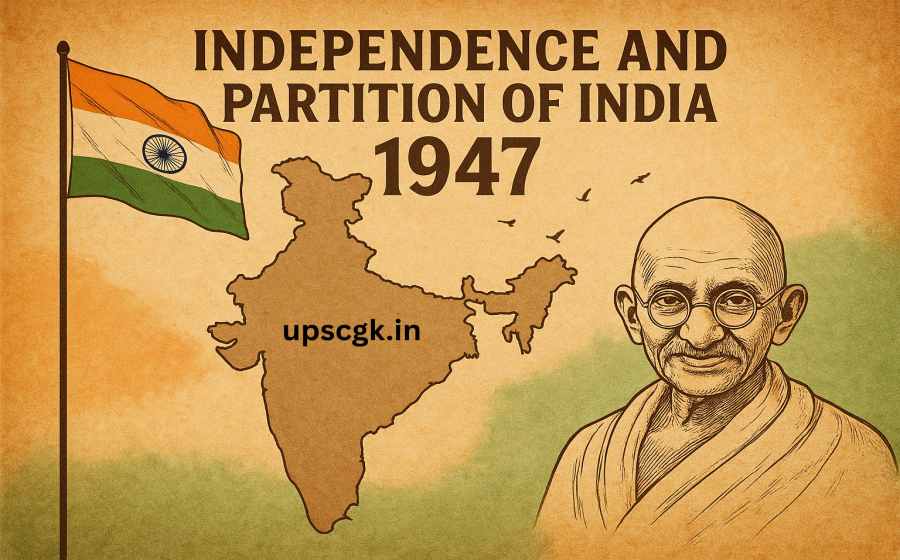
Independence and Partition of India 1947 marked freedom from British rule and the tragic division creating India and Pakistan.
Independence and Partition of India 1947
The year 1947 stands as one of the most defining moments in Indian history. After nearly two centuries of British rule and centuries of socio-political struggle, India finally achieved independence on 15th August 1947. This moment was not just about the lowering of the Union Jack and the rise of the tricolor; it was the beginning of a new era, an era of self-governance, hope, democracy, and the promise of a better future.
However, independence came with a painful cost: the Partition of India and Pakistan. This division, based on religious lines, triggered one of the largest and most tragic migrations in human history. While India celebrated freedom, it also witnessed sorrow, displacement, and communal violence. Despite these dark moments, modern India rose with resilience, shaping itself into a democratic republic committed to secularism and progress.
Table of Contents
The Final Path to Independence
By the early 1940s, the British Empire was weakened by World War II. Meanwhile, Indian national movements had gained extraordinary momentum. The Quit India Movement (1942) demanded an immediate end to colonial rule. Leaders like Mahatma Gandhi, Jawaharlal Nehru, Sardar Vallabhbhai Patel, Subhas Chandra Bose, and many others intensified the struggle through mass resistance, diplomatic negotiations, and strong political vision.
The British realized that continuing their rule in India was no longer sustainable. In 1946, the Cabinet Mission was sent to discuss the transfer of power, but disagreements between the Indian National Congress and the Muslim League made consensus difficult, especially on the question of a united India.
The rising communal tensions, combined with political differences, pushed the British toward announcing their decision to leave India.
The Decision to Partition India
The demand for a separate nation for Muslims, led by Muhammad Ali Jinnah, became a central issue during the final negotiations. Jinnah argued that Muslims needed a separate nation, Pakistan, to safeguard their political and cultural rights. The Congress leadership, though initially opposed to Partition, eventually accepted it to prevent further unrest and civil war.
On 3rd June 1947, the Mountbatten Plan proposed the Partition of British India into two sovereign states, India and Pakistan. The decision, though painful, was seen as the only possible solution to avoid continued violence and political deadlock.
15th August 1947: The Birth of a Free Nation
At midnight, India awoke to freedom. Jawaharlal Nehru delivered his iconic speech, “Tryst with Destiny,” declaring India’s entry into a new era. The Constituent Assembly took charge, beginning the process of shaping a democratic constitution. Celebration, pride, and hope filled the hearts of millions across the country.
But even as the nation rejoiced, a humanitarian tragedy unfolded along its borders.
The Human Cost of Partition
Partition led to one of the largest human migrations in world history. Nearly 10 to 15 million people crossed the newly drawn borders, Hindus and Sikhs moving into India, Muslims moving into Pakistan. The sudden announcement of borders by the Radcliffe Commission left communities confused and vulnerable.
Trains were attacked, villages burned, and families torn apart. It is estimated that 1 to 2 million people lost their lives in the communal violence that followed. Cities like Lahore, Amritsar, and Delhi witnessed unimaginable chaos. Refugee camps emerged overnight, struggling to support the massive influx of displaced people.
Despite the tragedy, the resilience of ordinary Indians stood out. Communities came together, volunteers offered help, and the government made rapid arrangements for rehabilitation.
Building a New India: Democracy, Secularism, and Development
After independence, the biggest challenge was nation-building. India had to reunite princely states, restore peace, revive its economy, and create a political system that represented all its people.
Key developments included:
1. Integration of Princely States
Sardar Patel played a decisive role in integrating more than 560 princely states into the Indian Union, preventing further fragmentation.
2. Adoption of the Constitution
On 26th January 1950, India became a sovereign democratic republic, guided by a constitution that emphasized:
- Secularism
- Equality
- Justice
- Fundamental rights for all citizens
3. Economic and Social Reconstruction
India started building institutions, promoting education, improving agriculture, and planning industrial development through Five-Year Plans.
4. Commitment to Unity
Despite cultural, linguistic, and religious diversity, India adopted a system that celebrated pluralism rather than division.
Legacy of Independence and Partition
Independence gave India the freedom to shape its destiny, while Partition left deep emotional and political scars. Yet, the nation emerged stronger, determined, and forward-looking. Today, India stands as one of the largest democracies in the world, proving that even in the face of adversity, unity and resilience can lead to progress.
The events of 1947 continue to influence India’s identity, reminding us of the sacrifices made and the responsibilities we carry as citizens.
Also Check: History