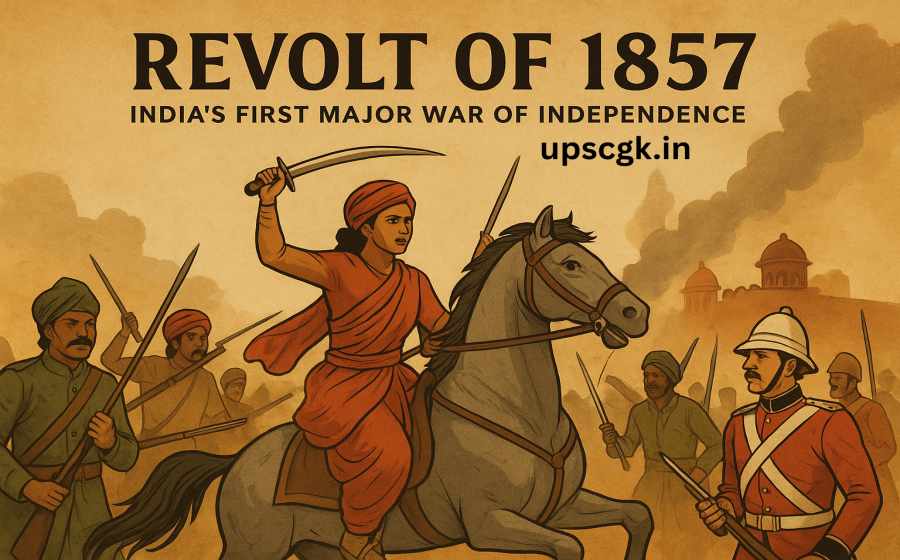
Revolt of 1857 marked India’s first major uprising against British rule, highlighting its causes, leaders, and historic impact.
Revolt of 1857: India’s First Major War of Independence
The Revolt of 1857 stands as one of the most defining moments in the history of modern India. Considered by many historians as the First War of Indian Independence, it marked the first large-scale, united, and determined effort by Indians to challenge British rule. Although the uprising was ultimately unsuccessful, its impact was monumental, reshaping the political landscape of India and planting the seeds of nationalism that later fueled the freedom struggle.
Table of Contents
Background of the Revolt
By the mid-19th century, British control over India had expanded dramatically. The East India Company, which began as a trading enterprise, had turned into a political power through battles, alliances, and annexations. Their policies affected farmers, soldiers, artisans, princes, and religious leaders, creating widespread resentment. The Company’s aggressive land revenue systems, interference in social customs, expansionist policies, and economic exploitation pushed various sections of society to the edge.
Tensions were already simmering across the country, and only a spark was needed to ignite a widespread uprising.
Immediate Cause: The Enfield Rifle Controversy
The introduction of the new Enfield rifle in the army acted as the immediate trigger. The cartridges of this rifle were believed to be greased with cow and pig fat—deeply offensive to both Hindu and Muslim soldiers. Hindu sepoys considered the cow sacred, while pigs were forbidden in Islam. Using teeth to open the cartridges was seen as a direct attack on their religious beliefs.
This issue exposed the insensitivity of British officials toward Indian customs and religious sentiments. The anger spread quickly through the army ranks, turning the dissatisfaction into open rebellion.
Major Causes of the Revolt
While the cartridge issue triggered the uprising, the revolt had deeper political, economic, administrative, and social causes:
1. Political Causes
The most controversial policy was Lord Dalhousie’s Doctrine of Lapse, which allowed the British to annex any state without a natural male heir. States like Jhansi and Nagpur fell victim to this policy, creating frustration among Indian rulers. The dethroning of Nawab Wajid Ali Shah of Awadh further fueled anger and humiliation.
2. Economic Causes
Heavy taxation, destruction of traditional industries, and unfair trade practices pushed peasants and craftsmen into poverty. Many zamindars lost their land due to new revenue laws. Farmers were unable to bear high taxes, leading to widespread economic misery.
3. Social and Religious Causes
British interference in Indian customs, introduction of Western education, Christian missionary activities, and social reforms like the abolition of Sati created suspicion that the British wanted to convert Indians to Christianity.
4. Military Causes
Indian sepoys formed a large part of the British Indian Army but were poorly paid, discriminated against, and treated unfairly. Their promotions were limited, and they felt alienated within their own land. This discontent played a crucial role in spreading the revolt.
Spread of the Revolt
The uprising began in Meerut on 10 May 1857, when Indian soldiers revolted, freed their jailed companions, and marched to Delhi. They declared Bahadur Shah Zafar, the last Mughal emperor, as the symbolic leader of the rebellion. This gave the revolt a unified national character.
From Delhi, the revolt spread rapidly across Kanpur, Lucknow, Jhansi, Gwalior, Bareilly, Bihar, and central India. Every region had its local leaders, grievances, and battles.
Key Leaders of the Revolt
The Revolt of 1857 witnessed the rise of several legendary leaders who showcased unparalleled courage and patriotism:
• Rani Lakshmibai (Jhansi)
The queen of Jhansi became the symbol of bravery. She fought the British fiercely, refusing to surrender her kingdom. Her valour in the battlefield made her one of the greatest icons of the rebellion.
• Nana Sahib (Kanpur)
Nana Sahib led the revolt in Kanpur and emerged as a central figure. He rallied local support and challenged British authority.
• Begum Hazrat Mahal (Lucknow)
She played a crucial role in the Awadh region, leading the revolt with strategic brilliance after the annexation of Awadh.
• Kunwar Singh (Bihar)
At nearly 80 years of age, Kunwar Singh led rebels in Bihar with remarkable courage.
• Tantia Tope
A loyal supporter of Nana Sahib, he fought several battles and led guerrilla warfare against the British.
Suppression of the Revolt
Despite massive participation, the lack of coordination, limited modern weapons, scattered leadership, and superior British military strength led to the suppression of the revolt by mid-1858. Many leaders were killed in battle, arrested, or executed. Delhi, Kanpur, and Lucknow fell one by one, marking the end of organized resistance.
Consequences of the Revolt
Though unsuccessful, the revolt changed India’s political future:
1. End of the East India Company
The British Government abolished the East India Company and took direct control of India through the Government of India Act, 1858.
2. Changes in Administration
A new policy of governance was introduced. The British promised not to interfere in religious matters and to treat Indian princes as allies.
3. Rise of Nationalism
The revolt inspired generations of Indians. The bravery of Rani Lakshmibai, Nana Sahib, and others became symbols of the fight for freedom. The uprising awakened nationalism and unity among Indians, paving the way for the later freedom movements.
Significance of the Revolt of 1857
The Revolt of 1857 was not just a military rebellion; it was a social, political, and cultural awakening. It marked the first time Indians from diverse backgrounds united against foreign rule. Although the revolt failed militarily, its legacy lived on as a powerful reminder of the desire for independence.
Also Check: History