
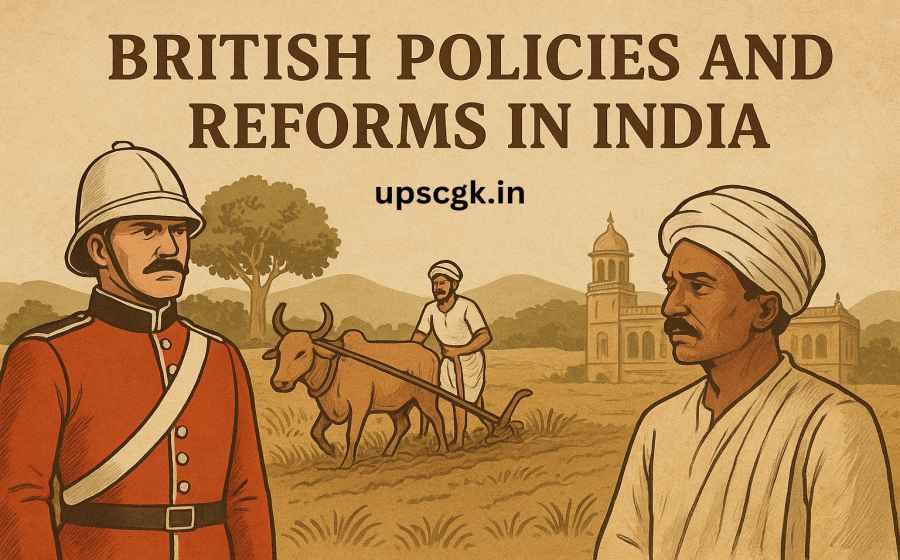
A brief overview of British Policies and Reforms in India and their impact on the nation’s economy, education, and administration.
British Policies and Reforms in India
The British rule in India was marked by a series of policies and reforms that reshaped the country’s social, economic, and administrative structure. These policies were often designed to strengthen British control and maximize colonial profits, but they also introduced new systems that eventually influenced modern India. From land revenue settlements to the introduction of English education and civil services, the British era transformed India in ways that still shape the nation today.
Here we explains the major British policies and their impact on India in a simple and detailed manner.
Table of Contents
1. Economic Policies: Reshaping India’s Agrarian and Trade System
One of the most significant aspects of British rule was the economic transformation, driven mainly by policies meant to benefit Britain.
Land Revenue Settlements and Heavy Taxation
The British introduced several land revenue systems, Permanent Settlement (1793) in Bengal, Ryotwari System in Madras and Bombay, and Mahalwari System in North India. Among these, the Permanent Settlement was the most impactful. Under this system, zamindars were made owners of the land and were responsible for paying a fixed revenue to the British government.
This fixed revenue was extremely high, and failure to pay often led to confiscation of land. As a result:
- Farmers faced burdensome taxes.
- Zamindars exploited peasants to meet revenue demands.
- Land became a commodity, and insecurity among peasants increased.
- Agricultural productivity suffered.
Destruction of Traditional Industries
Before British rule, India was a global leader in textile production and handicrafts. However, British economic policies destroyed these indigenous industries. British-imposed tariffs made Indian goods expensive, while machine-made textiles from Britain were allowed into India at cheap rates.
This led to:
- Decline of artisan communities
- Loss of millions of traditional jobs
- Rise of poverty in urban and rural areas
Monopolistic Trade Policies
The British East India Company imposed absolute control over Indian trade. Indian raw materials such as cotton, jute, indigo, and minerals were exported to Britain at very low prices, while finished British goods were sold in India at higher rates.
This resulted in:
- Drain of wealth from India
- Collapse of local markets
- Increasing dependency on British imports
These economic policies created deep-rooted agrarian distress and contributed to repeated famines, including the Bengal Famine of 1770 and the Great Famine of 1876-78.
2. Education Reforms: The Rise of English Education
British rule brought significant changes in India’s education system. These reforms had long-term effects on Indian society.
Macaulay’s Minute on Education (1835)
In 1835, Thomas Babington Macaulay introduced a policy to promote Western-style education in India. According to him, the aim was to create “a class of persons, Indian in blood and colour, but English in tastes, morals, and intellect.”
Key features of British education policy:
- Promotion of English language and Western sciences
- Decline of traditional learning institutions like pathshalas, gurukuls, and madrasas
- Creation of educated Indians who could work as clerks, teachers, and assistants in British administration
Positive Effects of Education Reforms
Although the intention behind these reforms was to support colonial administration, they also produced unintended consequences:
- Growth of a new educated middle class
- Spread of modern ideas like nationalism, democracy, and liberty
- Emergence of Indian leaders like Dadabhai Naoroji, Raja Ram Mohan Roy, Bal Gangadhar Tilak, and Mahatma Gandhi, who later led the freedom movement
British education reforms played a key role in developing political consciousness among Indians.
3. Administrative Reforms: Modern Governance in India
British policies also modernized India’s administrative framework. Many structures created during colonial rule still exist today.
Civil Services and Bureaucracy
The British established a centralized and powerful administrative system. The Indian Civil Service (ICS), often called the “steel frame” of British rule, was created to ensure effective governance. It was dominated by British officers, but over time, Indians like Satyendranath Tagore also entered the service.
Judicial Reforms
The British introduced:
- A uniform legal system
- Codified laws such as the IPC (Indian Penal Code, 1860)
- High courts in major cities
These reforms brought a sense of structure but often favored British interests.
Police and Military Reforms
To maintain control, the British created a modern police force and reorganized the army. These institutions later played a major role in shaping India’s post-independence administrative system.
4. Overall Impact: Seeds of Modernization and Discontent
British reforms introduced new systems in education, administration, and law, many of which continue to influence India. However, these reforms also led to exploitation, poverty, and widespread dissatisfaction among Indians.
The economic hardships, cultural suppression, and administrative discrimination eventually united Indians across regions and communities. These grievances became the foundation of nationalist movements, contributing directly to the struggle for independence.
Summary
British policies and reforms dramatically changed India’s economic structure, education system, and administration. While some reforms paved the way for modernization, the overall impact created deep social and economic inequalities. The dissatisfaction caused by these exploitative policies gave rise to Indian nationalism, ultimately leading to the freedom movement. Understanding these reforms helps us see how colonial rule shaped modern India while also motivating Indians to fight for independence.
Also Check: History