
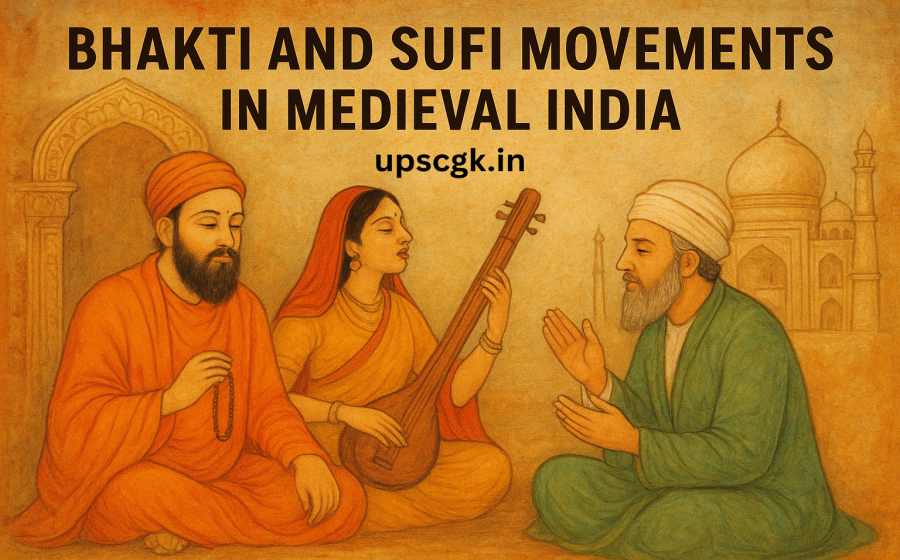
Discover how the Bhakti and Sufi Movements in Medieval India promoted devotion, equality, and cultural harmony, uniting people across religions through love and spiritual reform.
Bhakti and Sufi Movements in Medieval India
The Bhakti and Sufi movements were two of the most influential spiritual revolutions in medieval India. Emerging between the 8th and 17th centuries, these movements reshaped India’s religious landscape by promoting devotion, equality, love, and harmony.
At a time when society was deeply divided by caste, religious differences, and rigid rituals, Bhakti and Sufi saints brought a refreshing wave of change that touched the hearts of millions. Through their teachings and poetry, they united people across communities and built the foundation of India’s composite culture.
Table of Contents
Origin and Growth of the Bhakti Movement
The roots of the Bhakti movement can be traced to 7th-century South India, where the devotional traditions of the Alvars (followers of Vishnu) and the Nayanars (worshippers of Shiva) first began to flourish. These saints rejected strict rituals and priestly dominance, stressing that pure devotion (bhakti) was the only path to reach God. Over time, the movement spread to North India and developed into a major spiritual force.
North India saw the rise of several great Bhakti saints:
1. Kabir
Kabir was one of the most influential Bhakti poets. He rejected caste divisions, idol worship, and rigid religious practices. His couplets (dohe) emphasized inner purity and the importance of a direct connection with God. Kabir’s teachings appealed to both Hindus and Muslims, making him a bridge between communities.
2. Mirabai
Mirabai, the Rajput princess of Mewar, dedicated her life to Lord Krishna. Her devotional songs are full of love, surrender, and spiritual longing. Mirabai challenged social norms by refusing to follow royal traditions and choosing a spiritual path instead. Her poetry touched the emotional core of Hindu devotion.
3. Tulsidas
Tulsidas, the author of Ramcharitmanas, made sacred knowledge accessible to ordinary people by writing in the local language (Awadhi). Through his writings, he spread the values of dharma, devotion, and righteousness. His retelling of the Ramayana made the story of Lord Rama even more popular among the masses.
4. Chaitanya Mahaprabhu
Chaitanya Mahaprabhu was a major proponent of the Vaishnava Bhakti tradition in Bengal. He spread the message of devotion through kirtans (group singing of God’s name) and encouraged emotional connection with Krishna. His movement played a key role in shaping Bengal’s spiritual identity.
The central message of the Bhakti saints was simple:
God is one, and devotion is the path to reach Him.
They challenged social inequalities and encouraged the idea that anyone – irrespective of caste or gender – could attain spiritual liberation.
Rise of Sufi Movement in India
While the Bhakti movement flourished among Hindus, a parallel spiritual movement grew within Islam – the Sufi movement. Sufism emphasized inner purity, love for God, and service to humanity. Instead of focusing on rigid laws (Sharia), Sufis believed in experiencing divine love through meditation, music, and compassion.
1. Khwaja Moinuddin Chishti
The most revered Sufi saint in India, Khwaja Moinuddin Chishti of Ajmer established the Chishti Silsila (order). He preached tolerance, generosity, and universal brotherhood. His dargah in Ajmer became a symbol of communal harmony, attracting people of all religions.
2. Nizamuddin Auliya
Nizamuddin Auliya, another great Sufi saint, spread the message of love and equality in Delhi. His teachings focused on kindness, humility, and helping the poor. His close association with poet Amir Khusrau enriched India’s cultural and musical traditions, especially with the development of qawwali.
Sufi saints used simple language, poetry, and music to spread their message. Their approach was emotional and human-centered, which deeply influenced society.
Common Values and Impact of Bhakti & Sufi Movements
Despite emerging from different religions, Bhakti and Sufi movements shared several core principles:
1. Devotion Over Rituals
Both movements rejected complicated rituals and emphasized heartfelt devotion as the true path to God.
2. Social Equality
Bhakti saints attacked caste barriers, and Sufis welcomed people from all social backgrounds. This made spirituality more inclusive.
3. Love and Peace
Bhakti poetry and Sufi music both focused on universal love and brotherhood, helping reduce religious tensions in medieval India.
4. Use of Local Languages
Saints used local dialects like Hindi, Awadhi, Bengali, Tamil, and Persian-Hindavi, making spiritual teachings accessible to common people.
5. Cultural Fusion
The interaction between Bhakti and Sufi traditions helped create India’s composite culture – blending Hindu and Islamic elements in art, music, literature, and daily life.
Long-Lasting Influence on Indian Society
The Bhakti and Sufi movements brought major changes to medieval and modern India:
- Encouraged religious tolerance
- Strengthened vernacular literature
- Promoted music traditions like bhajans and qawwali
- Challenged social discrimination
- Inspired future reformers like Guru Nanak, who founded Sikhism
- Helped reduce conflict between Hindu and Muslim communities
The emotional, simple, and universal nature of their teachings ensured that these movements reached millions of people and left a permanent mark on Indian spirituality.
Summary
The Bhakti and Sufi movements were not just religious reform movements – they were social revolutions that transformed Indian society. They taught that God is found not in rituals or wealth, but in love, compassion, and devotion. By promoting unity, equality, and peace, these movements played a crucial role in bridging the gap between Hindu and Muslim communities. Their teachings continue to inspire India’s cultural harmony even today.
Also Check: History