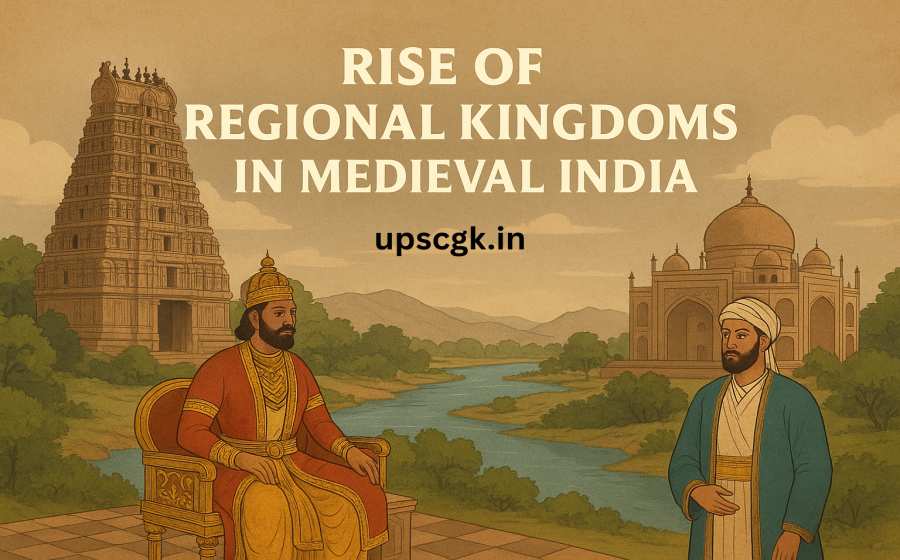
Rise of Regional Kingdoms in Medieval India – Explore how the Vijayanagara Empire and Bahmani Sultanate shaped culture, trade, and political balance in South India and the Deccan.
Rise of Regional Kingdoms in Medieval India
After the establishment of the Delhi Sultanate in northern India, political power and cultural developments were not limited to Delhi alone. Across the South and the Deccan, several regional kingdoms rose to prominence and played a crucial role in shaping India’s medieval history.
These kingdoms, especially the Vijayanagara Empire and the Bahmani Sultanate, developed distinct administrative systems, encouraged economic activities, supported art and literature, and contributed to India’s vibrant cultural diversity. Their rise ensured that medieval India was not defined by one political center but by many that worked independently while influencing one another.
Table of Contents
Vijayanagara Empire (1336-1646): A Stronghold of Culture and Power
The Vijayanagara Empire, founded in 1336 by Harihara I and Bukka Raya, emerged at a time when South India needed a powerful political authority to resist the expansion of northern forces. The founding brothers, who initially served the Kakatiya and later the Hoysala kingdoms, established their capital on the banks of the Tungabhadra River, a location that offered natural protection and economic advantages.
Within a short time, Vijayanagara grew into one of the most prosperous empires of medieval India. Its capital city, Hampi, became a flourishing commercial and cultural center that attracted traders from Persia, Arabia, Portugal, and China. Contemporary travelers like Nicolo Conti, Abdur Razzaq, and Domingo Paes described Vijayanagara as one of the richest cities of their time.
Cultural Contributions
The empire promoted Hindu art, literature, and temple architecture. Kings like Krishnadevaraya, the most celebrated ruler of the Tuluva dynasty, patronized poets and scholars in multiple languages including Telugu, Sanskrit, Tamil, and Kannada. His era is often called the Golden Age of Telugu Literature.
Architecturally, Vijayanagara is known for grand temples such as:
- Virupaksha Temple
- Vittala Temple (with its famous stone chariot)
- Hazara Rama Temple
These monuments reflect a unique blend of Dravidian and Indo-Islamic architectural styles. Even today, the ruins of Hampi stand as a UNESCO World Heritage Site, showcasing the empire’s magnificence.
Administrative and Military Strength
The empire was known for its efficient administration. It had a well-organized revenue system, strong provincial governors (called Nayakas), and a disciplined army equipped with cavalry, infantry, archers, and war elephants.
The empire successfully defended South India for over two centuries, especially against repeated invasions by northern sultanates. This resistance helped protect Hindu traditions and cultural centers during a time of political instability in North India.
Bahmani Sultanate (1347-1527): Persian Influence and Deccan Politics
While Vijayanagara dominated the South, the Bahmani Sultanate rose to power in the Deccan region. Founded in 1347 by Ala-ud-Din Bahman Shah, a governor who rebelled against the Delhi Sultanate, the Bahmani kingdom established its capital initially at Gulbarga and later at Bidar.
Cultural Flourishing in the Deccan
The Bahmani rulers actively promoted Persian art, architecture, and learning. Their courts became centers of scholarship, welcoming poets, scholars, architects, and artists from Persia and Central Asia.
Some notable contributions include:
- Persian-style architecture: domes, arches, and fort complexes
- Establishment of madrasas and libraries
- Promotion of literature in Persian, Arabic, and local languages
Architectural monuments like the Mahmud Gawan Madrasa in Bidar and the Gulbarga Fort highlight the sultanate’s artistic legacy.
Fragmentation and Emergence of Deccan Sultanates
By the early 16th century, internal conflicts weakened the Bahmani Sultanate. Eventually, it split into five smaller kingdoms, collectively known as the Deccan Sultanates:
- Bijapur (Adil Shahi)
- Golconda (Qutb Shahi)
- Ahmadnagar (Nizam Shahi)
- Bidar (Barid Shahi)
- Berar (Imad Shahi)
These states became powerful regional forces that shaped Deccan politics for more than a century. They continued the Persian cultural tradition while blending it with local art forms, giving rise to a unique Indo-Persian-Deccan culture.
Balance of Power and Cultural Exchange
The coexistence of the Vijayanagara Empire and the Bahmani Sultanate created a dynamic political environment in medieval India. Their frequent wars, especially over the fertile Raichur Doab, shaped the political boundaries of the region. Yet, despite rivalry, they promoted trade, craftsmanship, and urban development.
These kingdoms contributed to:
- Growth of maritime trade with West Asia and Southeast Asia
- Development of regional literature in Telugu, Kannada, Tamil, Marathi, and Persian
- Promotion of religious tolerance as different communities coexisted under their rule
- Flourishing of architecture, sculptures, music, and dance
Their rise ensured that medieval India was not culturally homogeneous but a mosaic of traditions shaped by diverse regional powers.
Summary
The period of the regional kingdoms represents one of the most vibrant eras in Indian history. The Vijayanagara Empire preserved and enriched Hindu cultural traditions, while the Bahmani Sultanate introduced and developed Persian influences in the Deccan. Together, they fostered an environment of cultural growth, trade expansion, and artistic achievements. Their legacies, seen today in Hampi, Bidar, Bijapur, and Golconda, continue to remind us of India’s rich and diverse medieval heritage.
Also Check: History