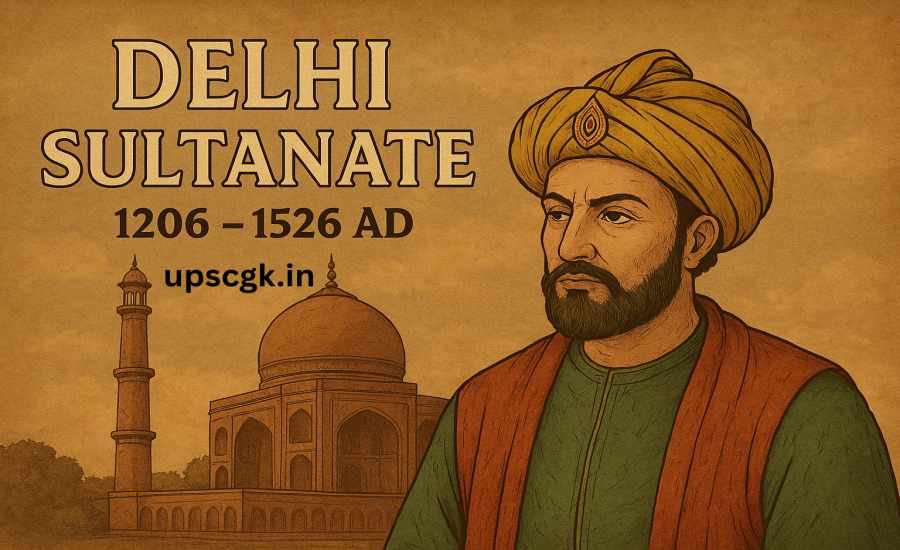
Explore the Delhi Sultanate (1206-1526 AD), its five ruling dynasties, major rulers, administration, and cultural legacy that shaped medieval Indian history.
The Delhi Sultanate (1206–1526 AD)
The Delhi Sultanate marks a crucial phase in Indian history. It represents the establishment of Muslim rule in northern India and introduced significant cultural, political, and administrative changes. Founded by Qutb-ud-din Aibak in 1206 AD, the Sultanate ruled for more than three centuries (1206–1526 AD) and laid the foundation for the later Mughal Empire. During this period, Delhi emerged as a prominent political and cultural center of the subcontinent.
Table of Contents
The Delhi Sultanate consisted of five major dynasties that ruled successively:
- Slave (Mamluk) Dynasty (1206–1290)
- Khilji Dynasty (1290–1320)
- Tughlaq Dynasty (1320–1414)
- Sayyid Dynasty (1414–1451)
- Lodi Dynasty (1451–1526)
Each dynasty contributed uniquely to governance, architecture, economy, and military conquests.
1. Slave (Mamluk) Dynasty (1206–1290)
The Delhi Sultanate began with the Slave Dynasty, founded by Qutb-ud-din Aibak, a trusted general of Muhammad Ghori. After Ghori’s death, Aibak declared independence and became the first Sultan of Delhi.
Key Rulers
- Qutb-ud-din Aibak (1206–1210)
- Laid the foundation of the Sultanate
- Began the construction of Qutub Minar
- Iltutmish (1211–1236)
- Real founder of the Sultanate
- Introduced silver coins (Tanka) and copper coins (Jital)
- Successfully defended the empire from Mongols
- Razia Sultana (1236–1240)
- First and only woman ruler of Delhi
Contributions
- Strengthened Delhi as a political capital
- Built architectural marvels like Qutub Minar
- Improved administrative machinery
2. Khilji Dynasty (1290–1320)
The Khiljis were known for strong military expansion and strict economic reforms.
Key Ruler: Alauddin Khilji (1296–1316)
Alauddin Khilji was the most powerful ruler of the dynasty.
His achievements include:
- Conquering large territories including Gujarat, Malwa, and Deccan
- Strengthening the army
- Successfully preventing Mongol invasions
- Introducing market reforms to control price inflation
He expanded the empire further south and established economic stability.
3. Tughlaq Dynasty (1320–1414)
The Tughlaqs brought ambitious policies, although many failed due to poor execution.
Key Rulers
- Ghiyasuddin Tughlaq (1320–1325)
- Stabilized the empire
- Improved justice and administration
- Muhammad bin Tughlaq (1325–1351)
- Known for bold but unsuccessful experiments
- Transferred capital from Delhi to Daulatabad
- Introduced token currency
His decisions led to economic instability and revolts.
- Firoz Shah Tughlaq (1351–1388)
- Known for welfare works
- Built canals, rest houses, mosques, and towns
- Encouraged architecture and agriculture
After his death, the dynasty weakened, and the empire declined, especially after Timur’s invasion (1398), which devastated Delhi.
4. Sayyid Dynasty (1414–1451)
The Sayyid Dynasty emerged after Timur’s departure from Delhi.
Characteristics
- Ruled over a small and weak territory
- Depended largely on local chiefs
- Delhi’s power significantly reduced
The Sayyids could not restore the glory of the Sultanate and were eventually replaced by the Lodis.
5. Lodi Dynasty (1451–1526)
The Lodis were the last ruling dynasty of the Delhi Sultanate and also the first Afghan dynasty to rule Delhi.
Key Rulers
- Bahlol Lodi (1451–1489)
- Reunified territories and strengthened the kingdom
- Sikandar Lodi (1489–1517)
- Promoted agriculture and trade
- Founded Agra
- Ibrahim Lodi (1517–1526)
- Faced nobles’ opposition
- Babur’s win at the First Battle of Panipat in 1526 marked his downfall.
This turning point ended Sultanate authority and marked the rise of the Mughal Empire.
Administration & Culture
The Delhi Sultanate transformed administration, taxation, and culture in India.
Administrative Features
- Centralized monarchy
- Use of Persian language in administration
- Division of the empire into provinces (Iqtas)
- Military-based governance
Cultural & Architectural Influence
- Adoption of Indo-Islamic architectural styles
- Construction of forts, mosques, and tombs
- Persian influence on art, language, and literature
- Beginning of Urdu language due to cultural fusion
Monuments like Qutub Minar, Alai Darwaza, Tughlaqabad Fort, Feroz Shah Kotla, and Lodi Gardens reflect this era’s architectural excellence.
Legacy of the Delhi Sultanate
The Delhi Sultanate left a long-lasting impact on India:
- Spread of Persian culture and literature
- Development of Indo-Islamic architecture
- Introduction of new administrative systems
- Foundation for the Mughal Empire
- Growth of urban centers like Delhi and Agra
- Rise of new social and cultural traditions
It served as a bridge between ancient and medieval India, shaping the subcontinent’s cultural and political evolution.
Summary
The Delhi Sultanate (1206–1526 AD) marked a transformative period in Indian history. It unified diverse regions under a powerful central authority and introduced new administrative and cultural frameworks. The five dynasties contributed significantly to political expansion, architectural development, and cultural synthesis. Although the empire eventually weakened, its legacy endured and became the foundation for the Mughal Empire, which followed in 1526.
Also Check: History