Mauryan Empire – Learn about India’s first pan-Indian empire, its rulers Chandragupta, Bindusara, and Ashoka, administration, art, and lasting legacy.
Mauryan Empire Introduction
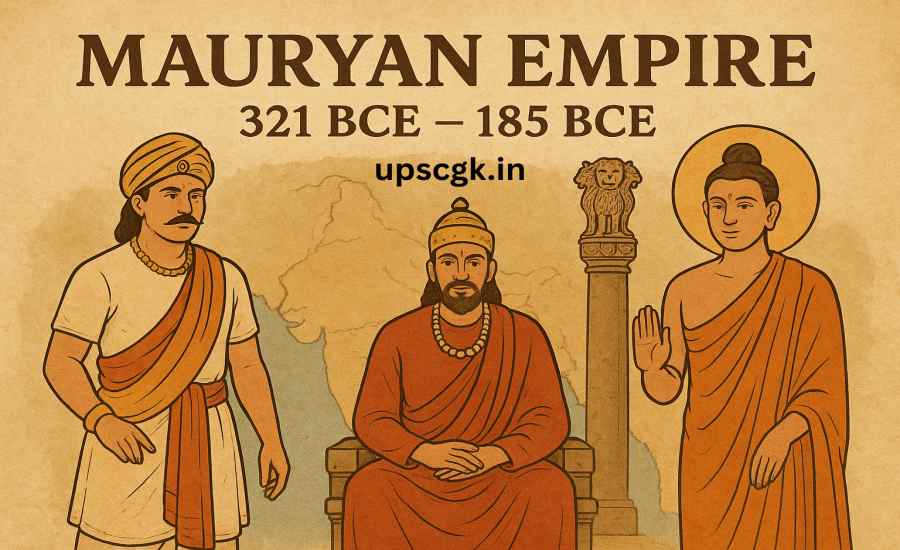
The Mauryan Empire (321 BCE – 185 BCE) was India’s first great pan-Indian empire, uniting almost the entire subcontinent under one rule. Founded by Chandragupta Maurya with the guidance of the brilliant strategist Chanakya (Kautilya), the empire marked the beginning of a new era in Indian political history. It was during this time that India witnessed strong central administration, efficient governance, and the spread of Buddhism under Emperor Ashoka the Great.
The Mauryan period is one of the most remarkable chapters in ancient Indian history – known for political unification, economic prosperity, and cultural development.
Table of Contents
Foundation of the Mauryan Empire
Before the rise of the Mauryas, India was divided into several Mahajanapadas, and the Nanda Empire ruled Magadha. However, the Nandas were unpopular due to their oppressive rule and heavy taxation.
Chanakya, a wise scholar from Takshashila, sought to overthrow the Nandas. He discovered Chandragupta Maurya, a talented young man with leadership potential. Together, they organized an army and defeated Dhana Nanda, the last Nanda ruler, around 321 BCE, establishing the Mauryan Empire with its capital at Pataliputra (modern Patna).
This victory marked the beginning of centralized imperial rule in India for the first time.
Key Rulers of the Mauryan Empire
1. Chandragupta Maurya (321-297 BCE)
Chandragupta was the founder of the Mauryan dynasty. With Chanakya’s political and diplomatic guidance, he built a strong empire that extended from Afghanistan in the northwest to Bengal in the east. He also defeated Seleucus Nicator, one of Alexander the Great’s generals, around 305 BCE, and a peace treaty was signed.
Seleucus gave Chandragupta control of eastern Afghanistan, Baluchistan, and parts of Persia in exchange for 500 war elephants and a matrimonial alliance.
After ruling efficiently for about 24 years, Chandragupta renounced his throne, embraced Jainism, and spent his last years at Shravanabelagola in Karnataka.
2. Bindusara (297–273 BCE)
Bindusara, the son of Chandragupta, succeeded him. He continued the work of expansion and consolidated the empire further south into the Deccan region, extending up to present-day Karnataka.
Greek sources mention him as Amitrochates (destroyer of enemies). He maintained diplomatic relations with foreign rulers like Antiochus I of Syria and Ptolemy II Philadelphus of Egypt. Bindusara’s reign ensured political stability and paved the way for his son Ashoka to ascend the throne.
3. Ashoka the Great (273-232 BCE)
Ashoka is the most famous and influential ruler of the Mauryan Empire. Initially, he ruled with firmness and ambition. However, the Kalinga War (261 BCE) changed his life completely. The massive bloodshed and loss of life during the war deeply affected him.
Ashoka renounced violence and adopted Buddhism, becoming one of the greatest promoters of peace and Dharma. He declared his rule based on Dhamma (moral law), inspired by Buddhist principles such as compassion, truth, and non-violence.
Ashoka built edicts and pillars across the empire to spread his message of righteousness. These inscriptions, found in places like Girnar, Dhauli, and Sarnath, are among the earliest examples of written records in Indian history.
Under Ashoka, the Mauryan Empire reached its greatest territorial extent, covering almost the entire Indian subcontinent except the deep south.
Administration of the Mauryan Empire
The Mauryan administration was one of the most efficient and organized systems in ancient India, as described in Kautilya’s Arthashastra.
1. Central Administration
The emperor was the supreme authority, assisted by a council of ministers called Mantriparishad. The empire was divided into provinces ruled by princes or governors. The capital city, Pataliputra, was managed by a municipal body that looked after sanitation, trade, and taxation.
2. Provincial and Local Administration
The empire was divided into four provinces – Taxila, Ujjain, Tosali, and Suvarnagiri – each governed by royal princes. Districts were managed by officers known as Rajukas and Pradesikas, responsible for maintaining law, order, and revenue collection.
3. Military and Espionage System
The Mauryas maintained a strong army with infantry, cavalry, chariots, and war elephants. Kautilya also designed a spy network to gather intelligence and prevent rebellion, ensuring internal stability.
4. Economy and Revenue
Agriculture was the backbone of the economy. The state levied land revenue, trade taxes, and customs duties. The Mauryan rulers built roads, irrigation systems, and maintained trade with foreign lands such as Greece, Egypt, and Sri Lanka.
Art and Architecture
The Mauryan period saw remarkable progress in art, architecture, and sculpture. The Ashokan pillars, carved out of single pieces of polished sandstone, are masterpieces of craftsmanship. The Lion Capital of Sarnath, adopted as the National Emblem of India, is a fine example.
The construction of Stupas (such as Sanchi and Bharhut) and rock-cut caves (like Barabar Hills) also flourished under Ashoka’s patronage.
Decline of the Mauryan Empire
After Ashoka’s death in 232 BCE, the empire gradually declined. Successors like Dasharatha and Brihadratha were weak rulers. Internal revolts, administrative inefficiency, and foreign invasions weakened the state.
Finally, Pushyamitra Shunga, a general of the Mauryan army, assassinated Brihadratha in 185 BCE, marking the end of the Mauryan dynasty and the rise of the Shunga Empire.
Legacy of the Mauryan Empire
The Mauryan Empire left an everlasting legacy on Indian history. It was the first empire to unify India politically. Ashoka’s policies of non-violence, religious tolerance, and moral governance influenced generations.
The administrative systems, taxation methods, and diplomatic principles laid down during this era became the foundation for later Indian kingdoms.
The Mauryan Empire remains a symbol of unity, strong governance, and moral leadership in ancient India.
Summary
The Mauryan Empire was more than just a powerful kingdom – it was a vision of unity, peace, and prosperity. From Chandragupta’s conquests to Ashoka’s transformation, the empire represents the evolution of Indian civilization from war to wisdom.
Its achievements in administration, culture, and philosophy continue to inspire modern India even today.
Also Check: History