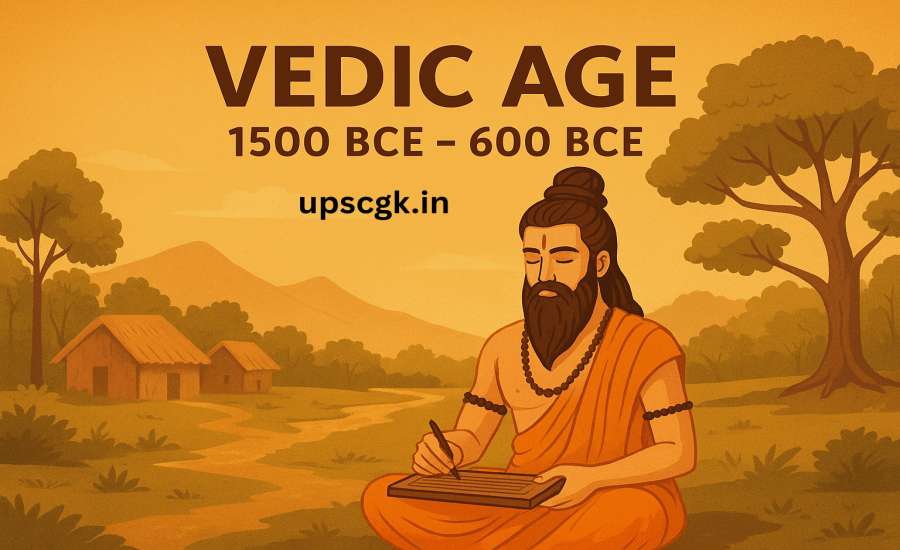
Explore the Vedic Age (1500 BCE – 600 BCE) – from the early Aryan settlements to the rise of Mahajanapadas. Learn about Vedic society, religion, economy, and the sacred Vedas of ancient India.
Vedic Age Introduction
The Vedic Age (1500 BCE – 600 BCE) is one of the most significant periods in Indian history. It marks the arrival of the Aryans in India after the decline of the Indus Valley Civilization. During this age, the Vedas – the earliest known religious and literary texts of India – were composed, giving rise to the foundations of Hindu culture, society, and philosophy.
Table of Contents
The Vedic Age is broadly divided into two phases – the Early Vedic Period (1500-1000 BCE) and the Later Vedic Period (1000-600 BCE). Both periods show a gradual transition from a simple tribal life to a complex agrarian society with kingdoms, rituals, and philosophical thought.
Early Vedic Period (1500-1000 BCE)
Origin and Life
The Aryans, originally from Central Asia, entered northwestern India through the passes of the Hindu Kush mountains. They first settled in the Punjab region, which they called the ‘Sapta Sindhu’ or the land of seven rivers. Their primary source of information comes from the Rigveda, the oldest of the four Vedas.
During this period, the society was pastoral and tribal. People mainly depended on cattle rearing for livelihood. Cows were regarded as a symbol of wealth, and conflicts between tribes often occurred over cattle and pastures.
Political Life
The political structure of the early Vedic period was simple. The basic political unit was the ‘Jana’, a tribe. Each Jana was led by a chief called the Raja, who was not a king in the modern sense but a tribal leader chosen for his bravery and wisdom. The administration was assisted by two major tribal assemblies – the Sabha and the Samiti.
- Sabha: A small council of elders advising the Raja.
- Samiti: A larger general assembly of the tribe.
There was no concept of hereditary monarchy, and the king’s power was limited by the consent of these assemblies.
Social Life
The society was patriarchal, with the family as the basic unit. The position of women was quite respected – they could attend assemblies, perform rituals, and even compose hymns. Marriage was sacred, and the institution of joint family was common.
Social divisions existed but were based on occupation, not birth. The Varna system had not yet become rigid. The four varnas – Brahmins (priests), Kshatriyas (warriors), Vaishyas (traders/farmers), and Shudras (servants) – were still fluid and flexible.
Religion
The early Vedic religion was naturalistic and polytheistic. The Aryans worshipped various forces of nature as gods:
- Indra (God of thunder and war),
- Agni (God of fire),
- Varuna (God of cosmic order),
- Surya (Sun God),
- Vayu (Wind God).
Religious practices centered around yajnas (sacrifices) and chanting of hymns to please these deities. There were no temples or idols, and worship was done in open spaces.
Economy
The economy of the early Vedic period was based on pastoralism and limited agriculture. People reared cattle, horses, and sheep. Barter was common, and cow was the main unit of exchange. Agriculture began to expand gradually, especially in fertile river valleys.
Later Vedic Period (1000-600 BCE)
Expansion and Settlement
During the later Vedic period, the Aryans moved eastward and settled in the Ganga-Yamuna Doab region. This expansion led to clearing of forests, use of iron tools, and the development of agriculture on a large scale.
Permanent villages and towns emerged, leading to the formation of kingdoms and the rise of Mahajanapadas – the sixteen great states of ancient India.
Political Developments
The position of the king became stronger and hereditary. The Raja was now seen as the protector of dharma and the ruler of a defined territory. He was assisted by officials like the Purohita (priest), Senani (commander), and Gramini (village head).
Assemblies like Sabha and Samiti continued but lost much of their political importance. The concept of taxation (Bali) also emerged, where people offered a part of their produce to the king.
Social and Cultural Life
Society became more complex and hierarchical. The Varna system became rigid, dividing people strictly by birth. The Brahmins gained great respect as priests and teachers, while Shudras were placed at the bottom of the social order.
The position of women declined – they lost rights to attend assemblies and were excluded from religious education. The joint family system remained, but social distinctions widened.
Economic Life
Agriculture became the backbone of the economy. The use of iron ploughs increased productivity. Trade and crafts also developed, leading to the rise of new professions like carpentry, pottery, and metalwork. Coins called Nishka and Krishnala were used in trade.
Religion and Philosophy
Religious thought became more ritualistic during this time. The performance of large sacrifices (Ashvamedha, Rajasuya, Vajapeya) was believed to bring prosperity and power to kings.
However, spiritual thinkers began to question the value of rituals. This led to the composition of the Upanishads, which emphasized philosophy, meditation, and self-realization. Concepts like karma, dharma, moksha, and Atman (soul) became central to Indian thought.
Literature
The later Vedic period saw the composition of texts like:
- Sama Veda – musical chants for rituals.
- Yajur Veda – formulas and procedures for sacrifices.
- Atharva Veda – magical hymns and healing rituals.
- Brahmanas – prose texts explaining rituals.
- Aranyakas and Upanishads – philosophical treatises exploring the meaning of life and the universe.
Summary
The Vedic Age laid the foundation of Indian civilization – in religion, philosophy, language, and social organization. From a pastoral life in the early phase to the rise of kingdoms and spiritual thought in the later phase, this period shaped the core values of Indian culture that continue to influence life even today.
Also Check: History