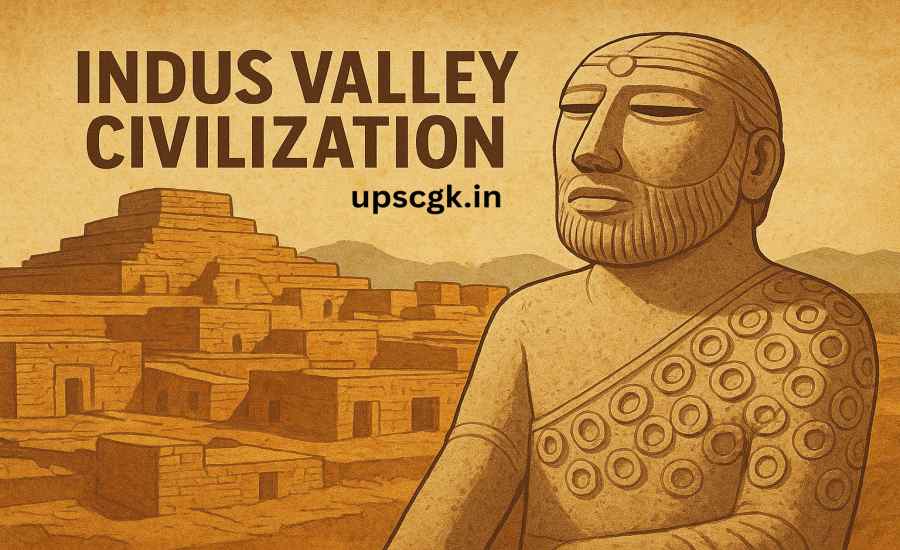
Discover the Indus Valley Civilization – one of the world’s earliest urban cultures known for its planned cities, advanced drainage system, and rich trade and culture.
Indus Valley Civilization Introduction
The Indus Valley Civilization (2600 BCE – 1900 BCE), also known as the Harappan Civilization, was one of the earliest and most advanced urban civilizations in the ancient world. It flourished along the banks of the Indus River and its tributaries, covering parts of present-day India and Pakistan. Contemporary with the civilizations of Mesopotamia and Egypt, the Indus Valley Civilization stands out for its remarkable urban planning, scientific approach to architecture, and sophisticated lifestyle.
Table of Contents
Discovered in the 1920s after excavations at Harappa and Mohenjo-Daro, this civilization revealed how ancient people created one of the world’s most organized societies thousands of years ago.
Geographical Extent
The Indus Valley Civilization stretched across an area of about 1.25 million square kilometers, making it larger than both Mesopotamian and Egyptian civilizations. It extended from Sutkagendor (near the Makran coast of Balochistan) in the west to Alamgirpur (Uttar Pradesh) in the east, and from Manda (Jammu and Kashmir) in the north to Daimabad (Maharashtra) in the south.
Major sites include:
- Harappa (Punjab, Pakistan)
- Mohenjo-Daro (Sindh, Pakistan)
- Lothal and Dholavira (Gujarat, India)
- Kalibangan (Rajasthan, India)
- Rakhigarhi (Haryana, India)
These sites show the widespread and organized nature of the civilization.
Urban Planning and Architecture
The most striking feature of the Indus Valley Civilization was its well-planned cities. Archaeologists found that the cities were built following a grid pattern – streets cut each other at right angles, dividing the city into rectangular blocks.
Key architectural features included:
- Use of Burnt Bricks: Every house and public building used uniformly sized burnt bricks, ensuring durability.
- Drainage System: Each house had access to covered drains, connected to main drains – showing advanced sanitation and public health awareness.
- Public Buildings: The Great Bath of Mohenjo-Daro is the best-known structure, possibly used for ritual bathing.
- Granaries and Warehouses: Large granaries found in Harappa and Mohenjo-Daro suggest organized food storage and trade management.
This level of urban development shows that the Harappans were skilled planners and engineers who valued cleanliness and organization.
Society and Culture
The Harappan society was peaceful, well-organized, and prosperous. There is no clear evidence of warfare or weapons of mass destruction, suggesting a focus on trade and daily life rather than conquest.
- Social Life: People lived in well-built houses with separate areas for bathing and cooking. There was a clear distinction between residential and public areas.
- Dress and Ornaments: Men and women wore cotton clothes. Ornaments made of gold, silver, and beads were common, showing both fashion and craftsmanship.
- Seals and Art: The Harappans made thousands of seals with images of animals and symbols. The most famous seal shows a figure sitting in a yogic posture, believed to represent Proto-Shiva or Pashupati.
- Religion: They worshipped Mother Goddess (symbol of fertility), Proto-Shiva, and sacred animals like bulls and unicorns. Trees like Peepal were also considered sacred. Temples were not yet developed, and worship seems to have taken place in homes or open spaces.
Art and crafts were advanced – they made terracotta toys, bronze figurines (like the famous Dancing Girl of Mohenjo-Daro), and pottery with fine designs.
Economy and Trade
The economy of the Indus Valley Civilization was diverse and well-developed, primarily based on agriculture, crafts, and trade.
- Agriculture: The fertile plains of the Indus River supported crops like wheat, barley, rice, and dates. Irrigation methods were simple but effective.
- Crafts: The people specialized in bead-making, pottery, metallurgy (copper, bronze, and gold), and textile weaving.
- Trade: The Harappans traded with Mesopotamia (modern Iraq) and other regions, as shown by Mesopotamian records mentioning trade with “Meluhha” (believed to be the Indus region).
They used standard weights and measures, and seals likely served as trademarks for traders – evidence of an organized economy.
Script and Language
The Harappans developed their own script, found mainly on seals and pottery. It consists of around 400 symbols, but it remains undeciphered to this day. Because no bilingual text (like the Rosetta Stone for Egyptian) has been found, the meaning of their writings is still a mystery.
However, this script shows that the people were literate and used written communication for trade and administration.
Decline of the Civilization
The decline of the Indus Valley Civilization around 1900 BCE remains one of history’s great mysteries. Several theories have been proposed:
- Climate Change: Possible drying up of rivers like the Saraswati led to agricultural collapse.
- Floods or Earthquakes: Natural disasters might have destroyed major cities.
- Invasion Theory: Some scholars once suggested an invasion by Indo-Aryans, though this is now debated.
- Economic Decline: Overuse of resources and disruption of trade could have weakened the civilization.
Eventually, the urban centers were abandoned, and the people moved eastward toward the Ganga-Yamuna plain, giving rise to the later Vedic civilization.
Summary
The Indus Valley Civilization remains one of the greatest achievements of ancient humanity. Its planned cities, advanced drainage systems, uniform weights and measures, and rich cultural life reflect a high level of development long before modern nations existed.
Even after more than a century of research, many questions remain unanswered – especially about their language and the exact reasons for their decline. Yet, the legacy of the Harappans continues to inspire admiration, reminding us of the brilliance of India’s ancient past.
Also Check: History