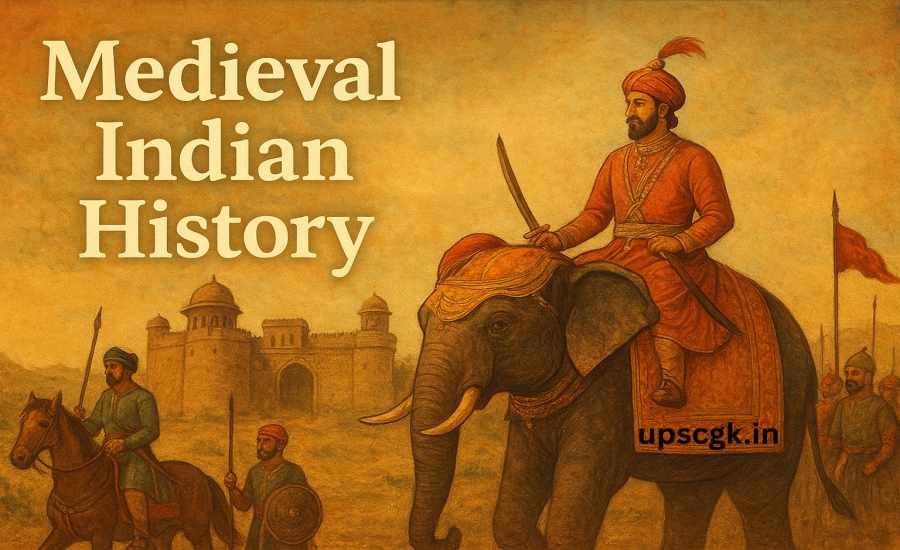
Explore Medieval Indian History, from the Delhi Sultanate to the Mughal Empire. Learn about dynasties and India’s cultural transformation. Useful for UPSC and competitive exams.
Medieval Indian History (8th to 18th Century AD)
The Medieval period of Indian history (8th to 18th Century AD) marks one of the most dynamic and transformative phases in the Indian subcontinent. It bridges the ancient world of powerful empires with the dawn of the modern age. During this time, India witnessed major political changes, the rise and fall of dynasties, growth of cities, and flourishing art, architecture, and literature.
Table of Contents
This period is especially significant for students preparing for UPSC, SSC, and State Civil Services exams, as it covers the foundation of India’s political, social, and cultural evolution.
Transition from Ancient to Medieval India
The decline of ancient kingdoms like the Guptas and Harshavardhana’s empire led to the emergence of several regional powers. From the 8th century onward, India saw a new wave of invasions and the gradual establishment of Islamic rule. This marked the beginning of the Medieval period, which continued until the rise of European colonial powers in the 18th century.
The Delhi Sultanate (1206–1526 AD)
The Delhi Sultanate was the first major Islamic kingdom in India. It was established by Qutb-ud-din Aibak after defeating the Rajputs and laying the foundation of Muslim rule in northern India. The Delhi Sultanate was ruled by five major dynasties:
- Slave (Mamluk) Dynasty (1206–1290) – Founded by Qutb-ud-din Aibak, succeeded by Iltutmish and Razia Sultana. This period saw the construction of the Qutub Minar and the consolidation of Delhi as the political center.
- Khilji Dynasty (1290–1320) – Alauddin Khilji expanded the empire to the Deccan and introduced market reforms.
- Tughlaq Dynasty (1320–1414) – Muhammad bin Tughlaq attempted administrative and economic experiments, while Firoz Shah Tughlaq promoted architecture and welfare projects.
- Sayyid Dynasty (1414–1451) – A relatively weaker dynasty that ruled after Timur’s invasion.
- Lodi Dynasty (1451–1526) – The last dynasty of the Sultanate, ended when Babur defeated Ibrahim Lodi in the First Battle of Panipat (1526), marking the beginning of Mughal rule.
The Delhi Sultanate introduced new administrative systems, Persian culture, and architectural styles that deeply influenced Indian society.
Regional Kingdoms and Cultural Growth
While Delhi was the center of power in North India, several regional kingdoms rose to prominence in the South and Deccan.
- Vijayanagara Empire (1336–1646) – Founded by Harihara and Bukka on the banks of the Tungabhadra River. It became a stronghold of Hindu culture and resistance against northern invasions. The empire promoted art, literature, and temple architecture, with the Hampi ruins still reflecting its grandeur.
- Bahmani Sultanate (1347–1527) – Established in the Deccan, it encouraged Persian art, architecture, and learning. Later, it split into five smaller kingdoms collectively known as the Deccan Sultanates.
These regional powers maintained political balance and encouraged trade, literature, and religious tolerance.
The Mughal Empire (1526–1857 AD)
The Mughal Empire was one of the most powerful and famous empires in India’s history. It combined strong administration with cultural brilliance and economic prosperity.
- Babur (1526–1530) – Founded the empire after winning the First Battle of Panipat.
- Humayun (1530–1556) – Faced challenges from Sher Shah Suri but regained power before his death.
- Akbar the Great (1556–1605) – The most celebrated Mughal ruler. He expanded the empire, introduced efficient administration, and promoted religious tolerance through his policy of Sulh-i-Kul (universal peace).
- Jahangir (1605–1627) – Encouraged art and painting.
- Shah Jahan (1628–1658) – Known for magnificent architecture, including the Taj Mahal, Red Fort, and Jama Masjid.
- Aurangzeb (1658–1707) – Expanded the empire to its largest extent but faced revolts due to strict religious policies.
After Aurangzeb’s death, the Mughal Empire declined, paving the way for British and regional powers to gain control.
Bhakti and Sufi Movements
The Bhakti and Sufi movements played a vital role in uniting people across religions.
- The Bhakti movement, led by saints like Kabir, Mirabai, Tulsidas, and Chaitanya Mahaprabhu, emphasized devotion, equality, and social reform.
- The Sufi movement, with saints like Khwaja Moinuddin Chishti and Nizamuddin Auliya, promoted love, peace, and brotherhood.
Together, they bridged Hindu and Muslim communities and contributed to India’s composite spiritual culture.
Art, Architecture, and Culture
Medieval India produced some of the world’s finest architectural marvels:
- Qutub Minar, Alai Darwaza, and Gol Gumbaz represent the fusion of Indo-Islamic architecture.
- The Taj Mahal, one of the Seven Wonders of the World, reflects the peak of Mughal art.
- Miniature paintings, calligraphy, and textile industries also flourished.
This era marked a true cultural synthesis that defined India’s identity for centuries.
Importance of Medieval Indian History for UPSC
Studying Medieval Indian History is crucial for UPSC and other government exams because it explains:
- The evolution of Indian administration and governance.
- The roots of India’s cultural diversity and religious harmony.
- The economic and political conditions before British rule.
- Contributions to art, architecture, and literature that still influence modern India.
Summary
The Medieval period (8th to 18th Century AD) was a bridge between ancient traditions and modern transformations. It witnessed the rise of mighty empires, cultural blending, and architectural wonders. Understanding this era helps us appreciate how India became a land of unity in diversity – a civilization shaped by both conquest and coexistence.
Also Check: History