Explore the historical background and making of the Indian Constitution, from British-era reforms to the Constituent Assembly and its adoption in 1950 clearly.
Indian Constitution
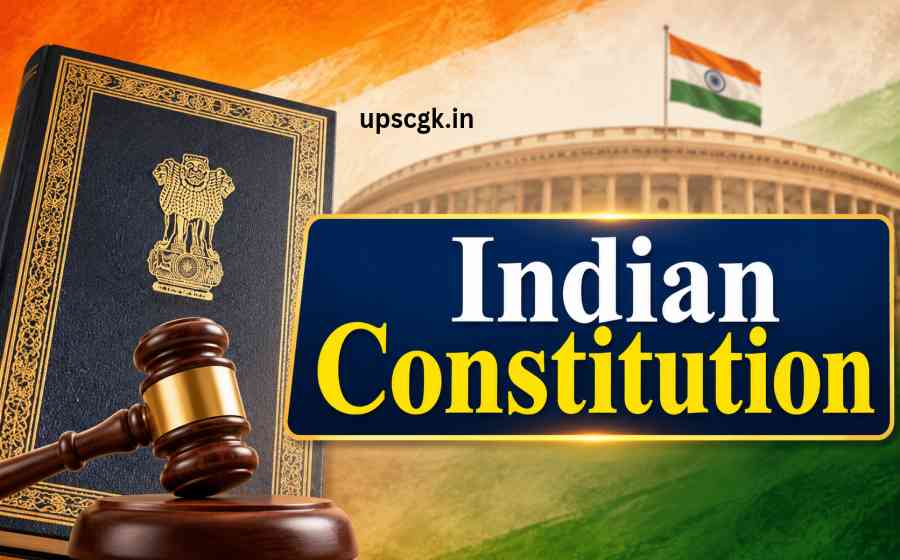
The Indian Constitution is the supreme law of India. It establishes the framework of the country’s political system, defines the powers and responsibilities of government institutions, and guarantees fundamental rights to citizens. It also reflects the ideals of justice, liberty, equality and fraternity.
The making of the Indian Constitution was a significant historical process that involved years of political developments, constitutional reforms, debates and discussions. After independence, India adopted a democratic system of government based on constitutional principles. The Constitution came into force on 26 January 1950, marking the beginning of the Republic of India.
Table of Contents
Historical Background of the Indian Constitution
The historical development of the Indian Constitution can be traced to British rule in India. Several laws and constitutional reforms introduced by the British government gradually shaped the administrative and legislative structure of the country.
Some important developments are discussed below.
1. Regulating Act of 1773
The Regulating Act of 1773 was the first major step taken by the British Parliament to regulate the administration of the East India Company in India. It established the office of Governor-General of Bengal, with Warren Hastings becoming the first Governor-General. It also provided for the establishment of a Supreme Court at Calcutta in 1774.
2. Government of India Act of 1858
Following the Revolt of 1857, the British government passed the Government of India Act of 1858. It ended the rule of the East India Company and transferred the administration of India directly to the British Crown. The Governor-General also became known as the Viceroy, representing the British Crown in India.
3. Indian Councils Act of 1909
Also known as the Morley-Minto Reforms, this Act increased Indian representation in legislative councils. It introduced separate electorates for Muslims, allowing Muslim voters to elect their own representatives.
4. Government of India Act of 1919
The Government of India Act of 1919, based on the Montagu-Chelmsford Reforms, introduced dyarchy in the provinces. Provincial subjects were divided into transferred and reserved categories. It also introduced a bicameral legislature at the Centre.
5. Government of India Act of 1935
The Government of India Act of 1935 was one of the most influential laws in the development of the Indian Constitution. It proposed an All-India Federation, introduced provincial autonomy and divided legislative powers into three lists: Federal, Provincial and Concurrent.
Several administrative provisions of this Act influenced the Constitution of independent India.
6. Indian Independence Act of 1947
The Indian Independence Act of 1947 ended British rule and created two independent Dominions, India and Pakistan, from 15 August 1947. It empowered the Constituent Assembly to frame and adopt a Constitution for independent India.
These constitutional developments provided the historical foundation for the making of the Indian Constitution.
Making of the Indian Constitution
The demand for an independent Constitution became an important part of India’s freedom movement. Indian leaders wanted a Constitution that would reflect the country’s democratic aspirations and establish a government based on popular sovereignty.
Formation of the Constituent Assembly
The Constituent Assembly was formed in 1946 under the Cabinet Mission Plan. Its members were indirectly elected by the provincial legislative assemblies, while representatives of princely states were nominated.
The Assembly originally had 389 members. Following the Partition of India in 1947, its membership was reduced to 299.
The first meeting of the Constituent Assembly took place on 9 December 1946 in New Delhi. Dr. Sachchidananda Sinha served as its temporary chairman. On 11 December 1946, Dr. Rajendra Prasad was elected as its permanent President.
Objectives Resolution
On 13 December 1946, Jawaharlal Nehru introduced the Objectives Resolution in the Constituent Assembly. It outlined the fundamental principles and ideals that would guide the Constitution.
The resolution was adopted on 22 January 1947. Its principles later became an important foundation of the Preamble, expressing India’s commitment to sovereignty, democracy, justice, liberty and equality.
Drafting Committee
On 29 August 1947, the Constituent Assembly established the Drafting Committee to prepare the draft Constitution.
Dr. B. R. Ambedkar was appointed as its Chairman. The committee examined various constitutional provisions, studied international constitutional practices and prepared the draft for discussion.
Dr. Ambedkar played a central role in explaining and defending the draft provisions during the Assembly’s debates. Other members also contributed significantly to the drafting process.
Adoption of the Constitution
The Constituent Assembly discussed the draft Constitution in detail and considered numerous amendments. The final Constitution was adopted on 26 November 1949.
The members of the Constituent Assembly signed the Constitution on 24 January 1950. It originally contained 395 Articles, 22 Parts and 8 Schedules, making it one of the world’s lengthiest written national constitutions.
The Constitution came into full effect on 26 January 1950, and India became a Republic. This date was selected to honour the historic declaration of Purna Swaraj (Complete Independence), made by the Indian National Congress in 1930.
The period between the first meeting of the Constituent Assembly and the adoption of the Constitution was 2 years, 11 months and 17 days.
Important Facts About the Indian Constitution
- Constitutional body: Constituent Assembly
- First meeting: 9 December 1946
- Permanent President: Dr. Rajendra Prasad
- Drafting Committee Chairman: Dr. B. R. Ambedkar
- Constitution adopted: 26 November 1949
- Constitution signed: 24 January 1950
- Constitution enforced: 26 January 1950
- Original Articles: 395
- Original Parts: 22
- Original Schedules: 8
Significance of the Indian Constitution
The Indian Constitution holds great importance in the country’s political system for several reasons:
- Supreme Law: It establishes the legal foundation of the country and ensures that all government institutions function within constitutional limits.
- Democratic Government: It provides for a parliamentary system based on elected representatives.
- Fundamental Rights: It guarantees essential rights and freedoms to citizens.
- Federal Structure: It distributes legislative and administrative powers between the Union and State governments.
- Independent Judiciary: It establishes an independent judicial system to protect constitutional rights and uphold the rule of law.
- Constitutional Amendments: It provides a procedure for making changes to meet the evolving needs of society.
The Constitution continues to serve as the foundation of India’s governance and democratic institutions.
Summary
The Indian Constitution is the result of a long historical journey involving colonial-era reforms, the freedom struggle and the collective efforts of the Constituent Assembly. Its makers established a democratic framework that protects citizens’ rights, defines government powers and promotes equality, justice and liberty.
Since coming into force on 26 January 1950, the Constitution has guided India’s political and administrative institutions. It continues to evolve through constitutional amendments while preserving its foundational principles. It remains the supreme law of India and the foundation of its democratic republic.
Also Check: Political Science